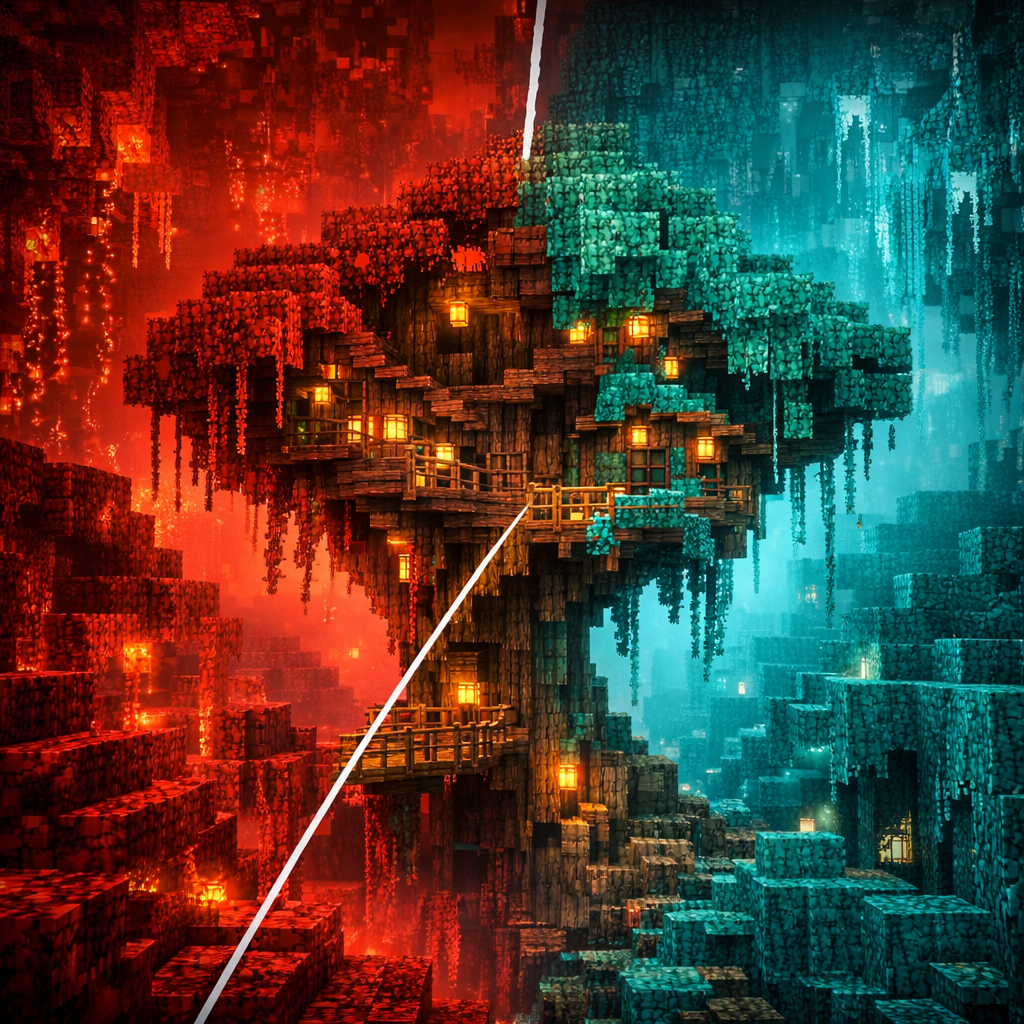
The Nether’s forest biomes offer something extraordinary—a chance to build architecture that feels truly alive. While most builders pave over these strange fungal landscapes, there’s a far more interesting approach: learning to live with the forest rather than against it. Crimson forests pulse with aggressive, meat-red energy, while warped forests glow with serene, alien beauty. Each presents unique building opportunities that go far beyond conventional Nether construction.
This guide explores how to create organic structures that integrate seamlessly with these biomes, turning hostile fungi into protective canopies and transforming dangerous terrain into sophisticated architectural statements.
Choosing Your Nether Forest Home: Crimson vs. Warped
The choice between crimson and warped forests fundamentally shapes your building approach. These aren’t just palette swaps—they’re entirely different ecosystems with distinct architectural possibilities.
Crimson forests feel like predatory ecosystems you must tame. The dense, dark red fog creates an oppressive atmosphere reinforced by blazing particles and unique ambient sounds. The floor mixes crimson nylium with patches of netherrack and nether wart blocks, while huge crimson fungi tower overhead with weeping vines hanging like organic curtains. This biome spawns hoglins and piglins regularly, making ground-level building genuinely dangerous. Think of crimson architecture as fortified tree-forts—defensive structures that embrace the “living canopy” aesthetic while protecting you from the meat forest’s aggressive inhabitants.
Warped forests offer a strange but protective sanctuary. The teal-blue palette of warped nylium, warped roots, and twisting vines creates an eerily calm environment despite the surrounding lava oceans. The cool fog and bioluminescent aesthetic contrast sharply with the Nether’s typical hellscape. Most importantly, warped forests are functionally the safest Nether biome—endermen are your only real threat, and they only aggro when provoked. This makes warped forests perfect for elevated fungal tree houses where you can build in peace, creating serene alien gardens that glow with shroomlights and soul fire.
The architectural distinction is clear: crimson demands armored, defensive designs with hoglin-proof platforms and vein-like support structures, while warped invites ethereal, elevated sanctuaries with enderman-safe sightlines and bioluminescent accents.
Using Crimson and Warped Wood Safely in Survival
Understanding how these unique woods behave is crucial for survival building. While crimson and warped stems are naturally fireproof blocks, crafting them into planks, slabs, and stairs creates flammable wooden blocks again. Lava and stray fire can still ignite your carefully detailed organic structures.
The solution lies in hybrid construction. Most experienced Nether builders mix blast-resistant blocks like blackstone, basalt, or deepslate into structural frames while using crimson and warped wood as cladding and detailing. This approach actually enhances the organic aesthetic—wrap wood cores in non-flammable “bark” of blackstone or polished basalt, letting crimson or warped planks read as cambium and inner tissue. Use stems and stripped stems as exposed “bones” in some places, with stone or basalt ribs maintaining structural safety.
Crimson wood specifics:
- Crimson stems have strong vertical grain; rotating them along different axes creates banded, organic patterns that mimic natural growth rings
- Stripped crimson stems appear smoother and slightly brighter, functioning as “fresh tissue” along edges and curves
- Use upright crimson stems as trunk segments and horizontal ones as “tendons” bridging between structures
- Combine crimson fences and trapdoors to create vein-like railings that maintain the natural aesthetic
Warped wood specifics:
- Warped stems and stripped warped stems provide cool-tone vertical elements that read as alien bark or fungal stalks
- Warped fences, buttons, and slabs add delicate detail and “filament” texture to warped bases
- Use warped stairs and slabs to form spiraling shapes around central trunks, reinforcing the “twisted” warped theme
- Pair warped wood with soul lanterns and soul fire campfires for lighting that complements the color palette
Growing Houses from Huge Fungi
Rather than clearing the forest, treat existing huge fungi as architectural foundations. These naturally generated structures already provide a trunk and cap—your job is expanding them into livable spaces.
Turning huge fungi into main support structures is the foundation of organic Nether architecture. Many base tutorials demonstrate hollowing the stem to create a narrow spiral stair, then expanding the cap into multiple living levels for storage, beds, and portals. This “symbiotic architecture” approach makes grown fungi into pillars for suspended walkways, bridges, and pods, with builders adding smaller constructed fungi to complete the canopy network.
For crimson forest tree-forts:
- Build a single massive “heart tree” by thickening a central huge crimson fungus with extra stems
- Carve the interior into a spiral staircase with rooms integrated into the trunk
- Create multi-ring balconies with weeping vines hanging as natural curtains
- Alternatively, build a forest network with several medium “trees” connected by bone-block spine bridges
- Design platforms that appear grown from wart blocks and reinforced by basalt ribs
For warped forest canopy bases:
- Create a spiral-trunk base where warped stems twist upward with slabs forming small pods branching at different heights
- Design each pod for specific functions—crafting, storage, enchanting
- Build a “glowing grove city” with multiple warped caps of different sizes, each containing a small interior
- Link all structures with twisted bridges lined with soul lanterns and shroomlights
Expanding the cap organically requires understanding that wart blocks form lumpy, clustered canopies. Exaggerate this natural tendency by adding irregular bulges of wart blocks and shroomlights. Use slabs and stairs under the canopy lip to soften silhouettes into organic curves rather than geometric circles. Create “droplet-shaped” cap extensions that start small at the stem, flare outward, then taper back in. Blend natural fungi with constructed elements like blackstone ribs, bone block “spines,” and hanging weeping or warped vines for a seamless grown-not-built appearance.
Organic Building Techniques for Nether Forests
Conventional building techniques fail in forest biomes. Organic architecture requires fundamentally different approaches to shapes, textures, and lighting.
Shapes and silhouettes must embrace asymmetry. Organic builds avoid strict symmetry, instead leaning on curves, staggered heights, and irregular branching. Start with 3–5 irregular “nodes”—pods or platforms at different heights—then connect them with curved bridges of stems and slabs. Use alternating stair orientations to create flowing edges instead of square rings around platforms.
In Nether forests specifically, this translates to:
- Multi-level platforms at different heights within the canopy
- Asymmetric root-like supports reaching down to the nylium floor
- Branch-bridges that twist organically instead of running in straight lines
Block mixing creates natural textures that make structures feel grown rather than placed. The key is using at least 3–4 blocks in any organic surface: a base color, shadow block, highlight block, and “noise” elements like vines, buttons, or fences.
For crimson builds, combine:
- Crimson stems and planks
- Nether wart blocks
- Netherrack and crimson nylium
- Blackstone and basalt
- Weeping vines for organic draping
For warped builds, use:
- Warped stems and planks
- Warped wart blocks and warped nylium
- Warped roots
- Bone blocks for fossilized elements
- Soul lanterns for bioluminescent accents
Fade from forest floor into your build by dotting nylium and roots around supports, creating the impression that structures emerged naturally from the terrain rather than being placed artificially.
Lighting becomes part of the organism itself. Shroomlights are natural light sources you can embed within nether wart or warped wart blocks as “bioluminescent organs.” Hide them behind trapdoors or within cap bulges to make fungi appear internally glowing. Soul lanterns and soul campfires provide cold blue light perfect for warped forests, while regular lanterns and carefully contained lava suit crimson’s warmth. Use irregular lantern placements along vines and roots to avoid artificial-looking grid patterns.
Living with the Locals: Hoglin vs. Enderman Management
Each forest presents unique mob challenges that influence architectural decisions.
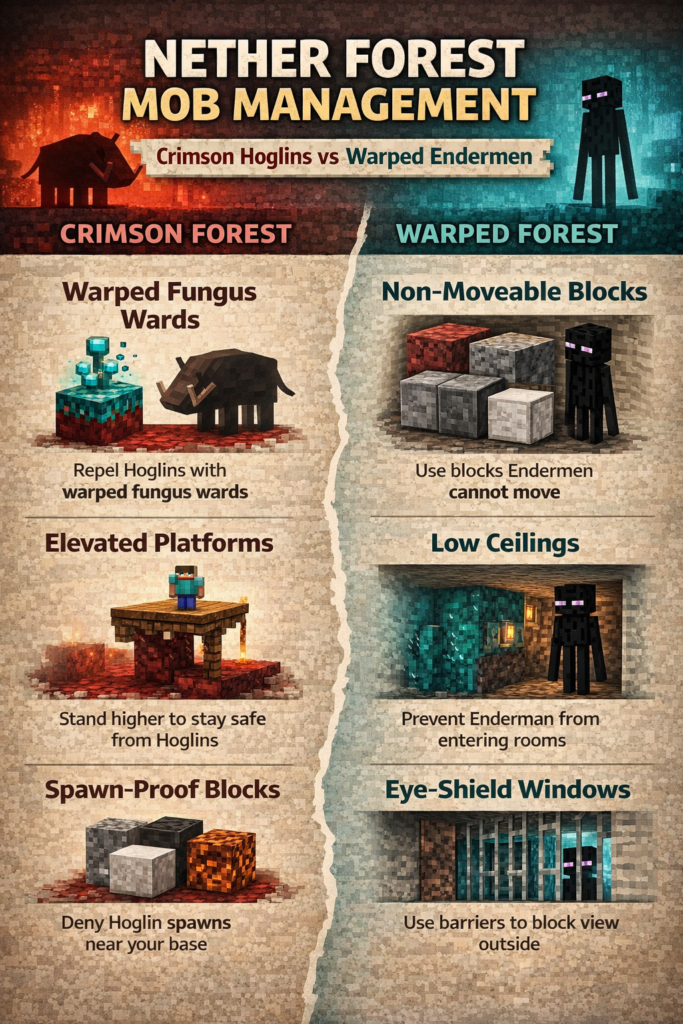
Hoglins in crimson forests spawn commonly and attack aggressively, quickly overwhelming players building at ground level. However, hoglins are frightened by warped fungus, creating a natural “repellant” mechanic you can incorporate into designs.
Practical hoglin management strategies include:
- Surrounding critical build areas with warped fungus “ward rings” or small warped planters
- Raising main living spaces at least 3 blocks above the forest floor with stem pillars, letting hoglins roam below without pathing upward
- Using half-slabs, carpets, and buttons on roofs and narrow branches to reduce spawnable surfaces near your treehouse
- Creating defensive platforms with crimson fence “veins” that feel natural but block hoglin access
This defensive necessity actually enhances the organic aesthetic—your crimson fortress appears to have evolved defenses against its environment, with warped fungus wards reading as symbiotic protection zones.
Endermen in warped forests are relatively benign unless looked at or attacked. However, they can move blocks from organic-style terrain and builds. The architectural solution lies in smart material choices and spatial design. Use non-moveable blocks for key structural and decorative elements—endermen can’t pick up most crafted blocks and stones. Provide covered, low-ceiling walkways and interiors to break line of sight, as endermen’s height restricts them in 2-block-high ceilings. Consider “eye-shield” building with plenty of interior windows for viewing outside safely without staring at endermen.
Tree House Style Builds in Each Forest
The distinct character of each forest demands different tree house approaches, similar to how different biomes influence building styles throughout Minecraft.
Crimson forest tree-forts emphasize elevation for both hoglin defense and vantage over lava lakes that often border these biomes. Compact Nether starter houses built on stilts or fungus bases use crimson wood and blackstone for that fortified organic aesthetic.
Design a single massive “heart tree” by:
- Selecting a central huge crimson fungus and thickening it with extra stems
- Carving an interior spiral stair through the trunk
- Adding rooms directly into the thickened trunk structure
- Building multi-ring balconies with weeping vines as organic curtains
Alternatively, create a forest network with several medium “trees” connected by bone-block spine bridges and platforms that appear grown from wart blocks reinforced by basalt ribs.
Warped forest canopy bases take advantage of the biome’s relative safety. Popular designs feature entire houses living in and around warped fungi, with trunks carrying you from the safe forest floor up to canopy homes overlooking lava oceans.
Build a spiral-trunk base where a warped stem trunk spirals upward with slabs creating small pods branching at different heights for crafting, storage, and enchanting. Or design a “glowing grove city” with multiple warped caps of different sizes, each housing a small interior, all linked with twisted bridges and lined with soul lanterns and shroomlights for that bioluminescent aesthetic.
Creating Living Structure Aesthetics
The ultimate goal is making bases feel symbiotically attached to their biomes—grown, not built.
For crimson structures, embrace the meat-forest aesthetic:
- Use nether wart blocks and vines creeping over walls to show the forest reclaiming structures
- Add “vein” corridors—narrow tunnels of stems and wart that feel like arteries connecting different base sections
- Include lava-fed “organs”—small, enclosed areas with lava behind glass, representing the biome’s heat core
- Create asymmetric root supports that twist down to the nylium floor
For warped structures, treat your base as a fungal colony:
- Design pods, bulbs, and spores—small rounded rooms dotting the canopy
- Cluster warped roots, mushrooms, and shroomlight bulbs around doorways like coral growths
- Integrate bone blocks as fossilized trunks or ribcages emerging from the nylium beneath your build
- Use the cool teal palette to create an otherworldly sanctuary feel
Practical detailing tricks include:
- Alternating stripped and unstripped stems vertically or horizontally to add subtle banding that reads as growth rings or bark texture
- Using buttons, trapdoors, and fences as “nodules” to give surfaces organic bumps instead of flat planes
- Extending roots down slopes using stems and slabs, then sprinkling nylium, roots, and fungi around them so supports feel anchored rather than placed
- Incorporating the organic building principles you’d use in overworld construction but adapted for Nether materials
Building Your First Organic Nether Home
Ready to start? Here’s a practical build flow for creating your first crimson or warped forest base:
- Select one existing huge fungus as your foundation—look for one with good positioning relative to lava lakes and spawnable terrain
- Thicken the trunk with additional stems, alternating stripped and regular versions for natural texture variation
- Extend 3–4 uneven branches from different heights on the trunk, widening them with slabs on top and bottom to create walkways
- Add a main pod off one branch for your primary living space, then 1–2 smaller pods for utility rooms like storage or crafting
- Wrap roots around the base of the trunk into the nylium, scattering fungi around the base to finish the “grown” effect
- Integrate lighting by hiding shroomlights within cap bulges and placing lanterns irregularly along vines
- Add defensive elements appropriate to your biome—warped fungus wards for crimson, low ceilings for warped
This organic approach to Nether building transforms these dangerous dimensions into architectural playgrounds where your structures feel as alive as the forests themselves.
Embracing the Living Forest
Crimson and warped forests aren’t obstacles to overcome—they’re architectural partners waiting for builders who understand their unique character. By integrating huge fungi into your designs, mixing blocks for organic textures, and working with rather than against each biome’s inhabitants, you create structures that feel genuinely alive. The crimson forest becomes a fortified organic sanctuary, pulsing with defensive energy. The warped forest transforms into a bioluminescent haven, glowing with serene alien beauty.
The key is remembering that organic Nether architecture isn’t about imposing conventional building on hostile terrain. It’s about growing your base from the forest itself, creating symbiotic structures that blur the line between natural and constructed. Whether you’re building defensive crimson strongholds or ethereal warped sanctuaries, these forest biomes offer some of Minecraft’s most rewarding architectural challenges for builders willing to think organically.