Pick up two grey 2×4 bricks from different decades of your own collection and hold them under the same light. You will spot it almost immediately: one leans warm, faintly yellow, the other sits cooler and closer to true neutral. That is not ageing plastic playing tricks on you. It is two entirely different LEGO colours, separated by a 2004 manufacturing decision that AFOLs are still sorting through today. If you build seriously, understanding Dark Bluish Grey is not optional trivia. It is the difference between a build that reads as deliberate and one that quietly reads as mismatched.
🎨 The 2004 Colour Overhaul Nobody Asked For
In late 2003, sets started shipping with a noticeably different grey. LEGO had quietly retired Light Grey and Dark Grey, replacing them with cooler, more neutral tones that the community almost immediately nicknamed Bluish Grey.
The company’s own reasoning centred on consistency and modernisation. Internal testing reportedly favoured the newer, cleaner tone, and the older greys carried a warm, slightly dingy cast under a lot of standard lighting. LEGO used the broader 2004 palette revision to standardise several colours at once, not just grey, tightening up a palette that had grown inconsistent through the late 1990s.
The reaction from long-time builders was not gentle. Jake McKee, LEGO’s community liaison at the time, later described it as one of the most contested colour decisions the company has made, and it is well documented that some AFOLs sold off collections or refused to touch the new shade on principle.
The grey swap was not an isolated tweak either. LEGO reformulated several colours in the same window, including the brown family, which shifted from a plain “Brown” to the warmer Reddish Brown most builders know today. Grey simply drew the loudest reaction because it touched more parts, in more sets, than any other colour change in the revision.
By November 2004, LEGO’s community team went further and formally classified the new Bluish Grey shades as part of a Universal Colour list, meaning they were committed to staying in production without being altered or dropped again without significant internal and community discussion. That commitment is part of why Dark Bluish Grey has had two decades to entrench itself as a default, rather than fading out as a passing revision.
For a broader look at how the rest of the 2004 revision reshaped the wider palette, not just grey, our LEGO Color Guide: Complete Palette Analysis for Adult Builders covers every shift in one place. This piece stays focused on grey specifically.
🔍 Old Grey vs Dark Bluish Grey: What Actually Changed
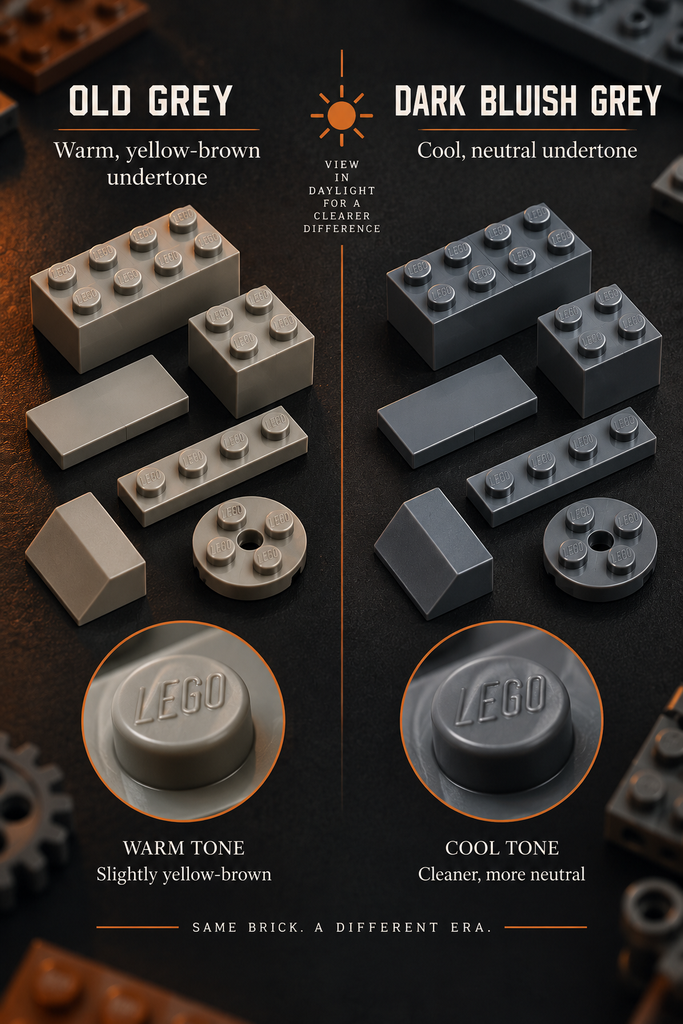
Set the two side by side and the difference is subtle but real. Old Grey carries a warm, faintly yellow-brown undertone. Dark Bluish Grey sits cooler and closer to neutral, with just enough blue in the mix to read as crisp rather than dingy under normal light.
The gap shows up more clearly in the dark greys than the light ones. Two light grey pieces can look nearly identical under warm household bulbs, but hold them under daylight or a phone flash and the split becomes obvious fast.
This matters in practice because the two shades never blend seamlessly in the same model. A greebled panel built half in Old Grey and half in Dark Bluish Grey reads as visually inconsistent even to people who could not name a single LEGO colour, the kind of “something’s off but I can’t say what” reaction that undermines an otherwise strong build.
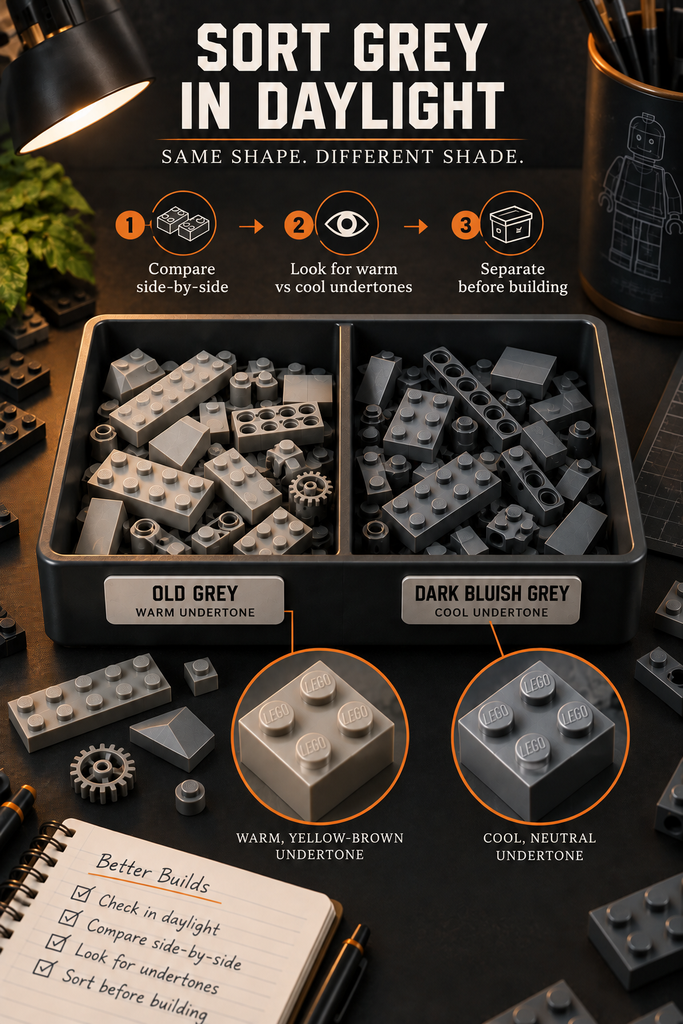
The easiest practical test does not require any special equipment. Lay the suspect pieces flat, side by side, under a north-facing window or plain daylight-balanced LED, and skip warm incandescent bulbs entirely since they flatten the undertone difference and can trick you into thinking a mismatched lot is fine. Large flat surfaces, baseplates especially, show the mismatch fastest because there is no shadow or geometry to hide the shift in tone.
We have written a full piece on the mechanics of getting colours to match properly, including undertones, lighting conditions, and how to test a pairing before committing bricks to a MOC. Read The Complete Guide to LEGO Color Matching and Substitution for that groundwork. If you have already been burned by a mismatch, LEGO Color Disasters: Common Mistakes and How to Fix Them collects the most common ways builders get grey wrong, mixed eras included.
⚙️ Where Dark Bluish Grey Actually Shows Up
Dark Bluish Grey is not a background colour, it is structural. Technic pins, beams, gears, connectors, and axles lean almost entirely on Dark Bluish Grey and its lighter counterpart, because LEGO standardised mechanical elements around the new shade after 2004 and has rarely looked back since.
In System building, Dark Bluish Grey dominates anything meant to read as concrete, weathered stone, gunmetal, or machinery. Think industrial diorama baseplates, starship hulls, vehicle chassis, and the dense greebled detailing that gives a spaceship or mecha its sense of mechanical complexity.
It is also the default for texture and shadow work. Builders layering panel lines, rivets, and mechanical detail onto an otherwise smooth surface reach for Dark Bluish Grey plates and tiles specifically because the cooler tone reads as industrial rather than toy-like under most lighting conditions. That distinction matters a lot if you are building weathered, post-apocalyptic, or hard sci-fi scenes.
Browse almost any Technic MOC or hard sci-fi build and Dark Bluish Grey will be the single most represented colour in the parts list by a wide margin, alongside Light Bluish Grey as its lighter partner.
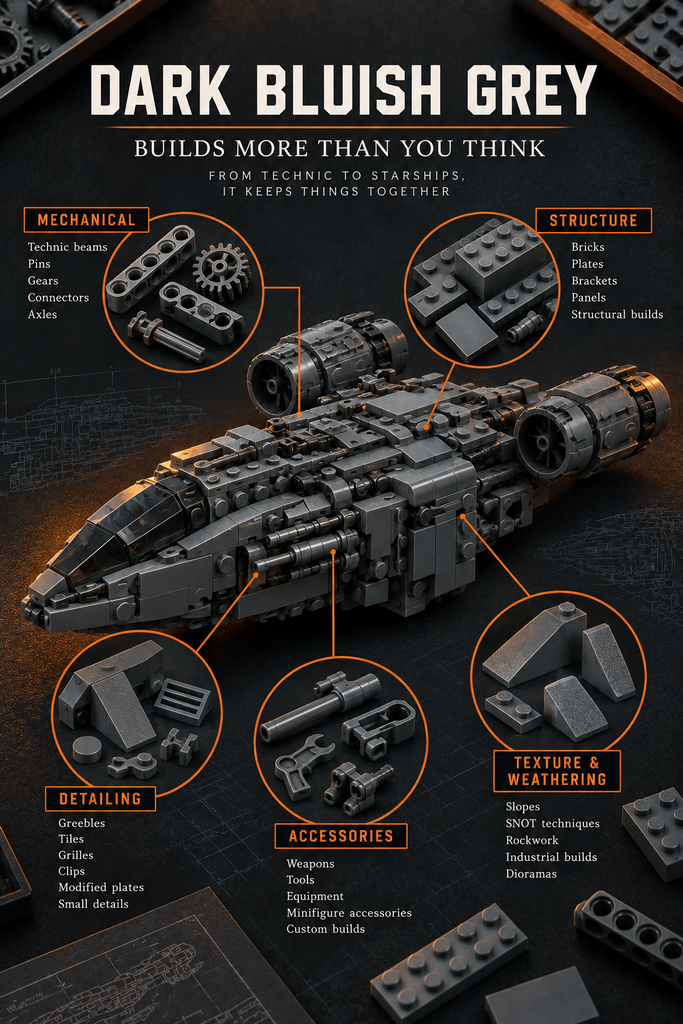
The colour also carries a lot of the weathering work in dioramas and display builds. Builders working on ruined buildings, abandoned vehicles, or battle-damaged mecha often layer Dark Bluish Grey underneath a top colour, so that where paint or panelling would realistically chip or wear away, the exposed “metal” underneath already matches the model’s own palette instead of looking like a random patch.
It shows up in minifigure accessories just as heavily as it does in structural parts. Tools, weapons, armour plates, and small mechanical greebles for minifigure-scale builds are disproportionately moulded in Dark Bluish Grey, partly because it reads as metallic at small scale without needing an actual metallic finish.
🏗️ Why It Became LEGO’s Most-Produced Grey
Versatility explains most of it. Dark Bluish Grey works equally well as a structural Technic colour, a System building material, and a fine detailing accent, which means one shade covers three very different build styles without forcing set designers to stock multiple greys for different purposes.
It also functions as the closest thing LEGO has to a true neutral. Old Grey read as warm and slightly beige-adjacent, while Dark Bluish Grey’s cooler cast sits close enough to genuine grey that it holds up under almost any lighting setup and against nearly any other colour in the palette. That is exactly why set designers keep reaching for it decade after decade.
We will not put a hard number on exactly how many parts have shipped in this colour since 2004. LEGO does not publish granular production figures broken down by colour, and specific counts circulating on forums are typically estimates rather than confirmed data. What is well documented, including analysis from LEGO colour researchers, is that black, Light Bluish Grey, Dark Bluish Grey, and white together make up a disproportionate share of every LEGO element ever produced, and Dark Bluish Grey’s share has only grown since it absorbed the mechanical and structural roles Old Grey used to cover.
There is also a simple design economics argument behind the dominance. Every additional colour LEGO commits to means additional moulding runs, additional inventory, and additional cost, so a colour that can cover Technic function parts, System structural elements, and fine detailing all at once is worth far more to a set designer than three separate niche greys ever were. Locking Dark Bluish Grey in as a Universal Colour only reinforced that logic, since designers could commit to it long-term without worrying it would be discontinued out from under a set in development.
🧱 Sourcing Dark Bluish Grey Without Getting Burned
Pick a Brick is the cleanest source if you are building anything Dark Bluish Grey heavy. Because it sells current-production LEGO, everything you buy there is guaranteed post-2004 stock, so the mixed-era problem never enters the picture.
Bulk lots on BrickLink or secondhand marketplaces are cheaper per part but riskier. Search by colour code rather than trusting a listing’s photo or description alone. BrickLink lists Light Bluish Grey as colour ID 86 and Dark Bluish Grey as colour ID 85, and filtering a parts search by those codes is far more reliable than eyeballing thumbnail images.
Watch specifically for older basic bricks and plates, since those are the parts most likely to have been sitting untouched in someone’s collection since before 2004. Technic and detailing pieces are generally safer bets, because so much of that specific inventory was only introduced after the switch had already happened.
If a bulk lot’s listing photo looks even slightly warm or yellow-toned next to other grey parts in the same shot, treat it as a mixed lot until proven otherwise. Ask the seller directly before buying, particularly for large basic brick and plate quantities, which is exactly where Old Grey tends to hide.
It also helps to know roughly which parts simply cannot be Old Grey in the first place. Any part number first introduced after 2004, which covers the vast majority of modern Technic connectors, structural panels, and detailing pieces, was never produced in the pre-2004 shade at all. When a lot mixes those newer part numbers with classic bricks and plates that have existed since the 1970s or 1980s, the classic pieces are the ones worth double-checking, not the newer ones.
Sorting containers by colour rather than by part type also pays off here. Once Old Grey and Dark Bluish Grey are physically separated, even briefly under good light, the undertone difference becomes obvious enough that you rarely need to second-guess a piece twice.
🧩 The Bottom Line for Builders
Dark Bluish Grey is not simply “the new grey.” It is the colour modern LEGO design leans on more than almost any other, precisely because it does structural, aesthetic, and detailing work all at once. Knowing why it replaced Old Grey, and how to tell the two apart at a glance, keeps your builds visually consistent and your bulk-buying decisions sharper.
Next time you are sorting a lot or filling a Pick a Brick cart, check the undertone before you check the price. Your finished model will look more deliberate for it.