There’s a moment every LEGO city builder eventually reaches. You’re browsing the new Friends range, you spot a colourful building with a florist on the ground floor, apartments above, and a surprisingly detailed interior — and you think: that could work. The architecture is there. The scale is roughly right. The part count is respectable. So you buy it, build it, and place it at the end of your modular row.
And then you stare at it.
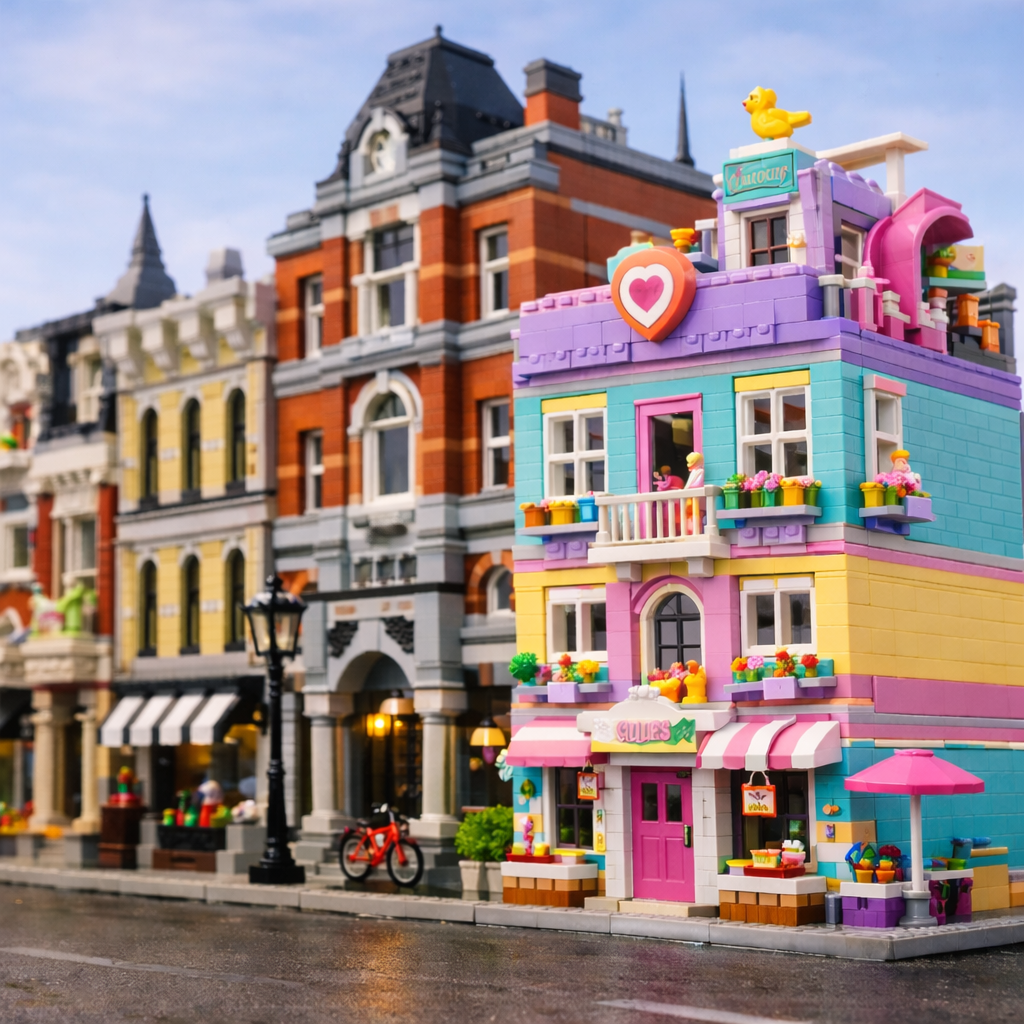
The pastel facade looks cheerful against your tan and grey city streetscape. The open-backed playset design means the whole building faces away from the road. The footprint doesn’t quite match standard modular dimensions. The roof is decorative rather than walkable. There are mini-doll accessories scattered across every floor that make no sense in a minifigure city. You start mentally calculating how many additional parts you’d need to close the back, add a proper base, and fix the height profile — and the number climbs quickly.
This is the experience that sent me down a very specific rabbit hole, and it’s one that a growing community of MOC designers has solved far more elegantly than any amount of personal modification could.
Friends Sets Are Actually Brilliant — Just Not Out of the Box
Let’s be clear about something before going further: LEGO Friends sets are genuinely impressive builds for their price point. The 2023 and 2024 waves in particular pushed the line into territory that should interest any serious adult builder. The Downtown Flower and Design Stores (41732) is a 1,035-piece building with three distinct architectural sections, an apartment floor, and real structural detail. The Castle Bed and Breakfast (42638) has a turret, a multi-floor interior, and some beautiful facade work. The Emma’s Art School (41711) is an 844-piece corner building with a three-storey profile that looks genuinely impressive from the front.
These are not sets that skimp on interesting parts. They use printed tiles, curved slopes, arches, and decorative elements that would cost a small fortune if sourced individually on BrickLink. The colour palettes, while undeniably vivid, often include neutrals that city builders can work with. The problem is never the parts — it’s the design philosophy. Friends sets are playsets, engineered for open-back access, interactive features, and storytelling play. Everything about their construction optimises for a child opening up the building to move characters around inside, not for a builder walking past a city block admiring the streetscape.
This means closed backs are rare, base dimensions don’t follow standard modular building conventions, staircase placement makes no structural sense for minifigures, and the overall silhouette often features odd protrusions or asymmetries that work beautifully as play features but look strange as permanent display pieces. You can fix all of this. It just takes a lot of extra work and parts — and there are people who’ve already done it better than most of us ever could.
The MOC Community Has Been Quietly Solving This Problem
The Rebrickable community has developed an entire cottage industry of Friends set modifications and alternate builds, specifically targeted at city builders who want the parts without the playset compromises. The quality of these designs has reached a remarkable level, with a handful of designers standing out for their consistency and craft.
KTBrickworks, Brick Artisan, and Legofan21 are three names worth bookmarking immediately if you haven’t already. Between them, they’ve produced modular-compatible builds based on a large swathe of the Friends lineup, and their approach reveals something important: the modifications aren’t just cosmetic. These designers are fundamentally rearchitecting the buildings to meet AFOL city standards — closed backs, proper 32-stud footprints, logical interior access, and height profiles that sit comfortably in a modular row.
KTBrickworks: Combination Builds That Add Real Value
One of the most common problems with Friends-to-city conversions is that individual sets, once enclosed and properly based, end up too narrow or too shallow to fill a modular slot convincingly. KTBrickworks addresses this by designing combination builds — MOCs that use two related sets together to create a single building with better proportions and a more varied roofline.
The Castle Bed & Breakfast and Bakery Combination Modular (MOC-198073) pairs the Castle Bed and Breakfast (42638) with the Heartland City Cafe into a 2,320-part building with a deliberately varied height profile. Both structures are fully enclosed, the B&B section is fully modular-compatible, and — importantly — all stickers are used in the same positions as the original sets, meaning you don’t need to make a decision about placement before committing to the MOC. For builders who’d already stuck their stickers on, that’s a genuine act of kindness.
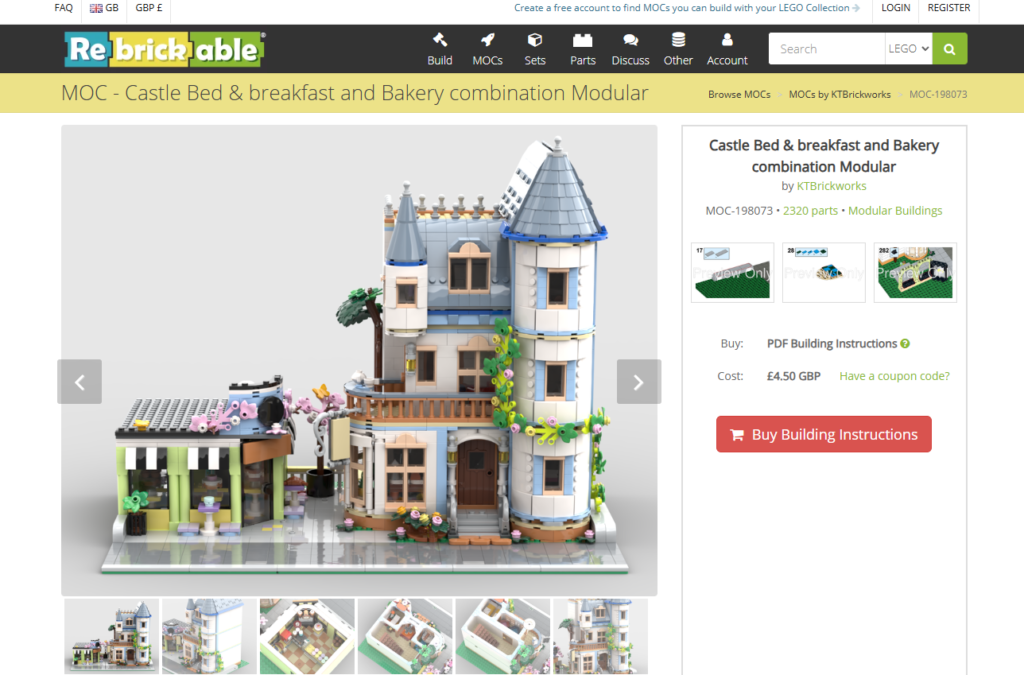
The Friends Community Centre and Kitchen Combined Modular (MOC-164742) takes the same approach with two other sets, producing a 3,007-part building that makes use of the parts from both originals for substantially less than the individual MOC prices. KTBrickworks is also active on Instagram (@ktbrickworks) if you want to see builds in context.
Brick Artisan: Precision Modifications With Minimal Extra Parts
Brick Artisan’s philosophy tends toward tight, efficient modifications — builds that use the set parts intelligently rather than supplementing heavily with additional pieces. The Classic Townhouse (MOC-144837) is perhaps the purest expression of this: a modification of two copies of the Creator 3-in-1 Cosy House (31139) that uses only the 1,530 pieces from the two sets, requiring no additional parts at all. It’s a masterclass in working with what you have.
The Emma’s Art School Corner (MOC-114180) takes two copies of set 41711 and rearranges them into a corner building format — the kind of 90-degree building that every city builder needs and that LEGO’s modular range almost never provides. Again, it retains most of the original interior from both sets, so you’re not losing the detail that made the Friends set appealing in the first place.
The newer Corner Apartments & Store (MOC-212552), based on set 42670, follows the same principle: a corner-format modular conversion that takes a Friends set’s characteristic architectural flair and gives it the structural discipline a permanent display demands. Comments on the Rebrickable listing suggest builders have been buying the set specifically for this MOC rather than ever building the original — which tells you everything about the value proposition.
Legofan21: City-Scale Thinking From the Ground Up
Legofan21 brings a city planning perspective to Friends modifications that makes them particularly useful for builders who care about streetscape coherence. The Downtown Flower and Design Store (MOC-134953) takes the 41732 set and creates a 2,536-piece modular building with removable roof sections and a facade that opens properly — with the crucial addition of closed back walls and logical floor separation that the original entirely lacks.
The design also comes with two separate parts lists: one for the modification of 41732 alone (798 extra pieces), and a combined list for builders who want to build both the flower store and design store as a pair, accounting for shared pieces across the three sets. That kind of thoughtful documentation makes the difference between a MOC instruction that feels like homework and one that feels like a genuine guide.
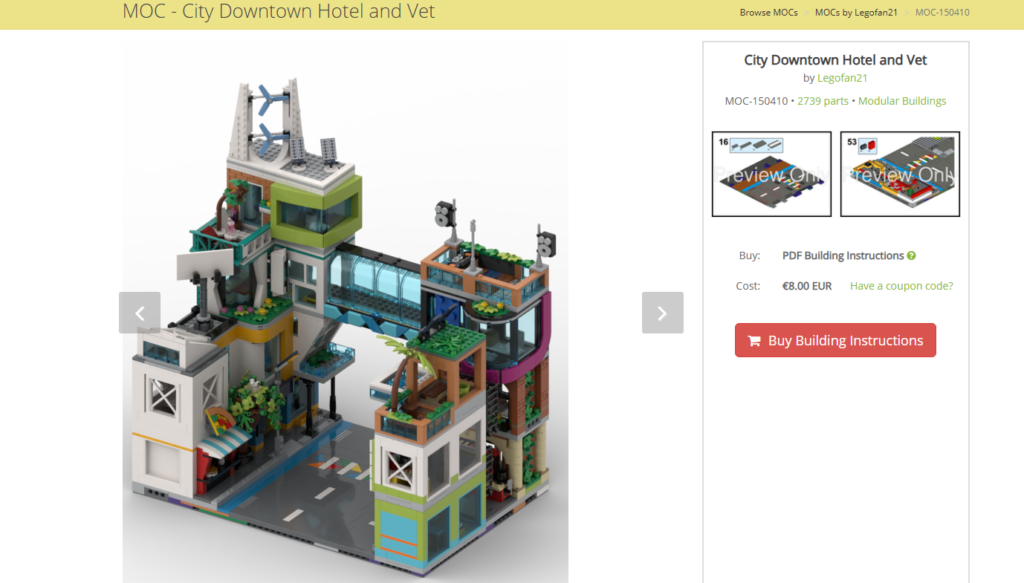
The City Downtown Hotel and Vet (MOC-150410) goes further, pairing City sets 60365 and 60380 into a 2,739-piece building with proper closed walls, logical stair and elevator access for minifigures, and MILS road system compatibility. Floors are removable just as in the originals, but the overall structure behaves like a purpose-built modular rather than a retrofit.
The Honest Conversation About Cost and Commitment
None of this comes free. Premium MOC instructions on Rebrickable typically run between £4.50 and €8.00, and you’ll almost always need additional parts beyond the base sets. The combination builds in particular can require 300–400 extra pieces, which adds up — especially if you’re sourcing through BrickLink and factoring in postage across multiple sellers.
But here’s the calculation worth making honestly: if you buy a Friends set intending to modify it for city use, you will spend money on extra parts anyway. You’ll also spend significant time designing the modifications yourself, with no guarantee the result will be structurally sound or visually coherent. A £4.50 set of Stud.io-designed instructions from a designer who has already solved every problem you’re going to encounter is, by any reasonable measure, excellent value.
There’s also a timing argument. If you know from the moment of purchase that you’re going to build a specific MOC, you can use the Rebrickable Build This MOC tool to generate a precise parts list of only what you’re missing — which means ordering once rather than going back to BrickLink three times as you discover gaps mid-build. Planning the MOC route from the start is genuinely more efficient than retrofitting your city plans after the fact, and it keeps your building list honest about what you’re actually going to build.
What This Means for Your Wish List
The practical upshot of all this is a shift in how you approach new Friends releases. Rather than buying a set and then wondering whether it might work in your city, it’s worth checking Rebrickable for MOC modifications before purchasing. The modular community is responsive — new Friends sets often have MOC alternatives within a few months of release, sometimes sooner. The Castle Bed and Breakfast MOCs appeared within the same year as the original set.
This also means paying attention to which sets generate MOC activity and which don’t. Sets with interesting architectural bones — multi-storey structures, corner buildings, commercial ground floors with residential above — attract designer attention. Sets that are primarily landscape-focused or vehicle-based tend not to translate as well. Learning to spot the difference before buying saves both money and shelf space.
The Friends range isn’t going anywhere, and its design quality continues to improve in ways that make the underlying parts increasingly useful to adult city builders. The MOC community has built a genuine infrastructure around translating that potential into display-worthy results. The most efficient path through all of this is to use both: buy the set for its parts and its price, build the MOC for its city credentials, and skip the frustrating middle stage where you’re trying to make a playset behave like something it was never designed to be.
Continue Your Journey
- LEGO SNOT Building Techniques: A Complete Guide — Essential techniques used throughout Friends MOC modifications and modular city builds.
- Standard Brick Building Techniques Guide — Understand the foundational methods that make these MOC designs structurally sound.
- LEGO Glossary — New to terms like MILS, MOC, and AFOL? This is your reference guide.
Have you taken the MOC route with a Friends set, or are you still trying to make the original work? Drop your experience in the comments — particularly if you’ve built any of the designs mentioned here. And if you haven’t signed up to our newsletter yet, it’s the best way to catch new city building content as soon as it goes live.