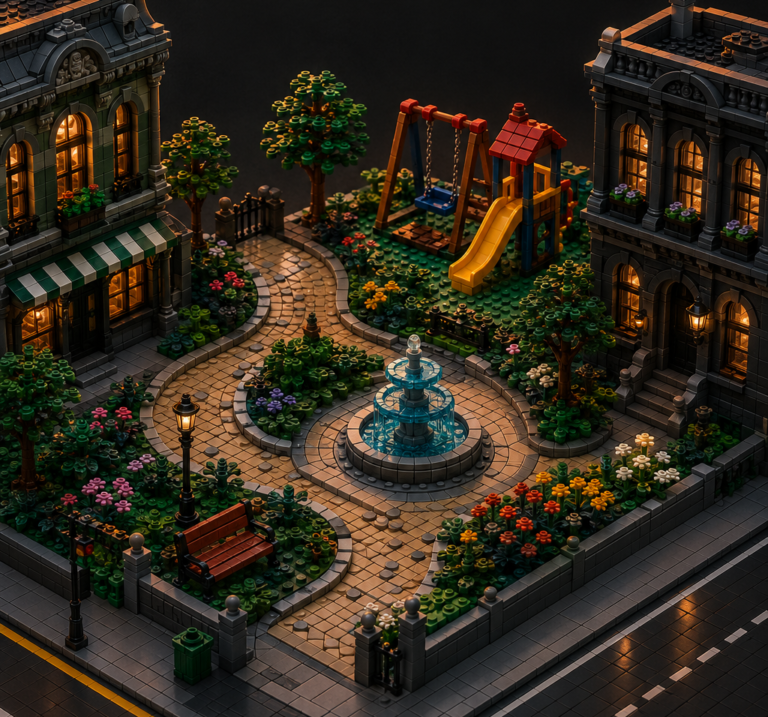
Building a LEGO city isn’t just about buying sets and stacking bricks—it’s about creating a strategic inventory that gives you the creative freedom to bring any urban vision to life. Whether you’re planning your first modular street or expanding an existing metropolis, having the right pieces in the right quantities makes all the difference between constantly hunting for parts and confidently building whatever your imagination conjures.
After years of building and a few reorganizations, I’ve learned that a well-planned inventory isn’t about having every piece ever made. It’s about identifying the workhorses—those versatile bricks, plates, and specialty pieces that appear in building after building—and acquiring them in sufficient quantity to avoid creative roadblocks. This guide will walk you through exactly what pieces to prioritize, how to build your collection strategically without breaking the bank, and how to organize everything so you can actually find what you need when inspiration strikes.
Understanding the Core Color Palette for Realistic Cities
Before you start filling drawers with random bricks, you need to understand which colors will give you the most mileage in realistic city building. While LEGO produces over 100 colors, a successful city inventory focuses on a strategic subset that mimics real urban architecture.
🧱 Essential LEGO City Building Colors
Your strategic palette guide for realistic urban construction
Neutral Architecture Colors
Accent Colors
Infrastructure Colors
Nature Colors
💡 Building Your Strategic Palette
Start with the neutral architecture colors as your foundation—these five colors alone enable serious building. Once you have adequate quantities (500+ pieces each), expand to accent and infrastructure colors. Nature colors can be added last, as they’re used more sparingly for landscaping and detail work. This phased approach keeps your initial investment focused while building a collection that grows naturally with your city.
Your foundation should be built on neutral architecture colors: light bluish gray, dark bluish gray, tan, white, and dark tan. These five colors form the backbone of nearly every realistic building, from contemporary office blocks to historic brownstones. They’re the colors of concrete, limestone, brick, and weathered stone—the materials that define real cities.
Accent colors add character and period authenticity to your builds. Dark red and dark orange bring Victorian brick warmth, while nougat and flesh tones work beautifully for Mediterranean and terracotta-style buildings. Sand green creates that oxidized copper look essential for older civic buildings and monuments. These aren’t throwaway colors—they’re what transform a generic gray box into a building with personality and history.
For infrastructure, you’ll need dark bluish gray and black for roads, roofs, and industrial machinery. These colors handle the heavy lifting of urban frameworks—the asphalt, the iron, the utilitarian elements that cities are built on. Meanwhile, green and dark green bring life to your city through parks and landscaping, while reddish brown and dark brown provide the organic warmth of trees, wooden details, and natural elements.
Must-Have Bricks: Your Essential Parts List
With your color strategy in mind, let’s talk specific pieces. Your city inventory should prioritize versatility and stackability—pieces that appear repeatedly across different building types and architectural styles.
Standard bricks form your primary volume. Focus on 1×2, 1×3, 1×4, 1×6, 1×8, 2×2, 2×3, and 2×4 bricks in your core colors. These aren’t glamorous, but they’re the difference between a city block and a few scattered buildings. You’ll burn through hundreds of 1×2 and 2×4 bricks creating wall sections, window surrounds, and structural support. Don’t skimp here—this is where your volume comes from.
Plates create floors, foundations, and horizontal layers. Prioritize 1-wide plates (1×2 through 1×8) and 2-wide plates (2×2 through 2×8) across your neutral palette. Add some larger 6× and 8× plates for substantial floor sections. Plates are your construction workhorse—they build faster than bricks for large surface areas and create the clean, finished floors that make interiors look professional.
Tiles transform rough LEGO surfaces into polished, realistic details. Stock 1×2, 1×4, 2×2, and 2×4 tiles primarily in light bluish gray, dark bluish gray, and tan. These pieces create pavements, interior floors, rooftops, and any surface where you don’t want visible studs breaking the visual flow. They’re essential for that finished, architectural quality that separates amateur builds from professional-looking cityscapes.
Slopes bring dimensionality and sophistication to your buildings. You’ll want both 33° and 45° slopes, inverted slopes, and curved slopes for roofs and vehicles. Roofs account for significant visual real estate in any cityscape—having adequate slope inventory in various colors lets you create convincing Victorian mansions, contemporary flat-roofed buildings, and everything in between.
Windows and doors are the details that make buildings feel inhabited and purposeful. Stock both modern styles (white and gray frames) and older styles (dark tan and reddish brown frames) with appropriate glass elements. These pieces define architectural eras more than almost anything else. A building with dark tan window frames immediately reads as historic, while white frames signal contemporary construction.
Building Your Bulk Collection Strategically
Here’s where many city builders go wrong: they either buy completely random bulk lots that leave them with mismatched colors and useless specialty pieces, or they try to buy everything individually at retail prices and go bankrupt before they’ve built a single street.
The smart approach is targeted bulk acquisition—buying large quantities of the pieces you actually need, in the colors that matter, from sources that give you the best cost-per-piece ratio for city building.
Pick-a-Brick (online and in-store) works brilliantly for small detail parts and basic bricks. In-store Pick-a-Brick cups can deliver costs around 5-7 US cents (4-6 pence) per piece if you pack strategically—prioritize small, stackable elements over large plates that waste valuable cup volume. Online Pick-a-Brick offers convenience and occasionally stock that isn’t available in stores, though costs tend slightly higher. This source excels for topping up specific colors or acquiring those perfect detail pieces for a current project.
Used bulk lots from local auctions, car boot sales, estate sales, and sites like ShopGoodwill or charity shops can land between $5-10 per pound (£4-8 per kilogram). With roughly 250-350 pieces per pound depending on mix, you’re looking at 2-4 US cents (1.5-3 pence) per piece. The trade-off is quality control—you’ll get mixed colors, some pieces you don’t need, and potentially damaged elements. But for sheer volume of basic bricks, this approach can’t be beaten. Plan to spend time sorting, but appreciate the cost savings.
Strategic set purchasing means buying discounted City, Creator, or Classic sets primarily for their parts inventory rather than the build itself. Keep the minifigures (they hold value well for resale), enjoy the build if you want, then break everything down into your organized inventory. Watch for end-of-season sales—major retailers often discount last year’s City sets by 30-50%, making this an excellent parts source with known quality and useful color distributions.
Most successful city builders follow a phased approach. Phase one focuses on volume—bulk up basic bricks and plates in neutral colors until you can confidently build several modular-sized building façades and a few city blocks. Don’t worry about details yet; you’re establishing your foundation inventory. Phase two adds specialty pieces—windows, doors, fences, foliage, and modified bricks for architectural details. Once you have the mass to build with, these details transform basic structures into buildings with character and sophistication.
Parts Storage and Organization: Finding What You Need
I’ve tried nearly every organization system over the years, and here’s what I’ve learned: the “perfect” system doesn’t exist, but the system that works for your brain and your building style absolutely does.
Most organization guides recommend sorting by part type—all your 1×2 bricks together, all your 2×4 plates together, regardless of color. This approach scales beautifully for massive collections and is how many professional builders organize. The logic is sound: you know you need a 1×4 tile, so you go to the 1×4 tile drawer and select your color.
But here’s my personal approach, which I’ve found works better for how I build: I sort by color first, then by part type within each color category. All my light bluish gray pieces live together, but within that color section, I separate bricks from plates from tiles from slopes. When I’m planning a new building project, I organize my parts list by color name on BrickLink, then I can efficiently gather all the relevant parts I need from each color section. For me, this reduces handling—I visit each color section once and grab everything I need rather than moving between dozens of part-type drawers.
This is absolutely a personal preference choice. Many builders swear by part-type organization, and if you have an enormous collection or build primarily in MOCing software before gathering parts, that approach may serve you better. The key is choosing a system that matches your workflow—whether you think “I need this part” or “I need these colors.”
Regardless of which primary sorting method you choose, here are universal truths about effective LEGO storage:
Start with broad categories when your collection is small. Three to five boxes labeled “bricks,” “plates,” “tiles & slopes,” “modified/technic,” and “minifigures & accessories” will serve you better than trying to implement a complex system prematurely. As your collection grows, split these into finer categories naturally.
Physical storage solutions matter as much as organizational philosophy. Small plastic drawer cabinets (Akro-Mils style or similar) are overwhelmingly recommended by experienced city builders because they’re stackable, have built-in dividers, and keep categories accessible without spreading parts across your building space. Larger drawer towers work well for bulky parts, baseplates, and road plates. Keep each drawer only about half full—leaving room for growth prevents the frustrating “I have nowhere to put these new parts” problem that kills organizational momentum.
Use shallow trays or funnel containers for active sorting. When you’re breaking down a set or reorganizing, having temporary containers lets you quickly sort without committing to final drawer placement. You can scan parts easily and pour them back without creating a mess across your workspace.
The most important rule: consistency matters more than complexity. A simple system you actually maintain beats an elaborate system you abandon after three months. Choose what makes sense for your brain, document your decisions, and stick with it long enough to see if it works for your building style.
Cost Breakdown: Building Your Inventory on a Realistic Budget
Let’s talk money. Building a serious city inventory requires investment, but understanding cost-per-piece bands helps you maximize value and minimize waste.
Typical cost-per-piece ranges (approximate, subject to sales and exchange rates):
- Used mixed bulk (auctions, yard sales): $0.02-0.06 / £0.02-0.05 per piece. Excellent for volume, expect quality variation and sorting time.
- New LEGO bulk sets (Classic boxes, Creator value packs): ~$0.06-0.09 / £0.06-0.10 per piece. Includes some less-useful parts for cities, but guaranteed quality.
- Pick-a-Brick (online/in-store): ~$0.05-0.12 / £0.05-0.12 per piece. Best value on small, stackable parts; poor value for large plates.
- BrickLink/BrickOwl common parts: ~$0.03-0.10 / £0.03-0.10 per piece plus shipping. Excellent for specific pieces in exact colors, shipping costs can add up.
Starter City Inventory Budget Example (targeting 5,000-6,000 useful parts):
Structural bricks and plates (60% of parts, approximately 3,200 pieces):
- Source: Used bulk and/or Classic-style sets
- Cost: ~$130 / £110-145 at roughly $0.04 / £0.035-0.045 per piece
Tiles, windows, doors, slopes, foliage (30% of parts, approximately 1,900 pieces):
- Source: Pick-a-Brick and BrickLink/BrickOwl for specific colors
- Cost: ~$150 / £130-170 at roughly $0.08 / £0.07-0.09 per piece
Vehicles, minifigures, specialty items (10% of parts, but significant visual impact):
- Source: Small City sets or targeted minifigure lots
- Cost: $50-100 / £40-90 depending on sales and second-hand opportunities
Total starter inventory investment: Approximately $330-380 / £280-360
This investment gives you the foundation to build multiple modular-sized buildings, several city blocks worth of streets, and enough detail pieces to make everything look finished and professional. It’s not cheap, but it’s strategic—every dollar goes toward pieces you’ll reuse repeatedly across dozens of projects.
Smart Shopping: Where to Find the Best Deals
Knowing what you need is only half the battle—knowing where to get it at the best price separates efficient city builders from those who spend twice as much for half the inventory.
LEGO.com official sales happen predictably around major holidays and during Double VIP Points events. Creator sets and City sets often get 20-30% discounts, making them viable parts sources rather than overpriced building experiences. Sign up for LEGO VIP (it’s free) and watch for bonus point periods—essentially giving you store credit toward future purchases.
Major retailers’ clearance sections are goldmines in January and July. Stores like Target, Walmart, and Smyths clear out last season’s inventory to make room for new releases, often marking sets 40-50% off. While everyone fights over the popular licensed themes, City and Creator sets—perfect for parts acquisition—sit ignored at massive discounts.
BrickLink requires more effort but delivers exactly what you need. Search for sellers with large quantities of common parts in your needed colors, then build orders that hit their free shipping minimums. Buying 1,000 light bluish gray 1×2 bricks from a single seller beats trying to accumulate them one Pick-a-Brick cup at a time. Many sellers offer discounts on bulk orders—don’t be afraid to message and ask.
Local LEGO user groups (LUGs) often have members selling off excess inventory or organizing group bulk buys. These communities understand city building needs and can point you toward local sources you’d never find otherwise. Plus, seeing other city layouts in person provides invaluable inspiration for your own projects.
What to Avoid: Common Inventory Mistakes
After watching countless builders (including myself in early days) waste money and drawer space, here are the traps to avoid:
Don’t buy random bulk lots just because the per-piece price looks attractive. A pound of LEGO for $5 sounds amazing until you discover it’s 80% Bionicle parts, pink princess bricks, and broken pieces. Targeted purchasing beats cheap randomness every time.
Don’t over-invest in large plates and baseplates early. Yes, you need some, but they’re expensive per piece and you won’t burn through them the way you will with basic bricks. A couple of 32×32 baseplates and some 16× plates will serve you fine initially—you can always add more later.
Don’t neglect minifigures and vehicles. Cities feel dead without inhabitants and traffic. These elements bring scale and life to your builds. Plan to dedicate about 10% of your budget to these “extras”—they’re not extras at all when it comes to presentation quality.
Don’t try to match official set color schemes exactly unless you’re specifically modifying or expanding that set. Official sets use whatever colors create visual appeal, not necessarily what you can easily source in bulk. Your cities will look better with consistency across your chosen palette than trying to match every detail of individual sets.
Growing Your Collection Long-Term
Your initial investment gets you building, but city building becomes addictive—you’ll want to expand continuously. Smart long-term collecting means:
Maintaining your core colors consistently. When you see sales on City or Creator sets featuring your primary palette colors, grab them even if you’re not building immediately. Having depth in your essential colors means never stopping mid-project to hunt for more dark bluish gray bricks.
Adding architectural variety gradually. Once your foundation is solid, branch into specialty pieces that enable specific styles: art deco details, industrial elements, modern glass panels, or historic ornamental pieces. These focused additions let you tackle new building types without bloating your inventory with random pieces.
Building a wishlist system. When you’re planning a project and realize you need specific pieces, don’t immediately buy them. Add them to a running wishlist, then make strategic bulk purchases that hit multiple project needs at once. This approach reduces shipping costs and helps you identify patterns in what pieces you actually use versus what you think you need.
Documenting your inventory once it reaches serious size. Whether you use spreadsheets, BrickStock, or Rebrickable, knowing what you have prevents duplicate purchases and helps with project planning. You don’t need to track every single brick when starting, but once you’ve invested hundreds of dollars and have thousands of pieces, basic inventory management pays dividends.
Putting It All Together: Your Action Plan
Building an effective city inventory doesn’t happen overnight, but it doesn’t need to be overwhelming either. Here’s your strategic roadmap:
Month one: Define your color palette and acquire 2,000-3,000 pieces in basic bricks and plates through a combination of used bulk and strategic set purchases. Focus on light bluish gray, dark bluish gray, and tan—these three colors alone enable serious building.
Month two-three: Add tiles, windows, and slopes to your core colors. Start experimenting with small building projects—a simple shopfront, a residential façade, a park corner. These builds reveal which pieces you burn through quickly versus which you need only occasionally.
Month four-six: Expand to your full color palette including accent colors. Your building confidence will grow, and you’ll start envisioning larger projects that demand more variety. Add vehicles, minifigures, and infrastructure elements.
Beyond six months, you’re in maintenance and specialty-expansion mode. You’ll develop instincts for what you need, how much to keep on hand, and where to find the best deals. Your inventory becomes a tool rather than a puzzle—something that enables creativity rather than restricting it.
The Payoff: Creative Freedom
The real benefit of a well-planned inventory isn’t the organized drawers or the money saved on smart purchasing—it’s the creative freedom it provides. When you sit down to design a Victorian brownstone or a contemporary office tower, you’re not asking “do I have enough pieces?” You’re asking “what architectural details will make this building special?”
That’s the difference between an adequate collection and a strategic inventory. One forces you to build around limitations; the other lets you build your vision. The investment of time and money into smart parts acquisition pays off every single time you sit down to create, because instead of hunting for pieces or compromising your design, you’re building exactly what you imagined.
Whether you’re starting with your first bulk lot or optimizing an existing collection, remember that every successful LEGO city starts with the same foundation: the right pieces, in useful quantities, organized in a way that serves your building process. Master this foundation, and the only limit to your city is your imagination.
Looking for more city building guidance? Check out our beginner’s guide to LEGO city buildings for practical building techniques, explore advanced LEGO building techniques to elevate your constructions, and discover LEGO storage solutions to keep your growing collection organized. For budget-conscious builders, our guide on building a LEGO city on a budget offers additional money-saving strategies, while our LEGO City master planning guide helps you design cohesive layouts that accommodate growth.