The Chaos Cubed update handed adult builders a genuinely new kind of toy, and most of the internet is still treating it like a curiosity instead of a design tool. The sulfur cube eats blocks. That is the pitch in one sentence.
But once you sit with the mechanic for more than an afternoon, the real question stops being “what does it do” and starts being “how far can I push it into an actual game.”
This post treats the sulfur cube as a systems piece rather than a gimmick mob. Five mini-game concepts, each with concrete build notes, aimed at players who already know their way around redstone, command blocks, or a modded/datapack workflow and want fresh mechanics to drop into a world or server.
None of this is beginner material, and none of it needs a specific mod to work. It is written straight from the vanilla Chaos Cubed mechanics so it holds up whether you are playing survival, a creative-mode server, or a heavily modded pack that layers extra behavior on top.
🧪 What the Sulfur Cube Actually Does
The sulfur cube is a passive, slime-like mob added in the Chaos Cubed game drop (Java Edition 26.2, Bedrock Edition 26.30, released June 16, 2026). It only spawns inside sulfur caves, which sit beneath the small surface pools called sulfur springs.
In its default state it hops around like an ordinary slime and does nothing interesting. The moment you hand it a block, everything changes.
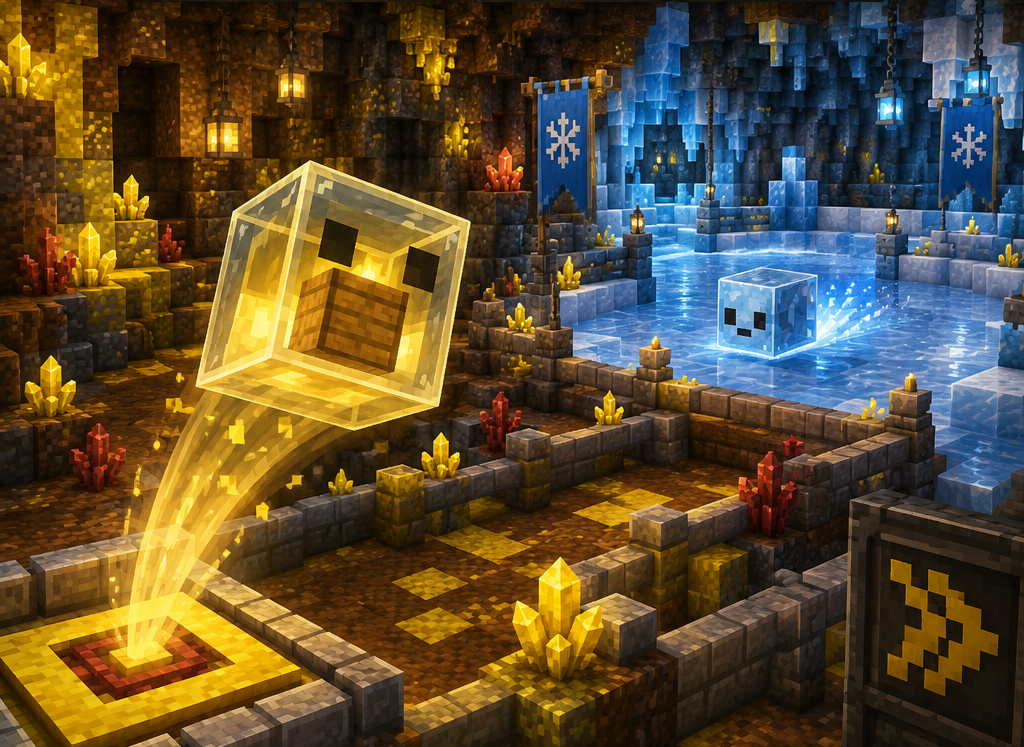
Feed a large sulfur cube a block by right-clicking it with the block in hand, dropping the block near it, or aiming a dispenser at it. The cube freezes in place, displays the block inside its transparent body, and becomes a physics object instead of a wandering mob.
Hit it after that and it does not take damage. Instead it launches in the direction you struck, with harder hits meaning longer travel.
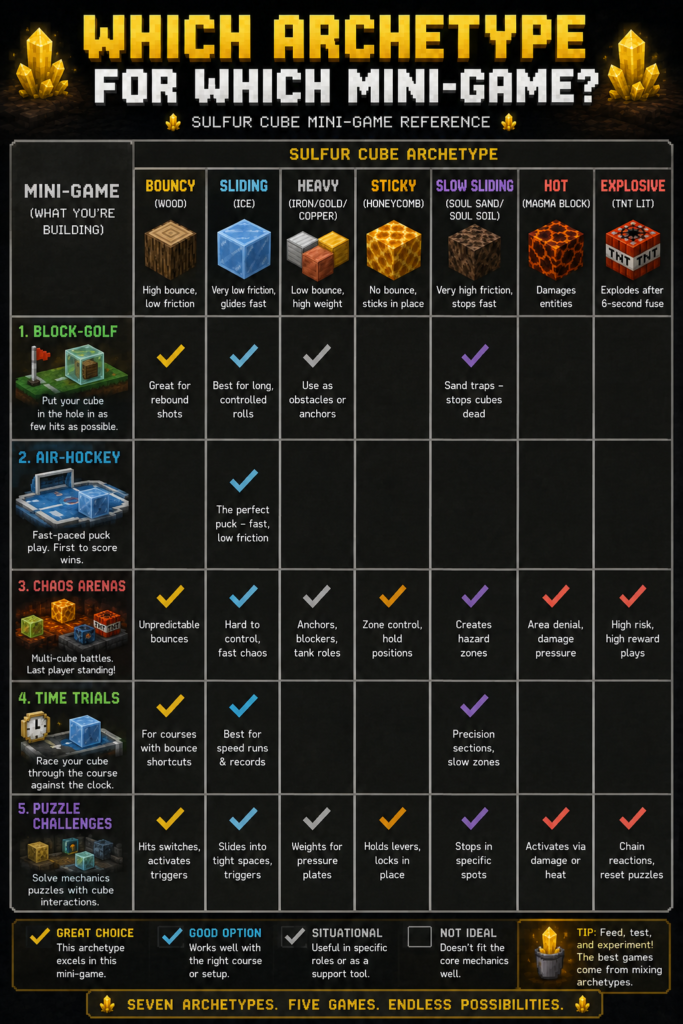
Twelve archetypes exist, each one setting bounciness, ground friction, air drag, and knockback resistance based on what the cube swallowed. The ones you will use most across these five builds:
- Bouncy (any wood block): fast and springy, rebounds hard off walls
- Sliding (ice or packed ice): near-zero friction, glides like a puck
- Heavy (iron, gold, copper): hard to move, good as an anchor
- Sticky (honeycomb): sticks in place with no bounce at all
- Slow Sliding (soul sand, soul soil): an immovable, friction-heavy anchor
- Hot (magma): a standing damage source
- Explosive (TNT, once lit): a six-second fuse and a real explosion

Shears remove the absorbed block and reset the cube to its default hopping state. You do not need to shear it first to change archetypes though, feeding it a new block ejects the old one automatically.
Bucket it for transport back to your base, the same way you would a fish. That whole toolkit, feed, launch, reset, re-feed, is what makes the cube a genuine game design component rather than a novelty.
If you want the deeper mechanical reference before building any of the five concepts below, our redstone engineering guide covers the scoreboard and detector circuits you will lean on for scoring and triggers in most of these builds.
⛳ Mini-Game 1: Sulfur Cube Block-Golf
The concept is simple to explain and genuinely hard to master. Players “putt” a sulfur cube by hitting it, trying to route it into a target zone in as few strikes as possible, exactly like golf but with a mob that behaves like whatever you fed it.
Build notes:
- Lay out short holes, three to seven strikes each, using low walls to define fairways and hazards
- Feed your cube the Bouncy archetype for a course built around rebound shots off angled walls
- Or feed it the Sliding archetype for a course that rewards precise, low-friction lines across open ground
- Build sand traps from Slow Sliding trigger material (soul sand or soul soil), since a cube that lands there stops dead and needs extra weak hits to work free
- Sink a pressure plate or hopper-fed detection line at the bottom of each hole to trigger a scoreboard tick plus a sound cue or particle burst on arrival
- Use slime or honey block launchers as tee-off points for a consistent starting hit
For a single player, this plays as a relaxing skill course. For a small server group, run it as a stroke-count leaderboard with a shared scoreboard visible near the clubhouse.
🏒 Mini-Game 2: Air-Hockey Sulfur Arenas
Two players, one flat arena, one sulfur cube set to the Sliding archetype. The near-zero friction and low air drag that ice and packed ice give the cube make it behave almost exactly like a hockey puck once it is moving, which is the whole appeal here.
Build notes:
- Build the arena as a smooth polished-ice or blue-ice rectangle, bordered by low walls angled slightly inward so rebounds stay lively
- Cut a goal slot at each end, wide enough for the cube to pass through but narrow enough to require a real shot
- Back each goal with a hopper or pressure-plate detector wired to a scoreboard
- Let players bat the cube with a sword or an empty hand, whichever your server’s PVP rules allow
- Trigger a quick particle effect or bell sound on goal, rather than anything that interrupts play
- Consider re-feeding the cube automatically via a hopper-dispenser loop so matches do not stall out resetting it by hand
The low friction means a single good hit keeps the cube moving for a long time, so positioning matters more than raw power. If you are building this arena in a Nether-adjacent server hub, our Nether redstone engineering guide has automation patterns that translate directly to a self-resetting goal system.
🌋 Mini-Game 3: Chaos Arenas for Servers
This is the one built for spectacle. Instead of one cube, stock a chaos arena with several feeding stations around the perimeter, each loaded with a different block type.
Players change the battlefield mid-match by choosing what they feed the cubes already in play. A few ways that plays out:
- A Heavy cube (iron, gold, copper) becomes an anchor obstacle nobody can easily push out of a doorway
- A Sticky cube (honeycomb) can be dropped in a chokepoint to block a lane entirely until someone shears it loose
- A Hot cube (magma) turns a corridor into a standing hazard
- A lit Explosive cube (TNT) is a six-second countdown you can lob into a crowd, if your server rules allow that level of chaos
Layer the arena floor with a few different materials so knocked-around cubes interact differently depending on where they land. Mark safe zones clearly with a distinct block or banner so newer players can read the danger at a glance.
Keep matches short, three to five minutes works well. Tie win conditions to something other than pure elimination if you want repeat play: last team with a surviving Heavy cube in their base zone, or most goals scored before a shared TNT cube detonates in the center.
Server-friendly rule sets matter more here than in any other build on this list, since an unmanaged chaos arena turns into either total gridlock or one player griefing the whole match with an early TNT cube. Write the rules on a sign at the entrance and enforce them.
🎲 Mini-Game 4: Resource Roulette Challenge Rooms
Cooperative or solo, this one turns block choice into a resource-management puzzle instead of a physics toy. Set up a bank of sulfur cubes behind an “offer altar,” a small input chute where players drop a block to feed a specific cube, and map each archetype to a real in-game outcome.
A few outcome ideas to build from:
- Feeding the Heavy archetype unlocks a loot chest by weighing down a hidden pressure plate
- Feeding the Sliding archetype is the only way to skate a cube across a gap onto a distant plate a jumping player could never reach
- Feeding the Explosive archetype, carefully, is the intended way to clear a rubble wall blocking the next room
The tension comes from limited resources. Give players a fixed, visible stock of blocks per attempt so they have to plan which archetype actually solves the room instead of brute-forcing every option.
Signal state changes clearly. A cube that just absorbed a block should be obviously different from an empty one, both visually and through a sound cue, so players can read the room without guesswork.
Avoid making any single solution feel like the “correct” one if you can help it. Multiple valid paths through a Resource Roulette room keep it replayable for a group instead of becoming a one-time puzzle everyone solves the same way after the first attempt.
🔬 Mini-Game 5: Laboratory Puzzle Labs
The most systems-heavy build on this list, and the one that rewards players who actually understand archetype behavior rather than just reacting to it. Puzzle labs are a sequence of small rooms where the only way forward is choosing the right block to feed a cube.
Early rooms should teach one behavior at a time in isolation:
- A Sliding cube that needs to glide across a frictionless floor onto a distant plate
- A Heavy cube that needs to sit on a plate and stay there under its own knockback resistance
- A Sticky cube that needs to plug a gap and hold position
Later rooms combine two or three cubes with interacting requirements, one plate that needs constant weight while another needs a cube launched through a gap in a wall on a precise trajectory. Wire pressure plates, tripwires, and observer blocks into your door and elevator logic so a correctly archetyped cube in the right spot is what actually progresses the player, not a lever or a button.
Escalate complexity gradually. A four or five room lab is plenty for a first attempt, and a multi-cube finale room where players juggle several archetypes at once makes a satisfying capstone without needing to become an engineering thesis.
Document the rules for each room on a sign just inside the door, since even experienced players will not intuit every archetype’s exact behavior without a memory jog.
🧠 Build Philosophy and Design Guidance
Treat the sulfur cube as a system component with inputs, outputs, and feedback, not as set dressing. The input is the block you feed it, the output is a specific, learnable physics behavior, and the feedback is whatever visual or audio cue tells the player what just happened. Every build on this list works better when that loop is fast and legible.
Prototype small before you scale up. Build a single test arena, feed a cube each archetype in turn, and get a feel for how it actually moves before committing to a full course or arena layout.
Once the rules feel right at a small scale, expanding to a full build is mostly a matter of repeating a pattern you already trust.
If you split time between Minecraft and LEGO, several of these ideas port cleanly to a physical tabletop. A block-golf course scales down into a marble-run style LEGO build with a weighted ball standing in for the cube’s archetype, and a chaos arena’s feeding-station concept works as a tabletop game where players draft cards instead of blocks.
Keep the crossover brief and conceptual rather than a full parallel build, this is still primarily a Minecraft post.
🛠️ Practical Implementation Notes
None of these builds require a mod or a datapack, the Chaos Cubed update handles the entire absorption mechanic natively. If you are running a modded server that extends sulfur cube behavior further, most of the build notes above still apply, just confirm your specific mod has not changed base archetype triggers before you commit to a full arena.
For a deeper look at how block properties vary across the game’s material set, which matters when you are choosing what to feed a cube for a specific effect, our Nether materials guide is a useful companion reference even though sulfur caves themselves sit in the Overworld.
A few habits worth building in from the start:
- Document your rules on a sign or book at the entrance to any of these builds, so you are not re-explaining archetype behavior to every new player
- Decide up front how often cubes get re-fed and how much of an arena a Hot or Explosive cube is allowed to threaten
- Build in an easy reset, whether that is a hopper loop, a redstone-triggered clear command, or a chest of spare blocks so a game master can reset by hand between rounds
Clear documentation also keeps server disputes about “that’s not how the cube is supposed to work” to a minimum.
Building Past the Gimmick
The sulfur cube is going to get a lot of shallow coverage over the next few months, mostly “here is a cool block you can feed it” content. That is fine as far as it goes, but it undersells what the mechanic can actually do once you start treating archetypes as design levers instead of party tricks.
Block-golf, air-hockey, chaos arenas, resource roulette rooms, and puzzle labs are five starting points, not a ceiling. Pick the one that fits your world’s scale, prototype it small, and tune the rules until it feels like a real game rather than a novelty someone will visit once.