
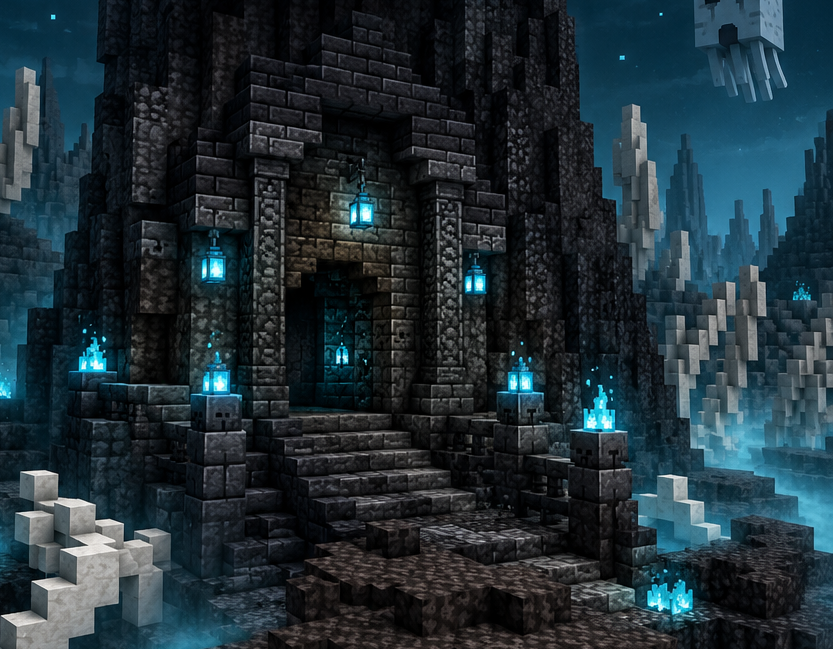
If you have ever stood at the edge of a soul sand valley and heard the wind carry those low, mournful voices across the fog, you already understand why this biome is the best canvas in the Nether for horror builds. It looks abandoned. It sounds haunted. And the terrain itself, with its ash-grey ground, blue-grey fog, and jagged bone fossils poking through the sand, does half the atmospheric work before you place a single block.
This guide walks through how to read the biome, work with its trickiest terrain, light it properly with soul fire, and put those lessons into three complete builds you can drop into your own Nether base.
👻 Reading the Biome’s Natural Mood
Soul sand valleys make up roughly 17% of the Nether by volume, which makes them the third most common biome in the dimension. That is a lot of real estate to work with, and almost all of it already leans toward horror before you touch it.
The biome’s built in atmosphere comes from a few overlapping effects. Cyan fog sits low across the terrain, gray particles drift through the air like ash, and an ambient soundscape of wind and distant voices plays constantly. Basalt pillars, those towering stone columns that stretch from floor to ceiling, break up the skyline into something closer to a blasted cathedral than a cave system. If you are already thinking in terms of gothic silhouettes, this piece on nether fortress design is worth reading alongside this one since the two styles share a lot of structural DNA.
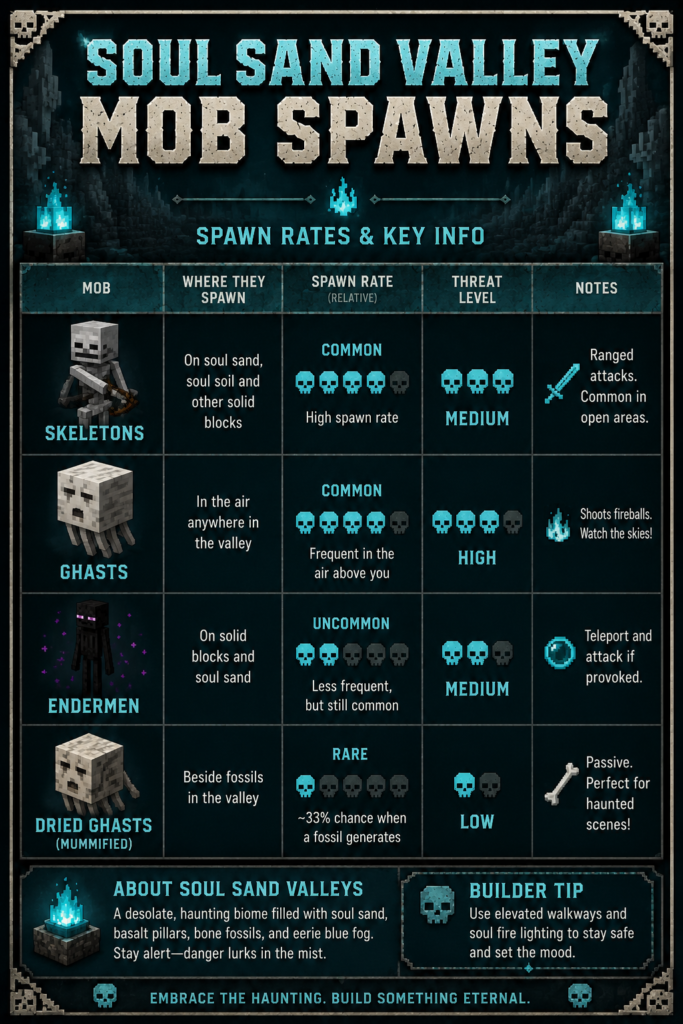
The mob population reinforces the mood without any extra effort on your part. Skeletons patrol the open ground, ghasts drift overhead trailing their signature wail, and endermen teleport through the fog at the edges of your torchlight. None of this needs staging. It is already there.
🔥 Designing With Soul Fire
Soul fire is the single most important lighting tool for this biome, and it does double duty as both illumination and set dressing. It only ignites on soul sand or soul soil, and it burns with a cold blue flame instead of orange, which instantly reads as unnatural or otherworldly to anyone who sees it.
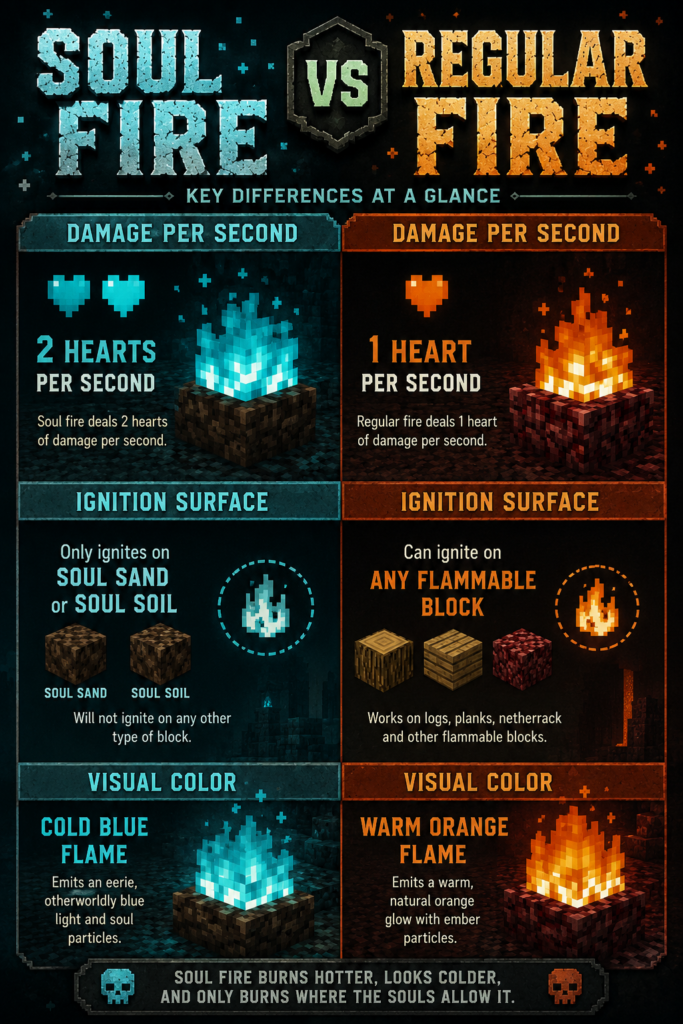
Functionally, soul fire deals two hearts of damage per second to anything that touches it, compared to one heart from ordinary fire, so treat it as a hazard as much as a light source. Keep it contained in braziers, lanterns, or recessed wall sconces rather than open ground level flames if you plan to walk your build regularly.
For a haunted architecture project, soul fire works best in small, deliberate clusters rather than blanket lighting. Line a processional path with soul lanterns spaced two or three blocks apart. Place a single soul fire brazier at the center of a ritual chamber instead of ringing the whole room. The contrast between deep shadow and cold blue light is what sells the horror tone, and over-lighting a build flattens that effect fast. For more on how spacing and contrast affect mood generally, the tips in Minecraft Lighting Design: Creating Mood and Atmosphere apply directly here, just swap warm light sources for soul fire and soul lanterns.
🦴 Working With Nether Fossils
Nether fossils generate randomly throughout soul sand valleys and are built from anywhere between 5 and 27 bone blocks, arranged across roughly a dozen known variants. They read instantly as skeletal remains, whether shaped like ribcages, spines, or partial skulls, which makes them one of the best pre-built assets a horror builder can find in the wild.
A recent addition worth knowing about if you have not explored soul sand valleys lately: fossils now have roughly a one in three chance of generating with a dried ghast perched beside them, a mummified variant added in a recent update that fits the cemetery aesthetic even better than the fossils alone. Treat one as a found object rather than raw material. Build your tomb or crypt around an existing fossil instead of demolishing it, and use bone blocks harvested elsewhere to extend the skeleton into walls, arches, or flooring that ties the whole structure together.
Bone blocks also have a practical use beyond decoration. They compost well and can be broken down for bone meal, so if you are running a farm alongside your haunted build, a fossil is a renewable resource as much as a set piece.
🏚️ Handling Soul Sand Terrain
Soul sand and soul soil are the defining ground materials of the biome, and both come with a real gameplay cost if you ignore them. Soul sand slows any entity standing on it, which makes traversal miserable without help, and the visual sinking effect sells the “you should not be here” feeling even before the mobs show up.
For working paths and building foundations, lay a strip of cobblestone, basalt, or blackstone over the soul sand. These blocks are ghast-proof and resist fireball explosions, which matters a lot in a biome where ranged mobs are a constant threat. Reserve open soul sand for areas you want to feel dangerous or overgrown, like the approach to a crypt entrance or the floor of an open pit.
If you or visitors to your world want to move through the valley quickly, Soul Speed enchanted boots let you sprint across soul sand and soul soil at speeds that rival regular sprinting on stone, effectively neutralizing the slow effect. Consider this for any build meant to be walked through repeatedly rather than just admired from a distance. For a deeper breakdown of what the Nether’s other blocks offer once you are ready to expand past the valley itself, see The Complete Nether Materials Guide: Building Blocks Breakdown.
⚰️ Horror Architecture Principles
A few structural habits separate builds that feel genuinely unsettling from builds that just look dark.
Asymmetry reads as decay. Perfectly even, mirrored structures feel intentional and safe. Introduce a leaning wall, a collapsed section, or a doorway that is slightly off center, and the whole structure starts to feel like it survived something rather than being built to a plan.
Negative space matters as much as blocks. Leave gaps in walls and ceilings where soul fog can drift through, and avoid fully enclosing rooms with light. A little visible darkness beyond a doorway does more work than any amount of detail inside a fully lit room.
Verticality creates dread. Basalt pillars already give you height to work with, so build downward into pits and upward into spires rather than staying at a single elevation. A crypt you look down into feels very different from a crypt at eye level.
Sound and silence should be deliberate. You cannot fully control ambient noise in Minecraft, but building near open soul sand keeps the wind and voice effects active, while sealing a chamber with stone muffles them. Use that contrast between exposed and enclosed spaces to control tension as players move through your build.
🎃 Halloween-Themed Builds That Work Year Round
Horror architecture does not have to be seasonal to earn its place in a base. A few Halloween-adjacent elements translate well into permanent Nether structures.
Carved pumpkins with soul lantern lighting inside make effective grave markers or path lights when scaled down and placed sparingly. Cobweb accents in doorways and corners work anywhere in the Nether since spiders are common enough that the material feels earned rather than decorative. Twisting fence posts made from nether brick fence or warped stems create the look of dead trees breaking through soul sand, especially when angled rather than placed perfectly upright.
None of these need a holiday theme to justify their presence. Framed as haunted architecture, they read as part of a serious build rather than a costume.
🪦 Cemetery and Tomb Design
Cemeteries are one of the strongest single structures you can build in a soul sand valley because the terrain already does the emotional heavy lifting.
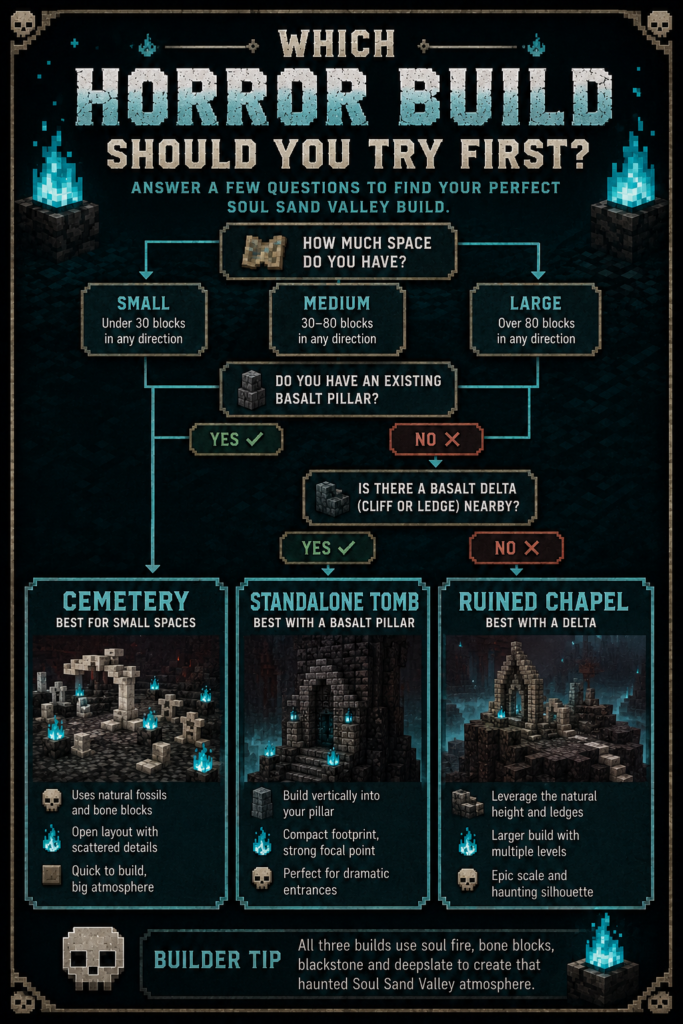
Start with a low perimeter wall in blackstone or polished basalt, broken periodically by open gaps rather than a single gate. Inside, place headstones using upside down stairs topped with a slab, spaced unevenly rather than in a tidy grid. Cluster two or three fossils within the walls as the centerpiece, and connect them with a soul sand path lined in soul lanterns rather than a stone walkway, letting visitors feel the slow, uneasy pull of the terrain as they approach.
For a standalone tomb rather than a full cemetery, dig into a basalt pillar rather than building freestanding. A tomb carved into existing terrain feels ancient in a way that a constructed box never will, and it lets you use the pillar’s natural height for a sunken entrance stairway lit with a single soul fire brazier at the bottom.
A third build worth trying is a ruined chapel: four broken walls of nether brick, a partially collapsed roof letting soul fog drift in, and a fossil positioned where an altar would normally sit. This one works especially well near basalt deltas if your valley borders one, since the deltas add textural variety just past the chapel’s edges.
Building in the Valley
Soul sand valleys reward builders who work with the terrain instead of against it. The fog, the fossils, the cold blue fire, and the constant low hum of hostile mobs are already doing most of the atmospheric work. Your job is mostly restraint: light sparingly, break symmetry deliberately, and let the biome’s natural decay read as part of the design rather than something to build over.
Whether you are adding a single crypt to an existing Nether base or planning a full haunted district, the soul sand valley is one of the few biomes in Minecraft where horror architecture and biome-appropriate building are the same skill.


