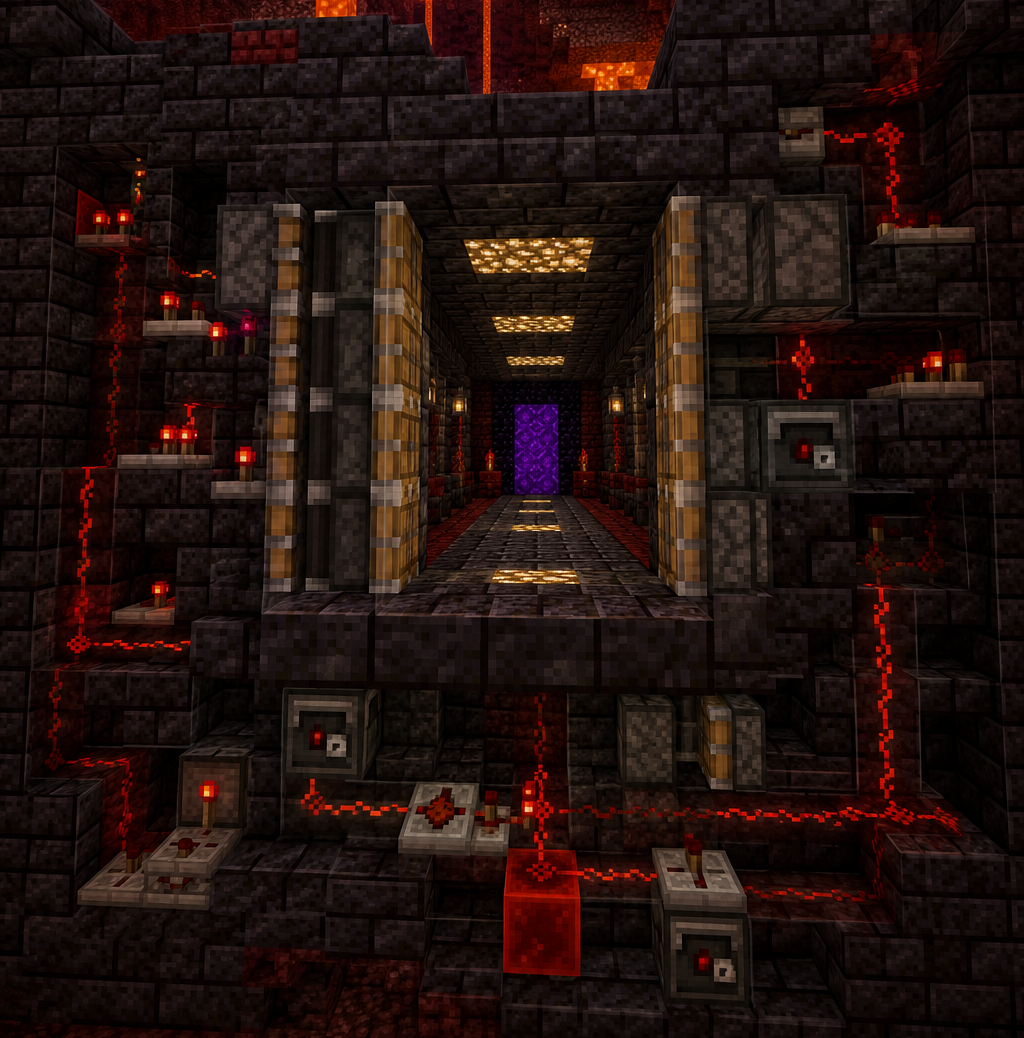
In the Nether, redstone stops being a convenience and becomes survival infrastructure. The moment you step through that obsidian frame, your priorities shift — decorative contraptions give way to hidden entrances, automated defences, and tightly controlled logistics. The dimension doesn’t forgive exposed circuits or poorly planned bases, which makes understanding its unique relationship with redstone all the more important for serious builders.
What makes the Nether genuinely interesting from a redstone perspective is that the dimension gatekeeps some of its most powerful components behind its own materials. Comparators, observers, and daylight detectors all require Nether quartz in their crafting recipes, which means your redstone ambitions and your Nether progression are directly linked. The builder who masters the Nether gains access to a toolkit that makes everything from hidden passages to automated resource loops significantly more achievable.
This guide covers the full stack of Nether redstone applications — from foundational piston door designs through to observer-based security, mob defences, farm automation, portal control, and hopper sorting. If you’re new to redstone altogether, our complete redstone engineering guide covers the fundamentals before you go dimension-hopping. For everyone else, this is the Nether-specific engineering framework that will turn a hostile dimension into a controlled stronghold.
Why the Nether Changes Redstone Design
Before diving into specific builds, it’s worth understanding why the Nether demands a different approach to redstone design than the Overworld. The environment is actively hostile in ways that influence every build decision: cramped terrain, aggressive mob spawning, lava everywhere, and zero natural light to work by. These constraints push Nether redstone design towards compact, reliable, and hidden systems rather than sprawling open contraptions.
The Quartz Connection
The dependency on Nether quartz isn’t just a crafting curiosity — it’s a design philosophy embedded in the game. Quartz is abundant in the Nether’s soul sand valleys and basalt deltas, making it easily accessible once you’re established. That accessibility means experienced players can arrive in the Nether and rapidly begin constructing the more sophisticated components their builds require, rather than having to return to the Overworld for materials. For a full breakdown of every Nether block and its structural and aesthetic applications, our complete Nether materials guide is the reference to bookmark.
Observers in particular become enormously useful in Nether contexts. Because they detect block state changes and emit short redstone pulses, they’re ideal for creating reactive systems — traps that trigger when a block is mined, secret doors that open on interaction, and alarms that respond to intrusion. The Nether’s hostile environment makes these reactive capabilities far more valuable than they might seem in a peaceful Overworld build.
Glowstone as a Build Material
Glowstone offers another Nether-specific advantage: it conducts redstone power when used in certain configurations, behaves as a full block, and provides light output that suits the dim Nether aesthetic far better than torches or lanterns. For builders who want hidden lighting integrated into redstone infrastructure — illuminating a control room, for instance, without exposing any circuitry — glowstone becomes a natural choice.
Piston Door Designs for Nether Bases
Piston doors are the bread and butter of Nether base security. They provide a physical barrier that looks like solid wall when closed, seal off storage and portal rooms from unwanted access, and can be constructed in several configurations depending on how much concealment and automation you need.
The 2×2 Compact Bunker Door
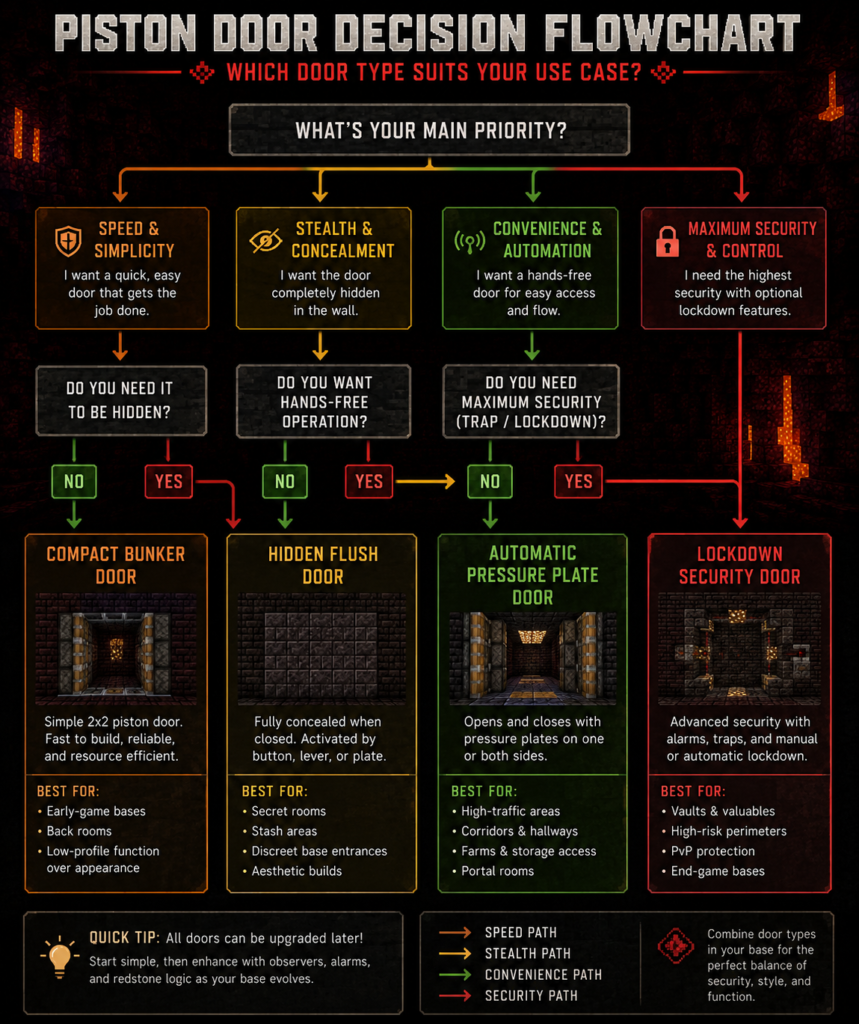
The simplest reliable design for a Nether bunker entrance is a standard 2×2 piston door — two columns of two pistons on either side of a 2-block-wide, 2-block-tall opening, driven by a simple lever or button. It’s quick to build, uses minimal resources, and gets a base sealed in minutes. For the walls of a Nether base where the priority is function over elegance, this is often the correct choice.
The key detail for Nether builds specifically is wiring. Exposed redstone lines on the floor of a base get in the way, and in a rough hewn Nether cave they look messy and give away the mechanism’s position. Route wiring through the wall blocks adjacent to the doorframe, or run it underneath the floor by digging one block down, covering with slabs.
The Hidden Flush Door
For concealed passages and stash rooms — the kind of space you don’t want casual observers to notice — a hidden flush piston door is the appropriate upgrade. The principle is the same as the compact door, but the pistons sit fully recessed behind the wall face so that when the door is closed, it’s indistinguishable from the surrounding wall material.
Building this in the Nether works best with netherrack, blackstone, or basalt as your wall material, since these blocks are visually uniform and easy to tile. The activation mechanism can be hidden behind a painting, a button placed on an adjacent block that’s disguised as decoration, or a pressure plate placed just before the door on the approach side. For a stash room, a secondary hidden pressure plate on the inside ensures you can exit without hunting for a button in a hurry.
The Automatic Pressure Plate Entrance
For high-traffic areas — portal rooms, storage halls, and farm access corridors — a hands-free automatic door is the right tool. Pressure plates on both sides of the door activate the pistons when you walk up, open the door, and close it after you pass through. This design is best driven by stone pressure plates rather than wooden ones, since stone plates respond only to player and mob pressure rather than items, which prevents dropped Nether star or debris from holding doors open.
The limitation of automatic doors in the Nether is that hostile mobs will also trigger them. In areas where mob spawning is a concern, pair the pressure plate door with a mob deterrent — a moat of lava around the entrance perimeter, or an observer-based trap triggered by mob movement through the threshold.
Portal Lockdown Door
A fourth design worth having in your toolkit is a portal lockdown door: a piston-gated room that physically seals the portal chamber when the portal is inactive or under threat. The mechanism uses a lever to lock the entire portal room behind a solid wall, preventing any mob — or unwanted player in a multiplayer context — from accessing or disrupting the portal. It’s the same piston mechanics as the flush door, scaled up to encompass an entire room entrance rather than a single passage.
Observer Security Systems
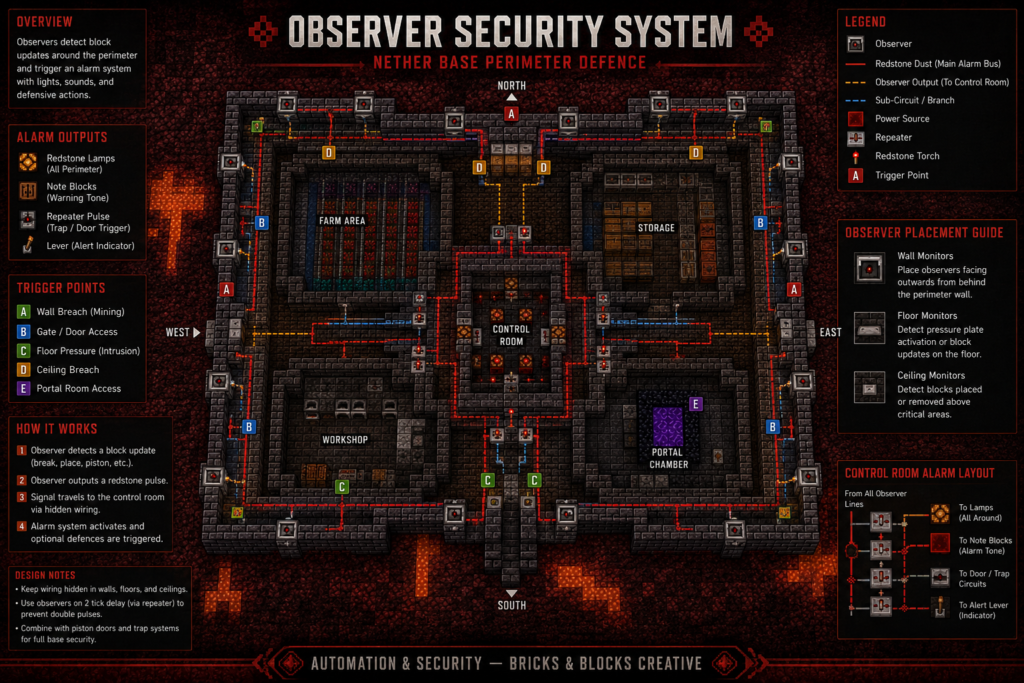
Observers are arguably the most powerful security tool available in a Nether base. Their ability to detect block state changes — mining, block placement, door interactions, pressure plate activation — and emit an immediate redstone pulse makes them ideal for a wide range of intrusion detection and reactive defence applications.
Perimeter Alarms
The simplest observer security application is a perimeter alarm. Place observers facing the exterior walls of a tunnel or base entrance, oriented so that any mining of those wall blocks triggers a pulse. Route that pulse to a bell, a noteblock array, or simply a series of redstone lamps inside the base that light up when the perimeter is breached. It won’t stop an intruder, but it gives you warning.
For a more robust setup, observers placed at chokepoints — the narrowest passages leading to your base — detect player and mob movement more reliably than exterior walls. A player moving through a tunnel will pass close enough to trigger observer detection on adjacent blocks, especially if you use a combination of observers covering different angles.
Tamper-Detection for Storage
One of the most practical observer applications for a Nether base is tamper detection on storage rooms. An observer facing a chest detects when the chest is opened, triggering a pulse that can activate an alarm, seal the room with pistons, or trigger a defensive response. This works reliably for any interactable block — chests, barrels, furnaces, and crafting tables all register as state changes when opened.
Combine this with the flush hidden door described earlier, and you have a storage room that’s invisible from outside and alarmed from within. If someone manages to find the room and opens a chest without your knowledge, the system logs the intrusion automatically.
Hidden Passage Triggers
Observers also excel at creating passage mechanisms that don’t rely on visible buttons or pressure plates. A block face that a player interacts with — even something as simple as placing a block against a wall — can be detected by an observer and used to open a hidden door. Advanced builders use this to create lore-appropriate Nether base entrances: pressing a specific netherrack block, placing a gold nugget in a particular spot, or triggering a specific sequence of interactions in the right order.
Automatic Mob Defences
No Nether base guide is complete without addressing the mob problem. Piglins, piglin brutes, ghasts, hoglins, and skeletons are all present in the Nether in significant numbers, and a base that isn’t defended becomes a liability quickly. Automated defences turn the Nether’s hostility into a manageable engineering problem.
Dispenser Trap Corridors
The most straightforward automated defence is a corridor trap using dispensers loaded with arrows or splash potions. Pressure plates or tripwire hooks in the corridor trigger the dispensers when a mob enters, applying consistent damage to anything passing through. For arrow dispensers, a clock circuit connected to the dispenser allows continuous fire while the pressure plate remains active.
In the Nether, corridor traps are particularly effective because mob pathing tends to funnel through narrow passages. A well-placed trap corridor between the base entrance and the interior can eliminate most threats before they reach your living and storage areas. Position the traps far enough from the entrance that you can approach from outside without triggering your own defences — two or three blocks of safe zone before the trap begins is usually sufficient.
Lava Moat and Gate Systems
Lava is abundant in the Nether and makes an excellent passive defence. A moat of lava around a base perimeter, managed with iron trapdoors and pistons to allow controlled access, creates a barrier that handles most standard mob threats without any active mechanism required. If you want to go further with lava as a design material — integrating it into walls, floors, and feature elements rather than just functional moats — our guide to Minecraft lava features covers safe containment and spectacular design applications in depth.
The challenge with lava moats is integration with the base aesthetic and managing flow containment. Blackstone and basalt are ideal containment materials since they’re non-flammable and visually appropriate for the Nether environment. Source block placement is important — ensure the moat contains source blocks throughout rather than flowing lava, which can behave inconsistently.
Farm Automation in the Nether
The Nether supports several farm types that benefit significantly from automation, with Nether wart farming being the clearest and most immediately useful example for any established base.
Automated Nether Wart Farms
Nether wart grows on soul sand and can be harvested manually, but an automated version dramatically increases throughput for players who use wart as a primary brewing ingredient. The basic automated design uses dispensers loaded with water buckets to flood the farm and wash harvested wart into collection channels, where hoppers route it into a chest or storage system.
The mechanism works in a loop: a clock circuit triggers the dispenser to flood the farm, water carries the wart to a collection point, hoppers pick it up, and a secondary dispenser retrieves the water bucket for the next cycle. This kind of farm is well-suited to a Nether base context because soul sand is available in the soul sand valley biome and Nether wart is a renewable resource once you have your initial supply from a fortress chest.
Blaze Farm Infrastructure
Blaze rods are one of the most strategically important Nether resources — fuel for brewing stands and the core ingredient for Eyes of Ender — which makes blaze farming a priority for any serious Nether base. While blaze farms are technically mob farms rather than crop farms, they follow the same automation principles: funnel mobs to a kill point, collect drops via hoppers, route to storage.
A well-built blaze farm adjacent to your Nether base turns rod collection from an active combat task into a passive logistics operation. The redstone component is typically a killing mechanism — pistons to deal the final blow, or a fall system — connected to a hopper collection floor that feeds directly into your sorting system.
Portal Activation and Control Systems
Portal control is one of the most thematically appropriate Nether security systems, and one that provides both convenience and genuine protection for a Nether hub.
On/Off Portal Systems
A portal can be deactivated by removing or obstructing its obsidian frame, but a cleaner solution is a dispenser-based lighting system that treats portal activation as a switchable state. A dispenser loaded with a flint and steel, triggered by a lever or button, lights the portal on demand. A second dispenser loaded with water buckets — or a piston that pushes a block into the portal frame — deactivates it. This gives you a controlled on/off switch for Nether access that works reliably without damaging the frame.
For a Nether hub with multiple portal connections — a common layout for players running a hub-and-spoke portal network — individual on/off controls for each portal let you route traffic deliberately. Open only the connection you need, deactivate the rest, and prevent accidental travel or mob transit through idle portals.
The Controlled Entry Room
The most complete portal security setup is a dedicated entry room: an enclosed chamber containing the portal, accessed via a piston door that only opens from a control room interface. Visitors arriving through the portal emerge into a controlled space that can be inspected before they’re granted access to the wider base. In survival multiplayer contexts, this is a genuine security measure that prevents uninvited arrivals from accessing your base infrastructure.
Item Sorting for Nether Bases
A productive Nether base generates a significant and varied stream of resources — Nether wart, blaze rods, magma cream, quartz, ancient debris, gold nuggets from piglins, and more. Keeping that output organised requires a sorting system, and the Nether’s compact base aesthetic suits a well-hidden hopper sorting setup particularly well.
Hopper Sorter Fundamentals
A standard hopper item sorter uses comparators to detect item type within a hopper and filter specific items into dedicated chests. The comparator reads the signal strength of the hopper’s contents, and a locking mechanism holds all other hoppers closed while a specific filter hopper processes its target item. This allows a single input stream to be divided into as many categories as you have filter stages.
For a Nether base, the most practical sorter layout embeds the system behind the base walls — routing the hopper chain through wall cavities or under the floor so the surface remains clean. Position the output chests along one wall of a dedicated storage room, clearly labelled, with the hopper infrastructure invisible behind the stone. It keeps the base compact and the storage accessible without the chaotic tangle that often results from surface-level hopper runs.
Nether Resource Categories
The specific filter categories that make sense for a Nether base differ from Overworld storage. Priority categories typically include: Nether wart, blaze rods, magma cream, ghast tears, Nether quartz, gold (nuggets and ingots separately), ancient debris, and netherite scraps. A catch-all chest at the end of the sorter handles anything the filters don’t recognise — piglin trade outputs and miscellaneous drops from mob kills.
A sorting system connected to your farm output and your piglin bartering station creates a genuinely automated logistics loop: farms produce resources, mobs drop loot, piglins trade gold for materials, and everything routes to the right chest without manual handling. Once you have this loop established, the Nether base stops feeling like a hostile frontier and starts feeling like a controlled operation.
Building a Complete Nether Stronghold
The individual systems described in this guide are each useful in isolation, but their real value emerges when combined into a single integrated base design. A complete Nether stronghold has a logical layout: a controlled entry room containing the portal, a main living and crafting space accessed via a hidden flush door, a secured storage room with a hopper sorting system, a blaze farm and wart farm on the perimeter, and observer-based security covering the tunnel approaches.
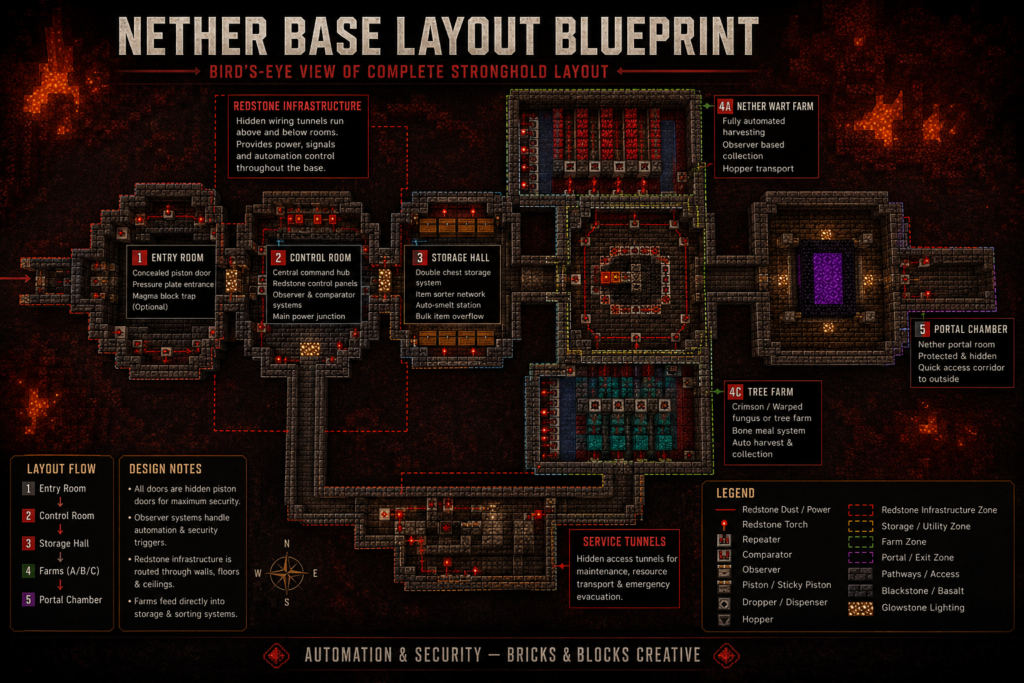
The redstone infrastructure — wiring, observers, dispenser mechanisms, hopper chains — runs entirely hidden behind the walls, floor, and ceiling of the base. The surface of the build looks like a dense, atmospheric block build with no visible circuitry. Every function is accessible from a central control room where levers manage portal access, door locking, and farm cycling from a single interface.
This is the Nether redstone philosophy at its most complete: a dangerous, hostile dimension transformed into a controlled, automated stronghold through deliberate engineering. The quartz is there, the glowstone is there, the soul sand is there — the only thing left to add is the knowledge of how to put it together.
Continue Your Journey
- Nether Hub Design: Complete Transportation Network Guide — How to plan and build a multi-spoke Nether portal hub for fast Overworld travel
- Nether Building Mastery: Surviving and Thriving in Hell’s Architecture — Choosing the right biome, materials, and layout for a permanent Nether base
- Nether Survival Essentials: Complete Preparation Guide — Resource priorities, mob management, and exploration strategies for the experienced player
- Ghast-Proofing Your Nether Base: Complete Defense Guide — How to build a base that survives the Nether’s most dangerous ranged attacker
- April 2026 Roundup: What’s New in Minecraft — Stay up to date with the latest Minecraft updates and community highlights
Are you running a dedicated Nether base, or do you treat the Nether as a transit dimension only? Drop your setup in the comments — we’d love to see how other builders are approaching the engineering challenge.
Want guides like this delivered directly? Subscribe to the Bricks & Blocks Creative newsletter for new Minecraft and LEGO content every week.