
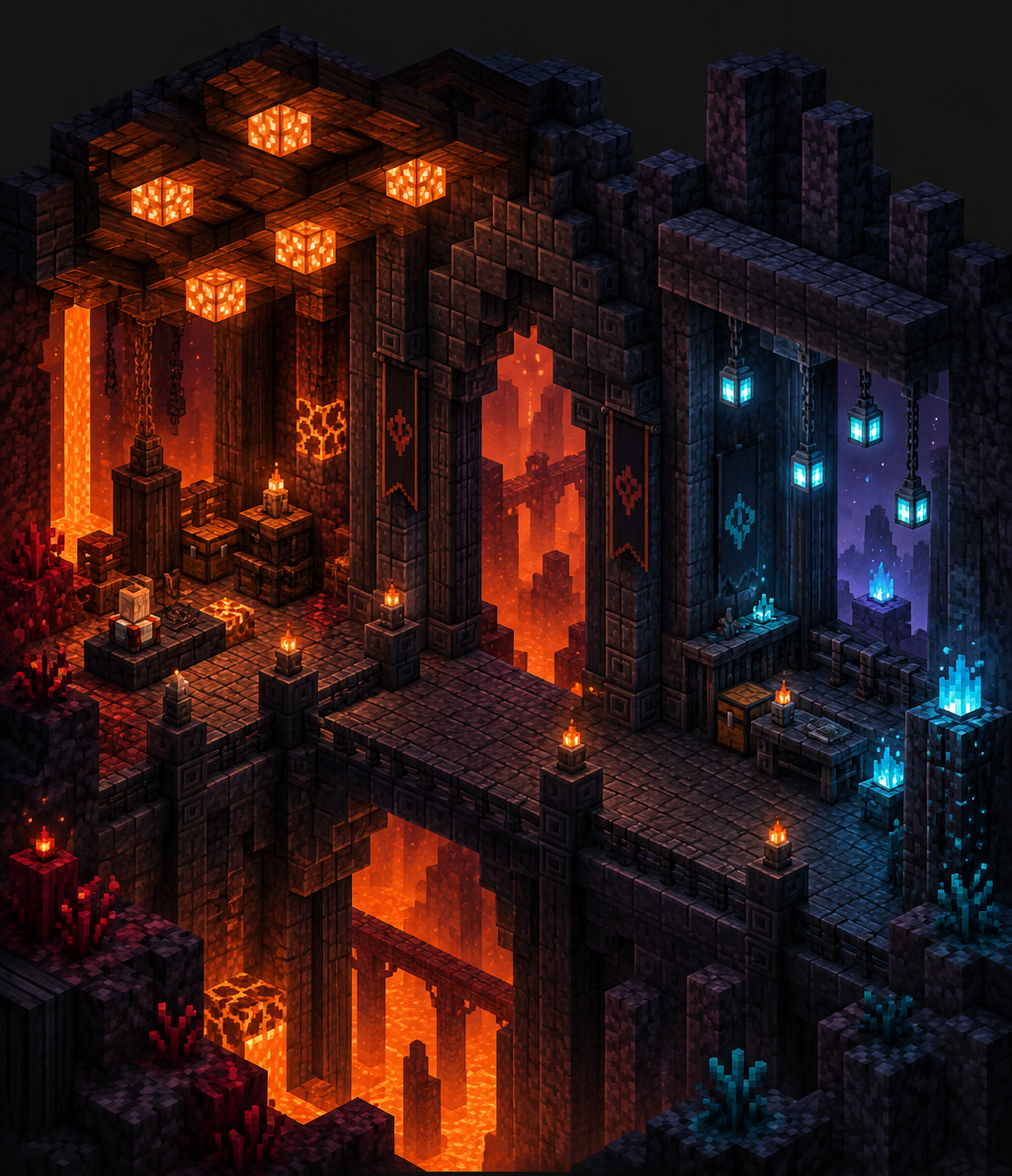
Most Nether bases get their lighting treated as an afterthought, a scattering of torches jammed in wherever the mob spawns got annoying. That’s a waste, because light in the Nether is doing double duty whether you plan for it or not: it keeps hostiles off your walls and it’s the single biggest thing separating a base that looks thrown together from one that looks designed. Treat it as a material in its own right, not a chore, and the whole build changes.
🔥 Every Nether light source, compared
Before you can design with light, you need to know what each source actually gives you. Here’s the full lineup, judged on brightness, colour and how it behaves as a building material rather than just a utility block.
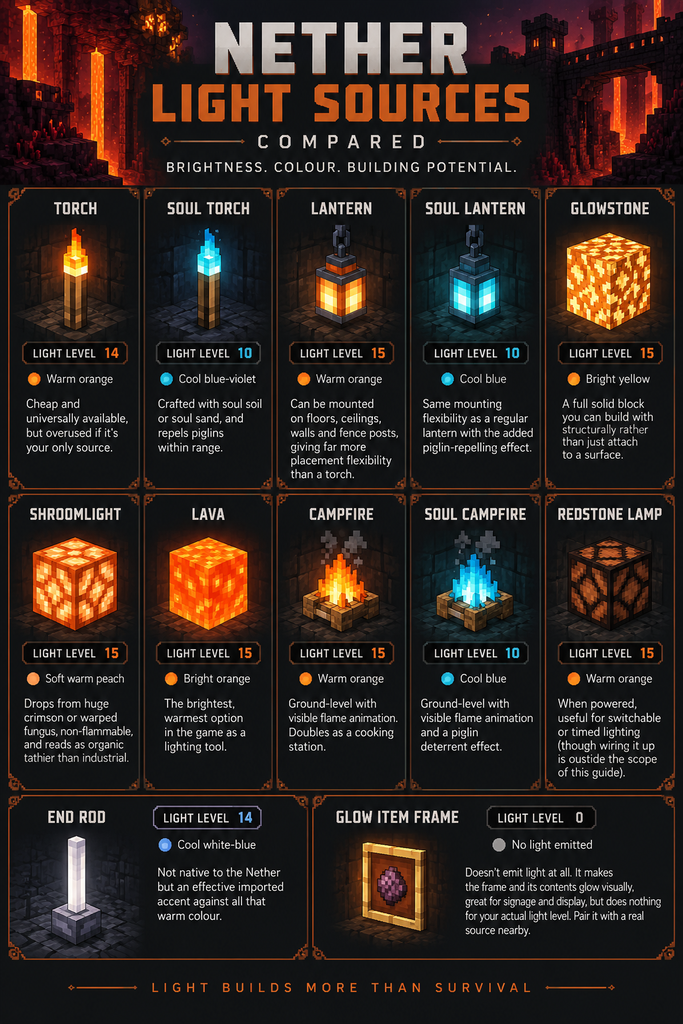
- Torch – light level 14, warm orange, cheap and universally available, but overused to the point of looking generic if it’s your only source.
- Soul torch – light level 10, cool blue-violet, crafted with soul soil or soul sand, and repels piglins within range.
- Lantern – light level 15, warm orange, can be mounted on floors, ceilings, walls and fence posts, giving far more placement flexibility than a torch.
- Soul lantern – light level 10, cool blue, same mounting flexibility as a regular lantern with the added piglin-repelling effect.
- Glowstone – light level 15, bright saturated yellow, a full solid block you can build with structurally rather than just attach to a surface.
- Shroomlight – light level 15, soft warm peach, drops from huge crimson or warped fungus, non-flammable, and reads as organic rather than industrial.
- Lava – light level 15 at the source block, the brightest, warmest option in the game as a lighting tool; our lava features guide already covers placement and safety.
- Campfire and soul campfire – light level 15 and 10 respectively, ground-level with visible flame animation, doubles as a cooking station and a piglin deterrent in the soul variant.
- Redstone lamp – light level 15 when powered, useful for switchable or timed lighting, though wiring it up is outside the scope of this guide.
- End rod – light level 14, cool white-blue, not native to the Nether but an effective imported accent against all that warm colour.
- Glow item frame – doesn’t emit light at all, worth flagging since it’s an easy assumption to get wrong. It makes the frame and its contents glow visually, great for signage and display, but does nothing for your actual light level. Pair it with a real source nearby.
💙 Soul fire vs regular fire: colour temperature and sourcing
The single most useful distinction in Nether lighting is the one between warm and cool fire, because it changes the entire feel of a space. Regular fire sources (torches, lanterns, campfires) sit around 2000-3000K in colour terms, orange and amber, and read as cosy, industrial or aggressive depending on context. Soul fire sources sit at the opposite end, a blue-violet that reads as eerie, arcane or clinical.
Sourcing is part of the design decision too, not just an inconvenience:
- Regular fire variants need nothing but the base item (torch, lantern, campfire) plus fuel.
- Soul fire variants need soul soil or soul sand underneath or as a crafting input, both of which are themselves distinctive dark, textured blocks worth incorporating into the same build for visual consistency.
Architecturally, soul fire tends to read better in stone, blackstone and basalt spaces, where the cool light plays off grey tones instead of fighting them. Regular fire tends to suit nether brick, crimson and warped wood, where the warmth matches the material. Mixing both in the same structure works, but only if you’re deliberate about where the transition happens, a doorway or a change in wall material is a natural hand-off point.
🕳️ Hidden and concealed lighting techniques
Visible light sources are the easy option. The techniques that actually separate a considered build from a functional one are the ones where the fixture disappears and only the glow remains.

- Recessed niches. Carve a single-block recess into a wall, place a torch or soul torch inside, then cover the opening with a trapdoor, fence gate or iron bars. The light escapes through the gaps while the block itself stays hidden.
- Under-block glow. Place lanterns or soul lanterns on the underside of an overhang, stair lip or shelf so the light source is invisible from normal eye level and only the pool of light on the floor below gives it away.
- Behind-glass washes. A lava pool or glowstone cluster behind a single pane of glass or a basalt lattice gives you ambient light without a visible block silhouette breaking up a wall.
- Buried strip lighting. Glowstone or shroomlight sunk one block into a floor or ceiling, with only the top face exposed, reads as a seam of light rather than a row of blocks.
The common thread across all of these is that the light matters more than the block producing it. Once you start hiding the source, you start controlling the shape of the glow instead of just the presence of it.
🎭 Dramatic lighting for architecture
Good architectural lighting isn’t about making every corner equally bright, it’s about deciding what the eye should land on first. A structure lit evenly from every angle reads as flat, while one with a single strong source and a lot of shadow around it reads as deliberate.
A few ways to put that to work in a Nether build:
- Highlight, don’t flood. Pick one architectural feature (an archway, a statue, a central staircase) and give it the brightest, warmest light in the build. Let everything around it fall away into partial shadow.
- Use colour to separate zones. A warm-lit main hall against a soul-lit side corridor tells the player they’ve moved somewhere different before they’ve consciously registered why.
- Let shadow do the work. Basalt and blackstone both hold shadow well because they’re already dark. Don’t over-light them just because you can, some of the best Nether interiors keep large sections at light level 8-10 deliberately, safe enough with the right mob-proofing but still moody.
- Frame with contrast. A single end rod or soul lantern against an otherwise warm-lit room reads as a focal point precisely because it breaks the palette.
⚖️ Functional vs decorative: hitting safe light levels without killing the mood
The tension in every Nether build is that safety wants brightness and atmosphere wants shadow. The good news is you don’t need to flood a space to make it safe, you need to hit the threshold and stop.
As a general rule, keeping block light at level 12 or higher across a floor stops most hostile spawns, which leaves real room to work with since a lantern or shroomlight (both level 15) still has several blocks of falloff before dropping below that line. Ghasts, piglins and a few other Nether mobs follow their own spawn rules rather than a pure light threshold though, so light alone won’t fully mob-proof an open base; our ghast-proofing guide covers full defense properly.
Practically, that means:
- Light the floor and any surface a mob could stand on, not just the space at eye level.
- Use your brightest sources (glowstone, shroomlight, lava, lanterns) to cover functional square footage, and save torches and soul variants for the accents and niches.
- Test dark corners by standing in them at night, or use a light-level overlay if your client supports one, rather than guessing from how bright a room looks to you.
- If a section absolutely needs to stay dim for the aesthetic, close it off with glass, iron bars or a doorway rather than leaving it open and unlit.
💡 12 named lighting setups by use case
Rather than reinventing lighting from scratch on every build, it helps to have a working vocabulary of setups you can drop in and adapt. Here’s a working list, grouped by where they earn their keep.
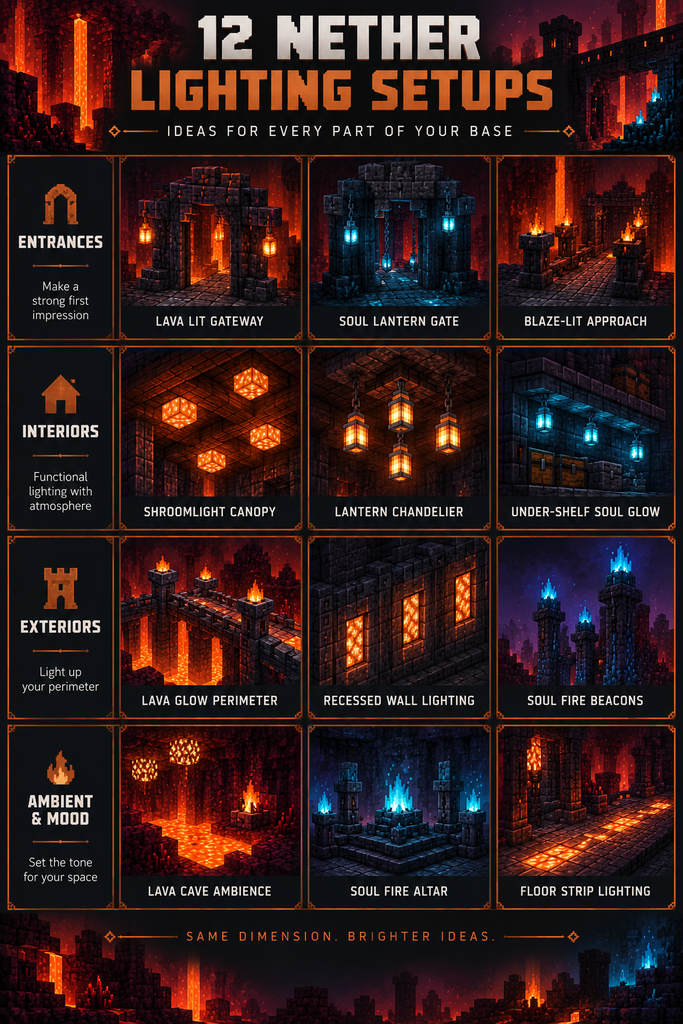
Entrances
- Soul Lantern Gate – twin soul lanterns flanking a nether brick or blackstone archway, marking the threshold in blue and quietly repelling piglins as they do it.
- Glowstone Threshold Strip – glowstone embedded flush into the floor on either side of a doorway, a bright, unmissable welcome mat.
- Path Lantern Row – regular lanterns on evenly spaced posts lining an approach path, guiding the eye (and the player) toward the front door.
Interiors
- Shroomlight Canopy – shroomlights recessed into a warped or crimson stem ceiling grid, giving a diffuse warm wash without a single visible fixture.
- Recessed Wall Niche – a torch or soul torch tucked into a one-block recess behind a trapdoor or fence gate, light escaping through the gaps.
- Under-Shelf Soul Glow – soul lanterns hung beneath stair overhangs or shelving to uplight a room from below.
- Campfire Hearth Corner – a campfire built into a lived-in nook with seating nearby, doing double duty as light source and cooking station.
Exteriors
- Lava Glow Perimeter – contained lava visible behind glass or a basalt lattice, giving a building’s exterior an ember-lit outline without any exposed hazard.
- Glowstone Constellation Facade – single glowstone blocks scattered irregularly across an exterior wall to suggest starlight against the dark stone.
- Basalt Uplighting – soul lanterns placed low against basalt columns so the light travels upward across the textured stone.
Ambient and mood
- Glow Item Frame Signage – glow item frames used for maps, banners or item displays, paired with a nearby hidden soul lantern so the display glows and the room still hits a safe light level.
- End Rod Accent Beam – a single end rod placed against an otherwise warm-lit room, a deliberate cool break in the palette that draws the eye.
None of these need to be used exactly as described. The point is a starting vocabulary, mix a Shroomlight Canopy with a Soul Lantern Gate and you’ve already got a build that reads as considered rather than default-torch-spam. For lighting on a timer, that’s a job for redstone rather than block choice, and our Nether redstone engineering guide picks up where this one leaves off.


