
Every interior trick that looks stunning in single-player has a hidden price tag on a server. Item frames, armor stands, redstone clocks, they all quietly tax the tick rate, and someone else always pays for it.
This guide is about decorating interiors that still feel personal and lived-in without becoming the reason your server chugs near spawn.
🖥️ Why Interior Design Choices Matter More on a Server
A gorgeous single-player build can get away with anything. Stack a hundred item frames on a wall, run six redstone clocks for ambient effects, fill every shelf with armor stands holding tiny props, and nobody but you ever pays the price.
On a shared server, every one of those choices is a cost the whole community absorbs. Interiors that look identical to their single-player counterparts can be the difference between a server holding a steady tick rate and one that chugs every time someone walks into your build.
This guide covers how to decorate interiors that still feel lived-in and personal without quietly becoming the reason everyone’s ping spikes near spawn.
⚙️ What Actually Causes Lag in a Decorated Interior
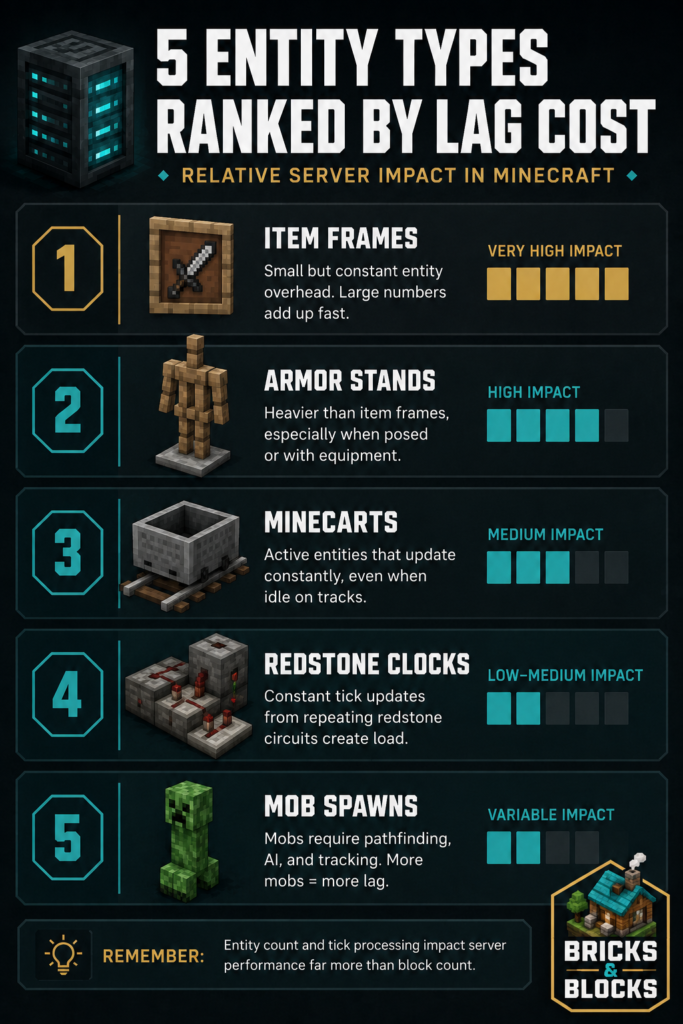
Before getting into specific techniques, it helps to know what you are actually managing. Server performance issues mostly come down to entity count and tick processing, not block count.
A massive stone build made entirely of static blocks costs the server almost nothing extra to render once it is placed. The expensive part is anything the server has to keep actively tracking:
- Item frames
- Armor stands
- Minecarts and boats
- Redstone contraptions running in a loop
- Nearby mob spawns
Entities like these are consistently one of the biggest drivers of server-side lag. A small, densely decorated room can rack up more active entities than an entire outdoor build twice its size.
This distinction matters because it means you do not have to decorate less. You have to decorate smarter, choosing block-based solutions over entity-based ones wherever the visual difference is small.
🪑 Lag-Conscious Decoration Techniques
The single highest-impact habit is defaulting to blocks, banners, and signs instead of item frames and armor stands whenever they can achieve a similar look. A shelf of decorative “books” can be built from bookshelves and trapdoors rather than item frames holding books. A display case can use glass panes and colored wool instead of an armor stand posed with a held item.
None of this is a huge visual sacrifice, and it adds up meaningfully across a full interior.
Where item frames and armor stands are genuinely the right tool, a trophy room, a weapon rack, a museum-style display, keep them clustered and capped rather than scattered across every room. A single showcase room with fifteen item frames is far cheaper than the same fifteen spread across five rooms, since it keeps the entity load concentrated in one loaded area.
Redstone deserves the same scrutiny. Ambient redstone effects, flickering lights, background clocks, animated displays, look great but tick constantly whether or not anyone is nearby. If you want atmospheric lighting, our Minecraft lighting design guide covers ways to build mood and atmosphere using static light sources instead of active redstone.
🏚️ Griefing-Resistant but Lived-In Design
Server builders face a tension single-player builders never deal with. The more visible and detailed your storage and decoration is, the more of a target it becomes.
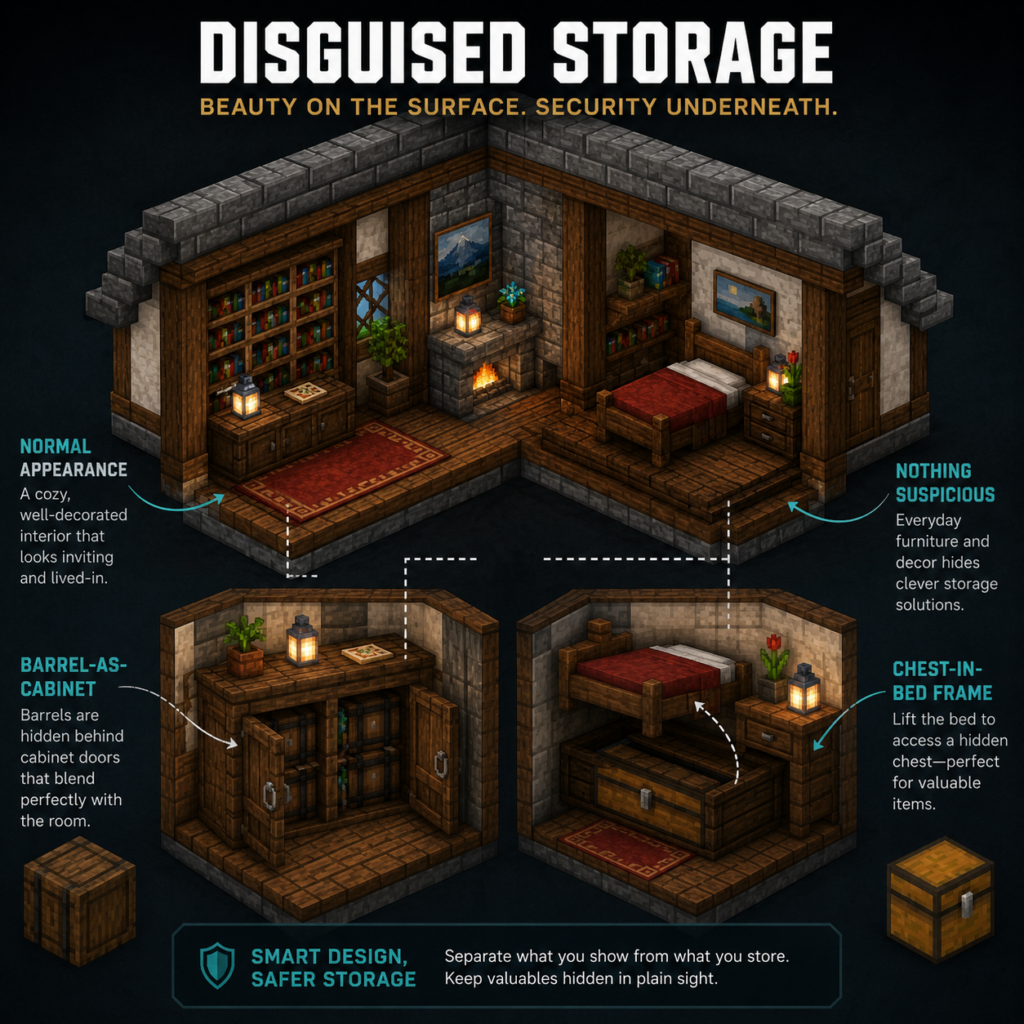
A wall of labeled item frames over your storage system is beautiful, but it also tells every passerby exactly where your valuables live. The fix is not to hide everything behind blank walls. It is to separate display from access.
Keep decorative item frames and trophies for things you are comfortable losing. Route your actual valuable storage into less obvious locations instead:
- Behind a hidden door
- In a separate, unlabeled room
- Built into furniture that does not read as storage at a glance, like barrels disguised as cabinets or a chest built into a bed frame
For more ideas on this specific balance, our Minecraft storage solutions guide covers organized storage that still looks intentional rather than purely utilitarian.
A lived-in interior does not need to expose everything to look inhabited. A few personal touches, a made bed, a stocked bookshelf, a plant by the window, do more for atmosphere than a fully itemized inventory on display.
🏛️ Community Space Interior Design
Shared community spaces, spawn hubs, shops, meeting halls, carry different constraints than personal housing because they are visited constantly rather than occasionally. A build that is fine as a private home can become a genuine performance bottleneck if it sits at spawn and gets loaded by dozens of players a day.
For these spaces, be more conservative than you would be at home. Limit particle-heavy blocks, certain plants, brewing stands running constantly, active furnaces in decorative rather than functional roles, in high-traffic areas.
If a community shop needs visual flair, concentrate the expensive decoration into a single focal area rather than spreading it throughout the whole structure. That way the server only pays that cost once per visit, rather than continuously as players move through multiple decorated rooms.
It is also worth designing community spaces with clear sightlines and simple navigation. A community hub that fifty players load in and out of all day benefits far more from being fast and legible than from being maximally ornate.
🏠 Player Housing in Shared Worlds
On a server, your build exists inside a shared map with finite reasonable space. Other players’ interiors are only ever a short walk from yours, which changes the calculus for player housing specifically.
A footprint that would be perfectly reasonable in single-player can feel disproportionate when it is competing for space and server resources with dozens of other builds. Favor compact, multi-purpose rooms over sprawling single-use ones.
A combined study and storage room, or a bedroom that doubles as a small crafting nook, gets you more usable interior variety per block placed than isolating every function into its own dedicated space. It also tends to look more genuinely lived-in, since real homes rarely dedicate an entire room to a single narrow function either.
If you are building your first proper interior on a server and want a broader foundation first, our survival mode interior design guide covers the fundamentals of building interiors that are both functional and good-looking.
🔜 Building With the Whole Server in Mind
None of this means giving up on beautiful interiors. It means being intentional about where the expensive choices go:
- Concentrate entity-heavy decoration instead of spreading it thin
- Favor block-based solutions over item frames and armor stands by default
- Keep valuable storage visually separate from decorative display
- Scale community spaces for constant traffic rather than occasional admiration
A server-friendly interior is not a worse interior. It is one that stays beautiful for everyone, including whoever is trying to play smoothly three chunks away.


