
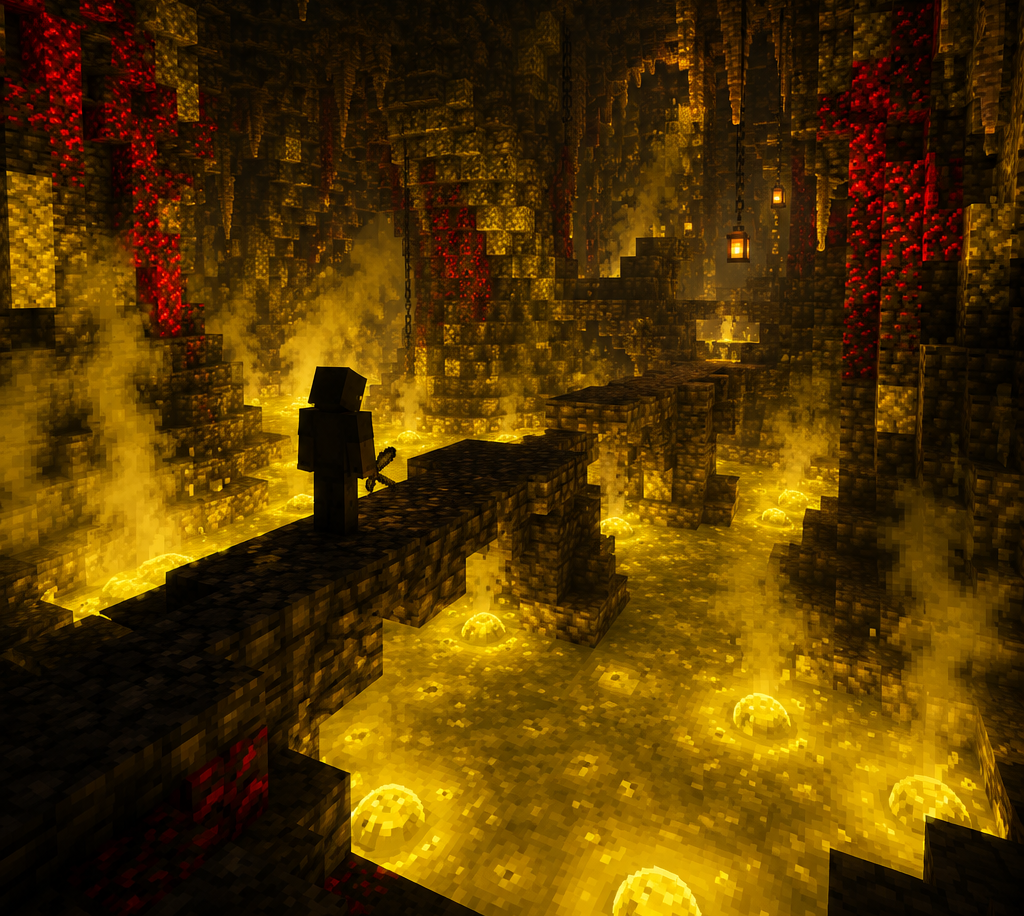
The Chaos Cubed drop introduced a lot of things to get excited about, but for adventure map builders, the sulfur cave biome stands apart. It is not simply a new location to set a dungeon in. It is a biome that arrives pre-loaded with hazards, visual drama, and interactive mechanics that do much of a designer’s heaviest lifting for them. If you have ever spent hours engineering a trap that feels genuinely threatening, or painstakingly constructed atmosphere from scratch using lighting and fog effects, sulfur caves offer something different: an environment where danger and mood are already baked into the terrain.
This guide is for builders who want to understand what sulfur caves actually offer as a design space, and how to use their unique features intentionally rather than just plopping a dungeon inside one and hoping the yellow rocks do the work.
Understanding What You Are Actually Working With
Before you can use sulfur caves effectively, it helps to understand the biome as a system rather than a collection of new blocks.
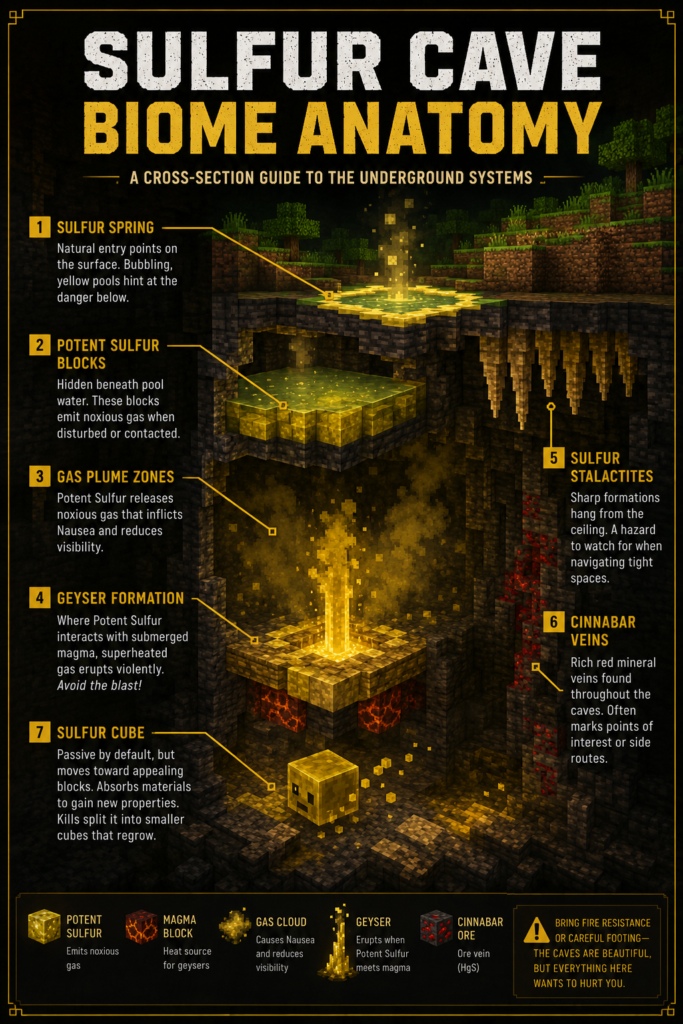
Sulfur caves generate underground, accessible via sulfur springs on the Overworld surface. Those springs, the yellow-rimmed bubbling pools you will notice when scanning terrain from a high vantage point, serve as a diegetic tutorial for players entering your map. They signal danger before players even descend, which is a genuinely useful framing device. A player who spots a sulfur spring understands that going underground here carries risk. You have communicated threat level without a single sign, book, or text block.
Once underground, the biome is defined by its warm yellow and red palette, dense bubble and steam particle effects, and the behaviour of Potent Sulfur blocks beneath pool water. Those blocks emit noxious gas that inflicts Nausea on contact, warping player vision in a way that makes even familiar mechanics feel disorienting. The constant visual churn of bubbles, gas plumes, and steam bursts creates an atmosphere of oppressive, claustrophobic danger that would cost a solo builder significant effort to replicate in a neutral cave environment.
Sulfur Cubes: The Wildcard Mob
Sulfur cubes are passive by default, but their design makes them explicit tools for map builders. They move toward blocks they find appealing, absorb those blocks, and gain new physics properties based on what they have consumed. A cube that has absorbed a bouncy material becomes a movable trampoline. A cube with high-friction properties absorbed can function as a slow, grinding moving platform. When killed, they split into smaller cubes that grow back to full size over time, which means any system built around them is naturally self-replenishing.
The developers framed sulfur cubes as components for redstone contraptions, parkour sequences, and traps, and they mean it. These are not ambient wildlife. They are modular mechanical elements that happen to be alive. For builders who enjoy the kind of layered systems design you find in advanced redstone engineering, sulfur cubes open up puzzle designs that were simply not previously possible without much more elaborate setups.
Designing Routes That Feel Earned
Standard cave-based adventure maps often struggle with route legibility. How do you tell players which tunnel to take without resorting to obvious torches or floating arrows? Sulfur caves offer organic solutions to this problem.
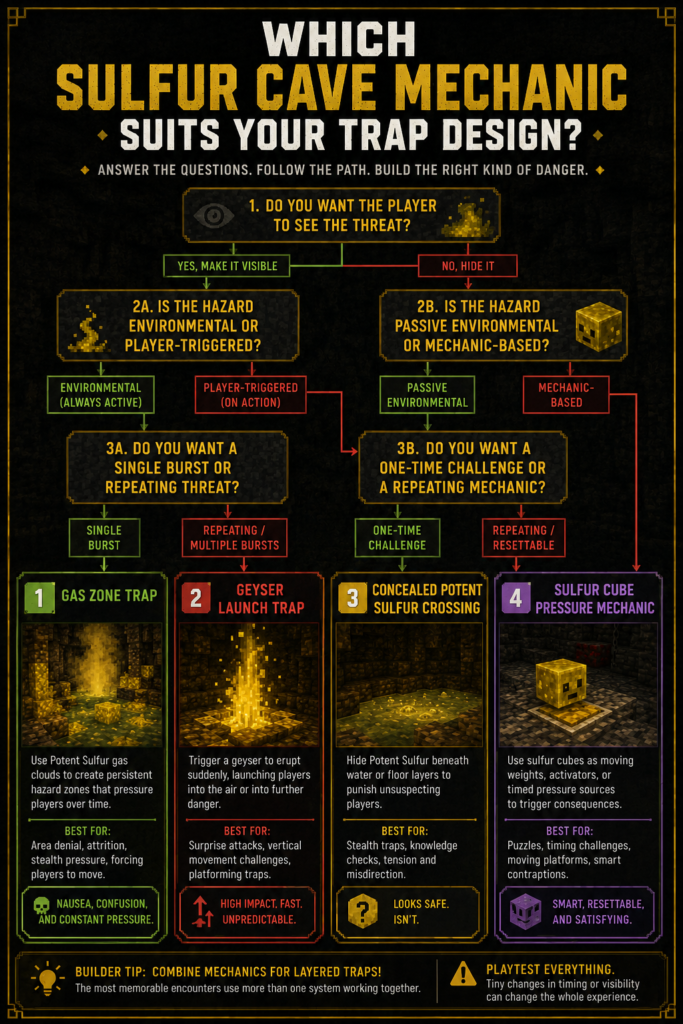
Because the biome is dense with environmental hazards, effective routing becomes a matter of weaving players through pockets of relative safety. The floor itself tells a story: solid stone and sulfur slabs are walkable, geyser tiles are dangerous, and Potent Sulfur beneath water is a threat to be avoided. Players will read these surfaces instinctively after their first encounter with the noxious gas effect, which means you can guide movement through terrain choice rather than explicit signposting.
Visual wayfinding also shifts in interesting ways. In a standard cave, torches mark the path. In a sulfur cave, you can use the biome’s own colour language: yellow sulfur pillars to guide forward movement, red cinnabar veins to mark side routes worth investigating, chains of bubbling pools as indicators that something significant lies ahead. The motion and light of the biome does the work that static torches would normally do, while keeping immersion intact.
Using Sulfur Springs as Route Architecture
Surface sulfur springs are not just entry points. They function as fast-travel and shortcut connectors between sections of your map if you design around them deliberately. A large-scale adventure map might use a network of springs as its hub-and-spoke travel system, with each spring connecting to a distinct underground section. Players who explore the surface thoroughly gain access to routes that more direct players miss, which rewards curiosity without punishing players who take the straightforward path.
This also gives you a surface layer of map design that sulfur caves uniquely support. Most underground-focused adventure maps have a thin surface section that exists mainly to funnel players downward. A sulfur cave map can make the surface exploration genuinely meaningful, since reading the landscape for springs becomes a skill with tangible payoff.
Environmental Traps That Do Not Need Explaining
One of the challenges with adventure map traps is teaching players the rules. If a player triggers a pressure plate and a piston pushes them into lava, they usually accept this. If they step on a tile that looks identical to the surrounding floor and take invisible damage, the trap feels unfair rather than clever. Sulfur caves largely solve this problem because the hazardous elements are visually distinct and behaviourally consistent.
Potent Sulfur blocks beneath water emit gas that both bubbles visibly and triggers Nausea. The visual cue and the consequence are directly linked. Players learn quickly that bubbling water in this biome is not safe, and they adjust their movement accordingly. This means you can build trap sequences around exposed or concealed Potent Sulfur without needing to teach players a new rule set — the biome teaches it for you.
The on/off dynamic is particularly useful for trap design. Concealing Potent Sulfur beneath what appears to be a safe water crossing forces players to choose between trusting still water and taking a longer detour around an obvious gas vent. Neither choice is guaranteed safe. That uncertainty, built from actual biome mechanics rather than artificial scripting, produces a quality of tension that is genuinely difficult to manufacture from scratch.
Geyser Trap Architecture
When Potent Sulfur generates beneath submerged magma blocks, it can create high-pressure geysers that launch players violently upward. This mechanic is startling on first encounter and presents some of the most interesting trap design opportunities in the biome. The key is context: a geyser in an open chamber is surprising but manageable. A geyser positioned beneath a narrow stalactite-lined corridor, above a pit, or directly beneath a timed jumping section becomes genuinely lethal in a way that still feels fair, because the player can identify the hazard before they trigger it.
You can combine geyser launch mechanics with mid-air arena design, using the vertical displacement to move players into a combat encounter they did not choose, or into a parkour segment that begins from an uncontrolled landing. The disorientation of the Nausea effect layered on top of unexpected vertical movement creates a difficulty spike that feels environmental rather than cheap, which is a meaningful distinction in adventure map design.
Parkour Over Toxic Pools
The Nausea effect deserves particular attention in the context of parkour design. In standard parkour, players calibrate jumps based on distance and their own movement consistency. They know how far they can jump. They know how long a block is. Sulfur pools disrupt this calibration by warping depth perception and introducing a visual distortion that makes familiar jump distances feel uncertain.
This effect works best when applied thoughtfully. Parkour that runs along the rim of a sulfur pool leverages the threat of the water below without requiring the player to engage with the Nausea effect directly. Parkour that crosses scattered safe tiles over an active gas zone forces players to manage the Nausea while also hitting their jumps. Both approaches are valid, but they produce different qualities of challenge. The second is significantly harder and should be used sparingly unless your map explicitly targets experienced parkour players.
Sulfur Cubes as Dynamic Platforms
Because sulfur cubes can absorb different block types and gain different physics properties accordingly, they are natural elements for timed parkour sequences. A cube that has absorbed bouncy material and is moving along a predefined path can serve as a trampoline platform with a rhythm — players need to time their approach to land when the cube is in the right position. A slow high-friction cube can be a moving platform in sections where precise, deliberate movement matters more than speed.
The self-replenishing nature of cubes matters here too. Split cubes grow back, which means you do not need to design reset mechanisms into your parkour sequences. The platform comes back on its own. For complex maps where players will retry sections multiple times, this is a significant quality-of-life detail that vanilla redstone platform resets rarely match for reliability.
Atmosphere: Working With the Biome Rather Than Against It
The visual character of sulfur caves leans heavily into warm yellows and reds, thick particle effects, and the constant motion of bubbles and steam. This is an atmosphere that rewards a specific design approach: go with it rather than against it.
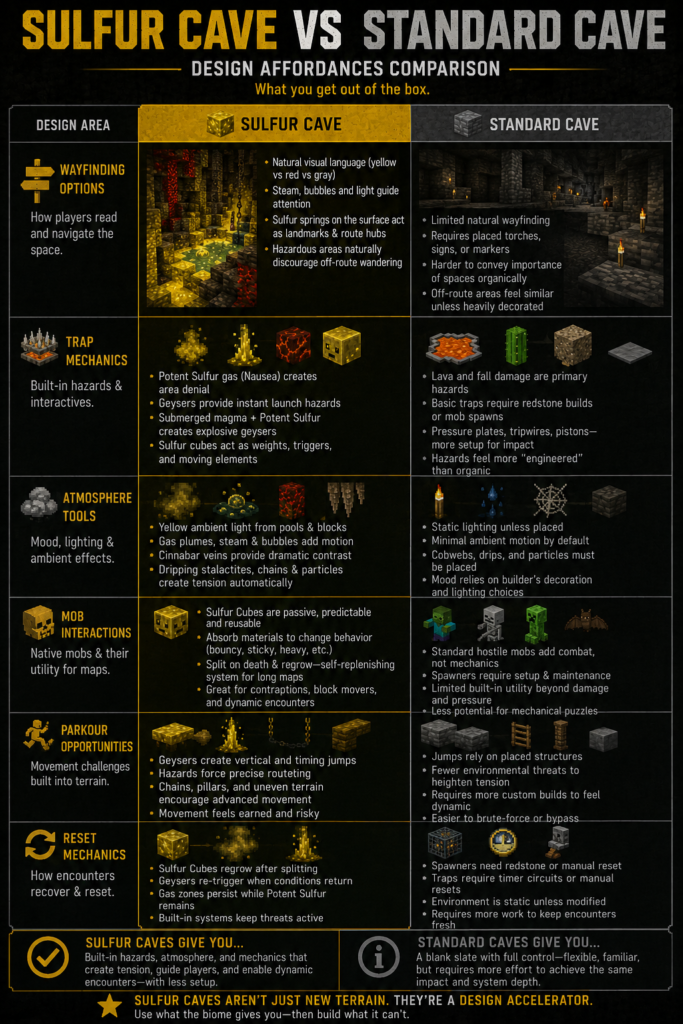
Builders who try to impose a different aesthetic on a sulfur cave — plopping a standard stone dungeon inside the biome and hoping the sulfur stuff stays in the background — will find the biome fighting them. The particle density and colour palette are aggressive. They demand acknowledgment. But builders who lean into the biome’s own direction find that the visual work is substantially done for them.
Lighting in sulfur caves works best when it works with reflection and silhouette rather than bright, even illumination. The toxic water surfaces catch light in ways that standard water does not, and sulfur pillars create natural silhouette opportunities against gas-lit backgrounds. The goal is claustrophobic danger, and the biome already wants to produce that. Your job as a builder is to amplify and direct it, not to replace it with something else entirely.
The real-world inspiration for sulfur caves is geothermal sulfur springs — environments that are genuinely toxic, strangely beautiful, and thoroughly alien to most human experience. Staying true to that reference, the pungent-but-beautiful quality that Mojang clearly had in mind, produces adventure map sections that feel grounded in something real rather than arbitrary. Players may not consciously recognise the reference, but they will register that the environment has internal logic. That sense of coherence is one of the qualities that distinguishes memorable adventure maps from forgettable ones.
For builders who want a deeper grounding in how light and colour shape underground spaces, the principles in our Minecraft lighting design guide apply directly to sulfur cave environments.
Connecting Sulfur Caves to the Broader Map
Sulfur caves tend to intersect naturally with other underground structures, including abandoned mineshafts and similar generation features. Adventure map builders can use these intersections as design opportunities: hotspot locations where distinct environments meet, offering unique loot, branching narrative choices, or encounters that combine hazards from both biomes.
Tying major rewards to these intersection points reinforces exploration as a skill. Players who navigate sulfur cave routes successfully and find the mineshaft connection earn access to resources that players who took safer routes do not. This kind of spatial reward design, where the map’s geography does the work of incentivising exploration, is one of the fundamentals of well-built adventure maps. The biome exploration checklist covers the general principles of resource distribution across different environments and is worth reviewing when planning how loot flows through a sulfur cave section.
Surface Entry as Map Framing
The surface sulfur springs offer something relatively rare in adventure map design: a natural above-ground framing moment. Most underground maps begin with an entry shaft that tells players very little about what they are descending into. A sulfur cave entry, by contrast, is preceded by a surface environment that communicates danger, geological strangeness, and the sense that this place operates by different rules than the world above.
Designing the landscape around your sulfur spring entries with intentionality, using vantage points that let players scan for multiple springs, incorporating surface terrain that feels affected by the underground geology, turns the above-ground section of your map into genuine prologue rather than a loading corridor.
The Broader Implications for Adventure Map Design
Sulfur caves represent something meaningful for adventure map builders specifically: a biome that was clearly designed with intentional use in mind. The developers explicitly named traps, parkour, and redstone contraptions as applications for sulfur cube mechanics. The Potent Sulfur gas behaviour is predictable enough to build around but impactful enough to matter. The geysers are violent enough to be dangerous but visually telegraphed enough to be fair.
This is a biome that respects the builder. It provides tools with clear applications rather than asking builders to figure out what, if anything, the new blocks are for. That clarity means adventure map designers can use sulfur caves with confidence that their intended effects will read to players without elaborate explanation.
For builders who want to push further into systems-based map design, combining sulfur cube mechanics with the kind of integrated redstone architecture covered in our Nether redstone engineering guide opens up a significant range of puzzle and trap designs that were simply not achievable in previous versions. The biome invites that kind of ambition. The question is whether you take it.
Continue Your Journey
- Nether Building Mastery: Surviving and Thriving in Hell’s Architecture — The foundational guide to Nether environments as a building space
- Gothic Architecture in Minecraft: Nether Fortress Design — Applying gothic design principles to underground and Nether structures
- Mastering Redstone Engineering: The Ultimate Guide for Adult Minecraft Players — Everything you need to design complex mechanical systems
- Essential Tools for Advanced Minecraft Building: The Complete Software Guide — Software that makes large-scale adventure map planning manageable
- Building Massive Structures in Minecraft: Planning and Execution — How to approach large-scale builds without losing coherence
Are you planning an adventure map that uses sulfur caves, or do you see other potential applications for the biome mechanics that we have not covered here? Drop your thoughts in the comments.
Want more guides on new Minecraft features and building techniques for adult players? Subscribe to the Bricks and Blocks Creative newsletter for fortnightly updates straight to your inbox.


