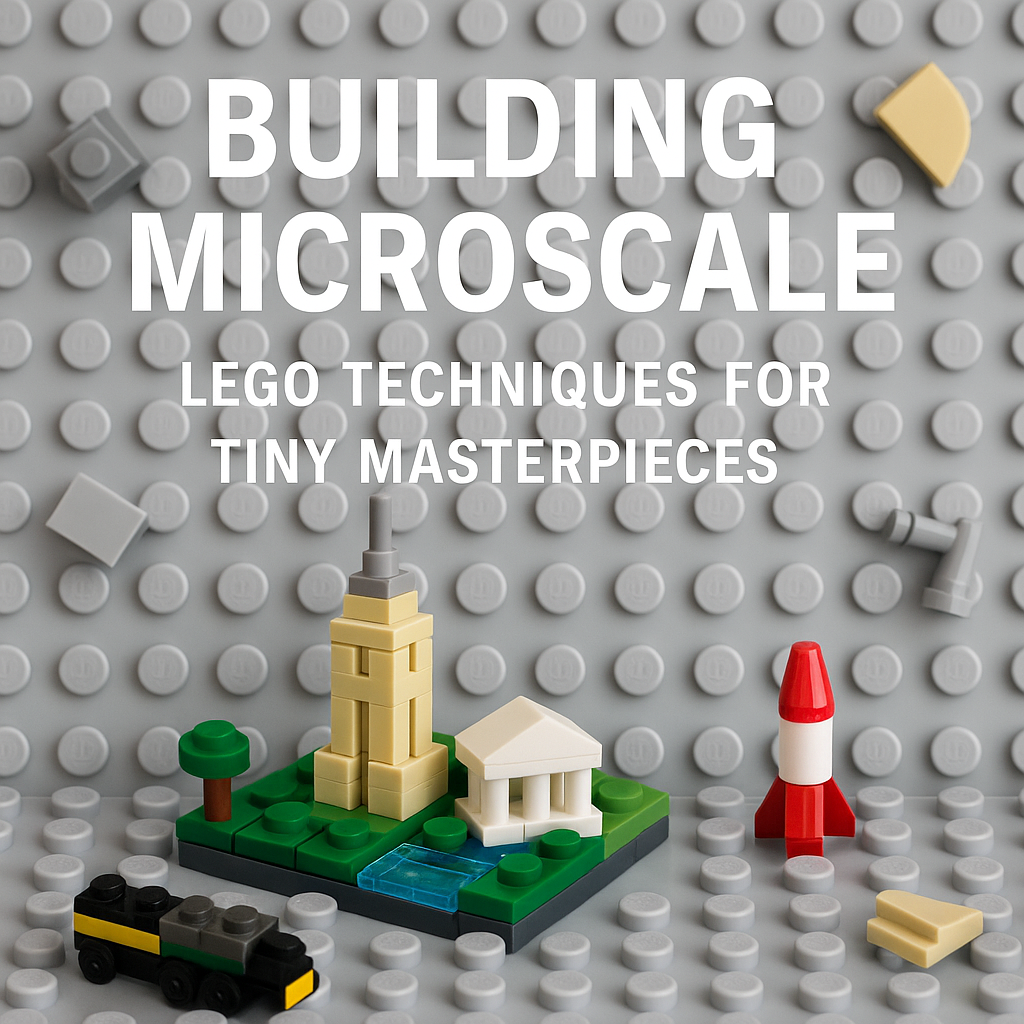
Master detail at a miniature size. That’s the ultimate challenge and reward of microscale Lego building – creating recognizable, detailed structures using minimal pieces while maintaining proper proportions and visual impact. Welcome to the first installment of our Scale Building Mastery series, where we’ll explore the technical artistry that transforms handfuls of bricks into breathtaking miniature worlds.
Microscale building represents one of the most disciplined and creative approaches to Lego construction. Unlike minifigure-scale builds that accommodate the 4-stud-wide minifigure standard, microscale creations compress entire buildings, vehicles, or landscapes into compact forms where individual pieces must work exponentially harder to convey detail and character. This isn’t just about building smaller – it’s about reimagining how every element, color choice, and advanced building technique can contribute to a cohesive miniature vision.
Why Build Microscale?
Building microscale offers advantages that extend far beyond space constraints. Cost-effectiveness stands as the most immediate benefit – creating impressive cityscapes, starship fleets, or medieval kingdoms requires significantly fewer pieces than their larger counterparts. This accessibility opens advanced building techniques to enthusiasts working with modest collections or limited budgets.
Space efficiency becomes crucial for adult builders managing display areas in homes or offices. A microscale city can showcase architectural diversity, urban planning concepts, and creative building solutions within the footprint of a standard baseplate, while equivalent minifigure-scale constructions would require entire rooms.
The creative discipline imposed by severe part limitations forces innovative problem-solving. Every piece placement becomes intentional, leading to breakthrough moments where builders discover new applications for familiar elements. This constraint-driven creativity often produces techniques that revolutionize larger-scale building approaches.
Popular microscale communities have emerged around contest themes like Micropolis (a collaborative city-building standard), Micro Space competitions, and various online challenges. These communities share techniques, celebrate innovations, and maintain quality standards that push the artistic boundaries of what’s achievable at tiny scales.
Core Principles of Microscale Building
Scale & Proportion
Successful microscale building requires establishing consistent scale relationships. A common approach treats each stud as representing approximately 8-10 feet in real-world measurements, though this can vary based on subject matter and available pieces. The key lies in maintaining internal consistency – if a door uses a 1×1 tile, windows should scale proportionally rather than defaulting to the same piece size.
Reference study becomes essential. Examine real architecture, vehicles, or landscapes to understand proportional relationships between elements. A cathedral’s spire should dominate its nave, castle walls should appear substantial compared to interior buildings, and starship engines should suggest the power necessary for their vessel’s size.
Abstraction & Suggestion
Microscale mastery involves suggesting detail rather than literally representing every feature. A single brown 1×1 round tile might represent an entire clock tower, while strategic color layering can imply window patterns across building facades. This principle of visual suggestion allows viewers’ minds to fill in details that individual pieces cannot physically provide.
Consider how silhouette contributes to recognition. The distinctive profile of a lighthouse, church spire, or rocket ship can be more important than surface detailing. Focus on capturing characteristic shapes that make structures immediately identifiable.
Color Depth & Contrast
Microscale builds live or die by their color choices. With limited surface area, every visible surface must contribute to the overall visual narrative. Contrast becomes crucial for defining separate elements – light gray walls against dark gray rooflines, bright colors for accent features, and strategic use of transparent pieces for windows or water effects.
Texture representation through color variation can suggest materials without explicit detailing. Mixing light and medium gray pieces implies stone construction, while brown and tan combinations suggest wood or adobe materials.
Essential Techniques & Advanced Methods
Strategic Parts Selection
Studs-Not-On-Top (SNOT) techniques prove invaluable for microscale work. Understanding SNOT building methods becomes essential as builders seek to eliminate visible studs that can overwhelm tiny constructions. Cheese slopes (1×1 slopes at 30-degree angles), clips, bars, and minifigure accessories offer smooth surfaces and interesting geometric possibilities.
“Illegal” techniques – building methods that stress parts beyond their designed intentions – appear frequently in advanced microscale work. While these approaches can create stunning results, they typically sacrifice structural integrity. Use them for display models rather than play-ready constructions, and always test joint stability.
Micro-element innovation transforms everyday pieces into specialized components. Minifigure hair pieces become architectural details, weapon accessories suggest industrial equipment, and plant elements can represent anything from trees to communication arrays.
| Traditional Use | Microscale Application |
|---|---|
| Minifig hair pieces | Dome roofing, decorative elements |
| Weapon accessories | Industrial details, antennae |
| Plant stems | Trees, communication towers |
| Cheese slopes | Smooth wall surfaces, terrain |
Landscape & Structural Techniques
Multi-level layering creates topographical complexity essential for convincing landscapes. Start with a foundation layer establishing basic elevation changes, then add successive layers that build terrain features. Use a combination of plates and bricks to achieve varied heights without creating step-like artifacts.
Water and transparent effects require careful consideration at microscale. Transparent blue plates work excellently for small water features, while trans-clear pieces can suggest glass surfaces or crystal formations. Layer transparent pieces with underlying colors to create depth and variation in water bodies.
Forced perspective can make microscale builds appear larger and more detailed than their actual piece count suggests. Place larger, more detailed elements in the foreground while simplifying background features. This technique proves especially effective for cityscapes where foreground buildings receive more detail than distant structures.
Vehicle and Character Representation
Creating recognizable vehicles at microscale requires identifying each vehicle’s most characteristic features. For spacecraft, focus on engine configurations and overall silhouette. For automobiles, emphasize proportional relationships between body and wheel elements.
Minifigure substitutes can suggest populated areas without overwhelming the scale. Single 1×1 round plates or tiles can represent people, while colored dots scattered strategically imply crowds or activity. Alternatively, avoid human representations entirely and let environmental details suggest habitation.
Structural Integrity Solutions
Microscale builds face unique stability challenges due to their high surface-area-to-connection ratio. Overlap techniques become crucial – ensure multiple connection points between major sections, and avoid relying on single-stud connections for critical structural elements.
Internal armatures can provide hidden support for delicate constructions. Use technic beams or brick frameworks inside large structures to provide stability that surface-mounted elements cannot achieve alone.
Case Study: Micro Medieval Castle
Let’s examine building a simple medieval castle to illustrate these principles in practice:
Foundation (8×8 baseplate):
- Green baseplates for surrounding landscape
- Gray 2×2 and 2×4 bricks for basic keep structure
- Dark gray for tower bases
Defensive Features:
- 1×1 cones in dark gray for tower tops
- Battlements using 1×1 bricks with intermittent gaps
- Brown elements suggesting wooden gate structures
Environmental Details:
- Trans-blue 1×1 round plates for moat water
- Green 1×1 round plates scattered for vegetation
- Tan elements for pathways and courtyards
Scale Consistency:
- Keep walls: 3 bricks high (approximately 24 feet)
- Towers: 5-6 bricks high with cone tops
- Courtyard spaces proportional to wall heights
This build demonstrates proper scaling relationships, effective color usage, and structural techniques appropriate for microscale work.
Inspiration Gallery
Castle Grayskull Micro (by Builder Unknown): This 6×6 stud creation captures the iconic Eternia fortress using primarily gray slopes and carefully placed accent colors. The builder’s use of symmetry and forced perspective makes the structure appear much larger than its actual footprint.
Microscale Star Destroyer Fleet: Multiple builders have tackled Imperial Star Destroyers at various micro scales. The most successful versions focus on the distinctive triangular silhouette and strategic placement of detail elements rather than attempting to replicate every surface feature.
Victorian Cityscape Series: Several community builders have created interconnected Victorian street scenes where individual buildings occupy 4×4 or 6×6 spaces. These builds excel at suggesting architectural details through color variation and strategic use of specialized pieces like lattice windows and decorative slopes.
Space Station Complex: Advanced builders have created rotating space habitats and industrial facilities that demonstrate sophisticated engineering at microscale. These builds often incorporate moving parts and lighting effects that enhance their visual impact.
Each of these examples demonstrates the power of focused design intent, consistent scaling decisions, and innovative part usage that defines excellent microscale building.
Common Pitfalls & Troubleshooting
Over-detailing represents the most frequent mistake in microscale building. Attempting to include every real-world feature results in cluttered, confusing constructions that lose visual coherence. Focus on 3-4 key recognizable features rather than comprehensive detailing.
Scale inconsistency destroys believability even in fantasy constructions. If your castle gate uses a 2×2 space, don’t place 1×1 windows that would accommodate giants. Establish scale relationships early and maintain them throughout the build.
Weak structural connections plague ambitious microscale projects. Test stability regularly during construction, and don’t hesitate to redesign sections that depend on precarious connections. A slightly less detailed but stable build always outperforms a fragile masterpiece.
Color overwhelm can make microscale builds appear chaotic rather than detailed. Limit your primary color palette to 3-4 colors plus appropriate accent shades. Remember that at microscale, colors need to work harder to define distinct elements.
When troubleshooting problem areas, step back and view your build from typical display distance. Details that seem crucial during hands-on construction may be invisible from normal viewing positions, while elements that appear minor up close might dominate the overall composition.
Practical Tips and Next Steps
Getting started requires assembling an appropriate parts collection. Focus on small elements: 1×1 pieces in various forms, cheese slopes, small slopes, plates, and tiles. Bulk lots from online marketplaces often provide better value than individual piece purchases, though you’ll need to sort and organize acquisitions.
Color-specific ordering through Pick-A-Brick services or Bricks & Pieces allows targeted expansion of your microscale palette. Prioritize neutral colors (grays, browns, tans) for structural elements and select bright colors for accent and identification purposes.
Building for photography enhances microscale builds’ impact when sharing with communities. Use proper lighting to emphasize texture and depth, and consider background elements that complement rather than compete with your constructions. Simple backgrounds often work better than elaborate setups.
Contest preparation can motivate skill development and provide community feedback. Many online communities host regular microscale challenges with specific themes or constraints. Participating builds technical skills while connecting you with other enthusiasts who share advanced techniques and innovative approaches.
Our upcoming Scale Building Mastery installments will explore minifigure-scale architecture, forced perspective techniques for dramatic displays, and advanced integration methods for mixing scales within single presentations. Each installment builds on previous concepts while introducing new technical challenges and creative possibilities.
Conclusion
Microscale building transforms limitation into liberation. By embracing the creative constraints of minimal pieces and compressed scales, builders discover innovative techniques, develop refined aesthetic judgment, and create impressive displays within practical space and budget requirements. The technical skills developed through microscale work enhance all aspects of Lego building, while the creative problem-solving approaches transfer to numerous other applications.
Your microscale journey starts with a single small build. Choose a simple subject, establish consistent scaling decisions, and focus on capturing essential characteristics rather than comprehensive details. Share your creations with the community using #BricksBlocksMicro – we’d love to see your innovative approaches and creative solutions.
Ready to explore the next level? Join our newsletter for the latest scale building tutorials, community showcases, and exclusive building challenges that will push your skills to new heights.