For years, a flat concrete roof meant a staircase of full blocks and a lot of compromise. You could get the colour you wanted or the profile you wanted, but rarely both. Anyone who has tried to shade a modern roofline in vivid concrete knows the frustration of that chunky, stepped edge.
That has changed. Concrete and wool now come as stairs and slabs in all 16 colours, and the difference to how you can build is bigger than a tidy new recipe list might suggest. Here is how to get them, how wool and concrete differ in practice, and the techniques that make the most of them.
If you want the wider context of the update, the Dappled Forest guide covers the biome, the new wood and the Abandoned Camp. This post stays firmly on the palette.
This post may contain affiliate links. As an Amazon Associate I earn from qualifying purchases.
🧱 What Actually Shipped
Wool stairs, wool slabs, concrete stairs and concrete slabs arrived with the Wilderness Bound drop. The Minecraft Wiki lists the update as Java Edition 26.3 and Bedrock Edition 26.50, with a release date of 15 September 2026.
Each family covers all 16 colours. That means 64 new block variants in total: 16 wool stairs, 16 wool slabs, 16 concrete stairs and 16 concrete slabs.
Builders have wanted this for an obvious reason. Concrete is the most saturated, cleanest-looking block in the game, and until now its only shape was the cube. Every curve, pitch and overhang had to be faked with other materials or left blocky.
It is worth saying plainly what this post is not. It is not a patch-notes recap. It is about what the new blocks let you build.
🛠️ How to Get Them
Both families are crafted, and if you build in Creative mode they should also be available from the inventory, although I could not confirm that placement from the official pages. Check recipe yields in-game on your own version, because sources differ on exact counts.
Concrete
The route to concrete is the one you already know.
- Combine dye, sand and gravel to make concrete powder.
- Place the powder next to water and it hardens into concrete.
- Craft the hardened block into stairs or slabs using the standard stair and slab patterns, or cut it in a stonecutter.
The Minecraft Wiki confirms that concrete stairs and slabs can be made either at a crafting table or in a stonecutter. Only hardened concrete works. Powder will not do.
Wool
Wool stairs and slabs are crafted directly from matching wool, following the usual stair and slab shapes. The wiki documents the stonecutter route for concrete but not for wool, so assume the crafting table for wool unless you find otherwise in-game.
Wool also carries a quirk that builders will notice. The wiki notes that the new wool pieces dampen sound, just like wool blocks and carpets.
A practical tip on resources
Where a stonecutter route exists, it is worth testing it against the crafting table for material cost. If you are working at scale, say a full roof in a single colour, that comparison can save a lot of concrete. If you are building in Creative, none of this matters and you can simply pull what you need.
⚖️ Wool vs Concrete: Choosing Your Material
Both families come in the same 16 colours, so the choice is rarely about hue. It is about finish.
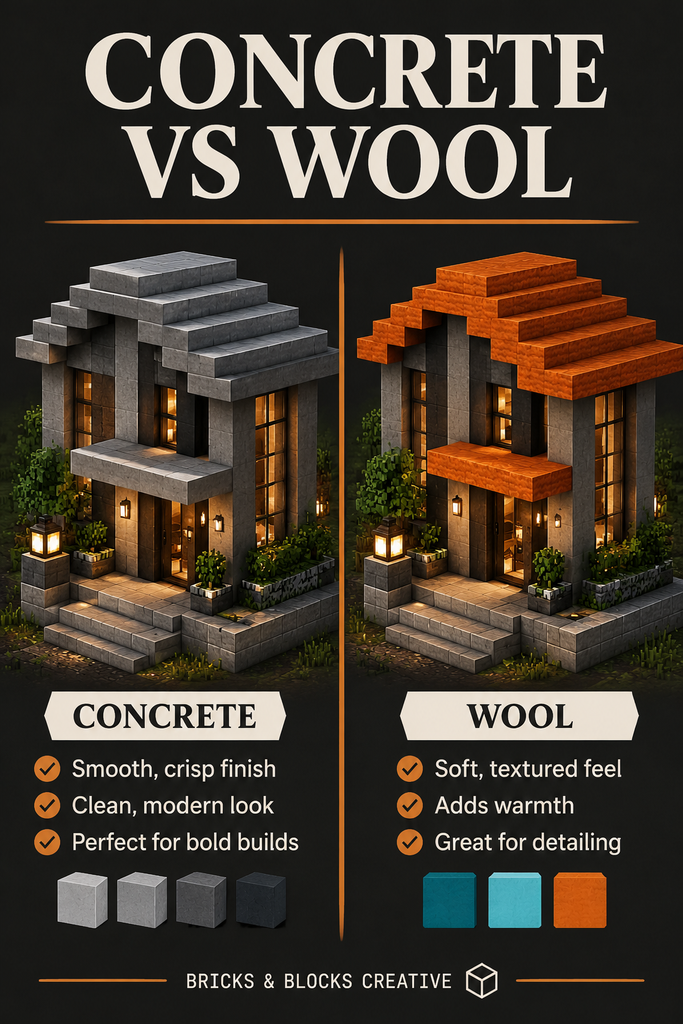
Concrete
Concrete gives you a flat, uniform, almost painted surface. There is no pattern to break up a large area, which is exactly why it suits crisp, architectural work.
Use it when you want:
- Clean modern facades with hard edges
- Roof surfaces that read as one solid tone
- Brutalist massing where the shadow does the work
Wool
Wool has a soft, textile-like grain. In a big run it looks warmer and slightly worn, which makes it better where you want a lived-in feel.
Use it when you want:
- Awnings, canopies and fabric-style roofing
- Interior seating, soft furnishings and bedding
- Colour that sits comfortably beside natural materials like wood
Mixing the two
The most interesting results come from using both in one build. A concrete shell with wool awnings and soft furnishings gives the contrast between hard structure and soft cover that real buildings have.
Keep one rule in mind. Pick two or three dominant tones for any one structure, then use the rest of the 16 colours sparingly as accents. The temptation with a full spectrum is to use all of it, and the result is usually busier than it needs to be.
🏠 Technique One: Smooth Roof Gradients
This is the headline use. A pitched roof built from full blocks has a stepped silhouette no matter how you stack it. Stairs fix that.
Build the roof in stairs and use slabs to fill the half-height gaps at the ridge and the eaves. The profile reads as a continuous slope from a few blocks away.
For a gradient effect, shift colour in bands as the roof rises. Two neighbouring shades work better than a leap between opposites. Light grey into grey into black, or a run of blues, gives a convincing weathered or shaded look without any texture pack.
Slabs are the quiet hero here. A slab course along the lowest edge of the roof gives a clean fascia line, and a slab course along the ridge gives a sharper cap than any full block can.
If you are new to roof shaping in general, the fundamentals in our Minecraft building fundamentals guide still apply. The new blocks change the material, not the geometry.
🏢 Technique Two: Modern and Brutalist Facades
Concrete’s flat finish makes it a natural fit for modern architecture, and the new shapes let you do what real concrete buildings do.
Cantilevers and overhangs
A slab laid on the underside of a floor plate gives you a thinner, more convincing overhang than a full block. Combined with a stair on the leading edge, you can create a chamfered corner that reads as poured concrete.
Depth through shadow
Brutalist work depends on shadow. Set windows back by half a block using slabs, add slab ledges between floors, and use stairs to bevel the tops of columns. The light does the rest.
Restraint
The best concrete facades use very few colours. A single grey with a darker grey for the plinth, and one accent colour on a door or an awning, will look more considered than a rainbow of options.
For inspiration on translating real buildings into blocks, our guide to recreating real architecture in Minecraft walks through the process step by step.
⛰️ Technique Three: Smooth Slopes and Ramps
Terrain is where half blocks have always been a builder’s best friend, and these blocks extend that to a wider palette.
A stepped ramp built from stairs and slabs gives you a gentle, walkable slope. Alternate slab and stair along a path and you get a gradient that rises evenly instead of in sharp one-block jumps.
This works for:
- Accessible ramps leading up to a building entrance
- Sunken plazas and raised banks
- Sculpted terrain features in a built-up area, such as a stylised hillside in a single colour
Wool is worth considering here for anything that should feel soft, like a grassy bank dyed in greens, while concrete suits hard landscaping such as plazas, steps and retaining walls.

🪑 A Quick Note on the Soft Furnishings
Cushions and straw beds arrived in the same update. In brief, cushions can be found in abandoned camps or crafted from three wool slabs of the same colour, while straw beds are crafted from three hay bales.
That connection is useful, because it means the new wool slabs feed straight into your interiors. This post does not go further into furniture. For that, see our interior design guide for how to make a space feel lived-in.
⚠️ What Is Still Missing
The new family is welcome, but it is not complete.
Two gaps stand out for builders. The first is concrete walls. The second is terracotta stairs and slabs. A modded source suggested these were absent, and none of the official or wiki pages I checked mention either as part of the update.
That is not proof either way. Please test both in-game before you plan a build around them, as availability may differ between versions.
It is also worth being careful with Java and Bedrock. Both editions list the new stairs and slabs, but the Bedrock page I checked did not cover recipe details or the Creative inventory. If you play across both, confirm the recipes on the edition you are building in.
🎨 Putting It Together: A Simple Starting Palette
If you want to try the blocks without overthinking colour, start small.
- Choose a main concrete colour for walls and roof.
- Choose one darker shade of the same family for the plinth and roof cap.
- Choose one wool accent for awnings or a sheltered seating area.
Build a small structure, around a ten by ten footprint, and use stairs and slabs wherever you would previously have used a full block. Look at it from ground level and from above. The silhouette will tell you very quickly how much the new shapes change the feel of a build.
From there, add a gradient to the roof and a setback to the facade. By the time you have done both, you will have a clear sense of which material suits your style.
🏁 Final Thoughts
Stairs and slabs in concrete and wool do not just fill a gap in the block list. They change what is practical to build, particularly for roofs, facades and sloped paths where a full block was always the weak link.
Use concrete when you want a crisp, architectural surface and wool when you want warmth and texture. Keep your palette tight, lean on slabs for fine detail, and test the gaps before you commit to a plan.
The most useful thing you can do next is open a Creative world and build one small roof in a gradient. It will take ten minutes, and it will probably change how you approach your next big project.