Every Minecraft builder eventually hits the same wall with tropical builds: default to jungle green and the whole thing reads as “generic warm biome” instead of anything specific. The fix is picking one material and building your entire visual language around it. For tropical and beach builds, that material is bamboo.
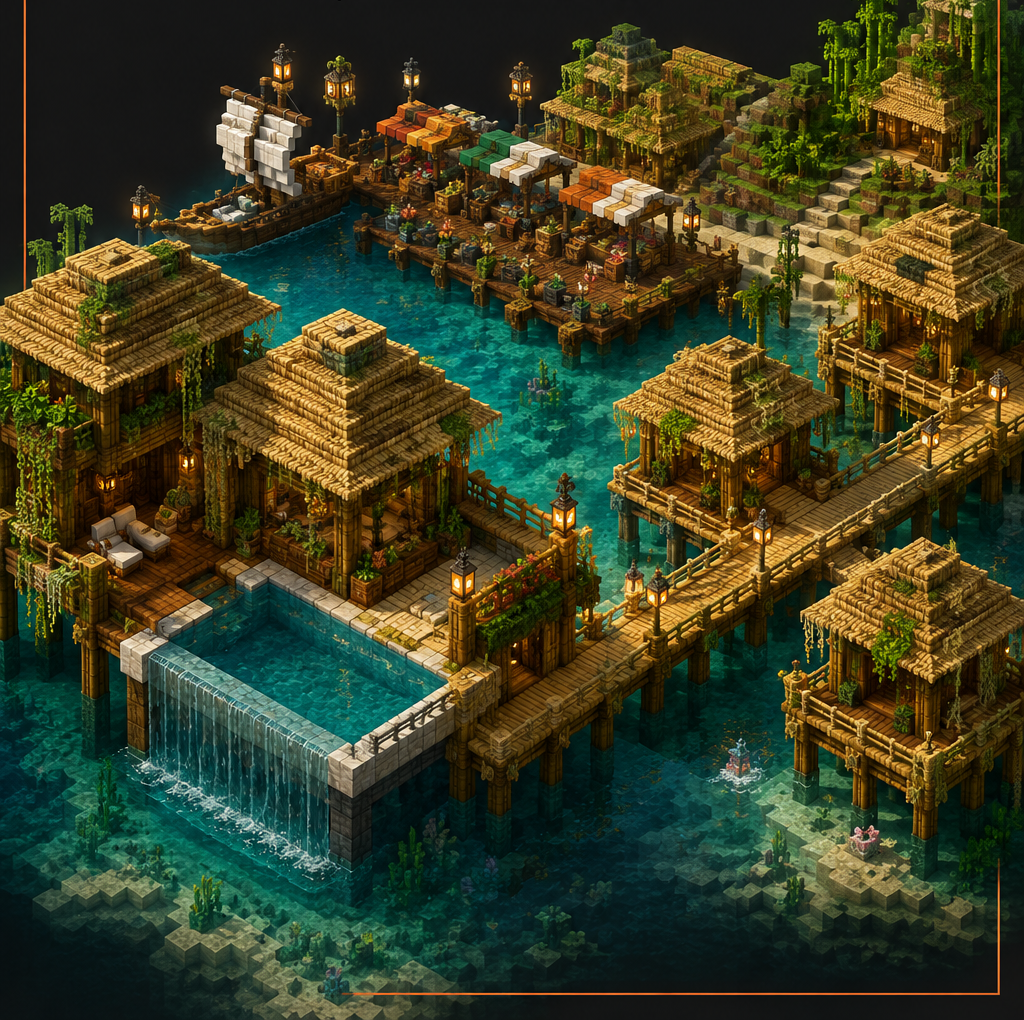
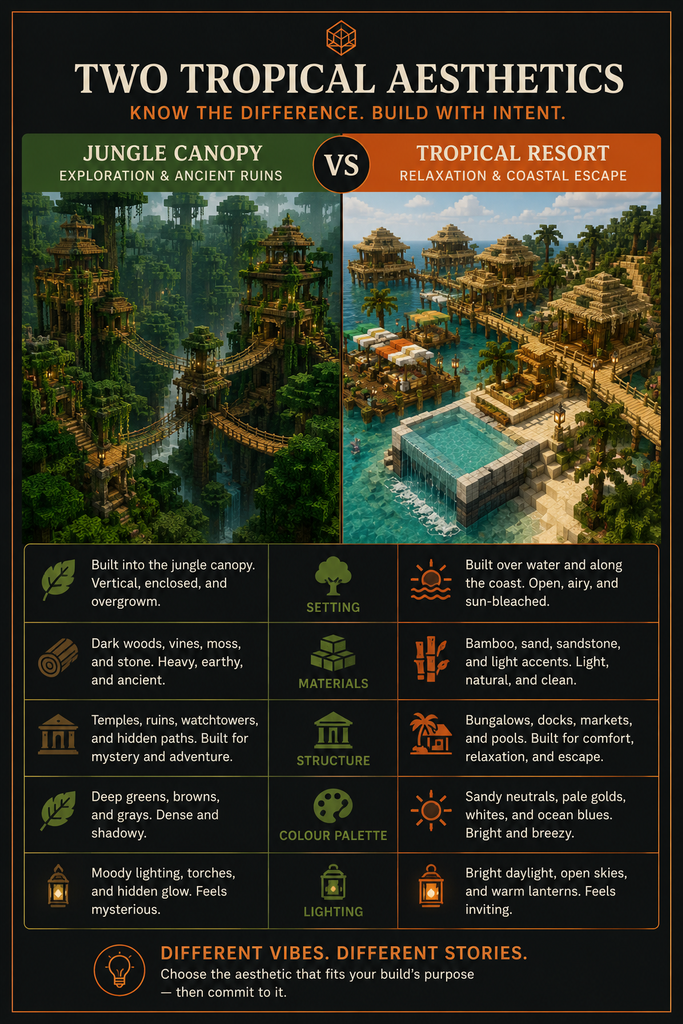
This isn’t the canopy-city, temple-ruin take on tropical building. This is open coastal resort work: overwater bungalows, market docks, sun-bleached walkways, the kind of build that reads as a getaway rather than an expedition.
🎋 Why Bamboo Carries the Tropical Look
Bamboo does for tropical builds what copper does for industrial ones and deepslate does for gothic ones. It’s the one material that instantly reads as “this location” before a viewer processes anything else in the frame.
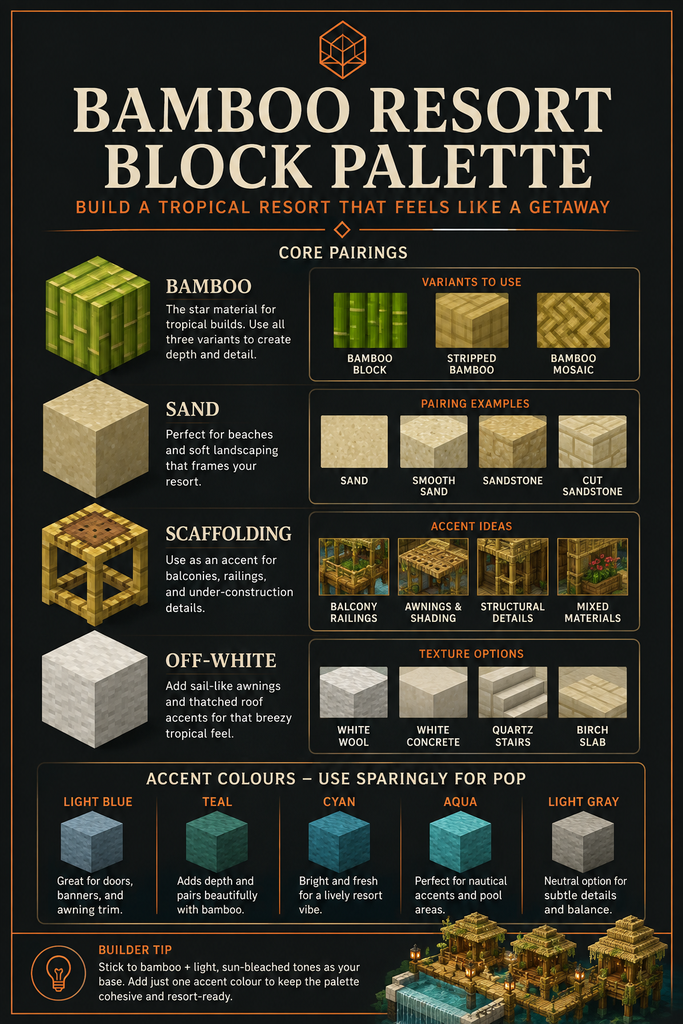
Three variants do most of the work:
- Raw bamboo blocks for structural framing and scaffolding-style supports, giving that lashed-together beach-hut texture
- Stripped bamboo blocks (made by axing a bamboo block) for a cleaner, pale look on walls and flooring where you want less visual noise
- Bamboo mosaic for decorative flooring, ceilings, and trim, since its diagonal weave pattern is unique among wood types and reads instantly as woven matting
Bamboo also grows fast, which matters more than it sounds like it should. A tropical resort build is usually large, and running back to a jungle biome for materials every twenty minutes kills momentum. Set up a farm before you start building anything else.
🏝️ Setting Up a Bamboo Farm Before You Build
The fastest reliable setup is a simple gravity farm: plant bamboo stalks against a wall with a two-block gap above, and let them grow until they hit the height limit and pop off, dropping into a collection point below. No redstone is required for a basic version, though adding a hopper-and-chest collection point at the base saves a lot of manual pickup once you’re building at resort scale.
Plant several stalks in a row rather than just one or two. A resort complex will burn through more bamboo than a single hut, especially once you’re mosaic-flooring entire walkway networks.
⛱️ Resort Complex Design: Bungalows, Pools, and Roofing
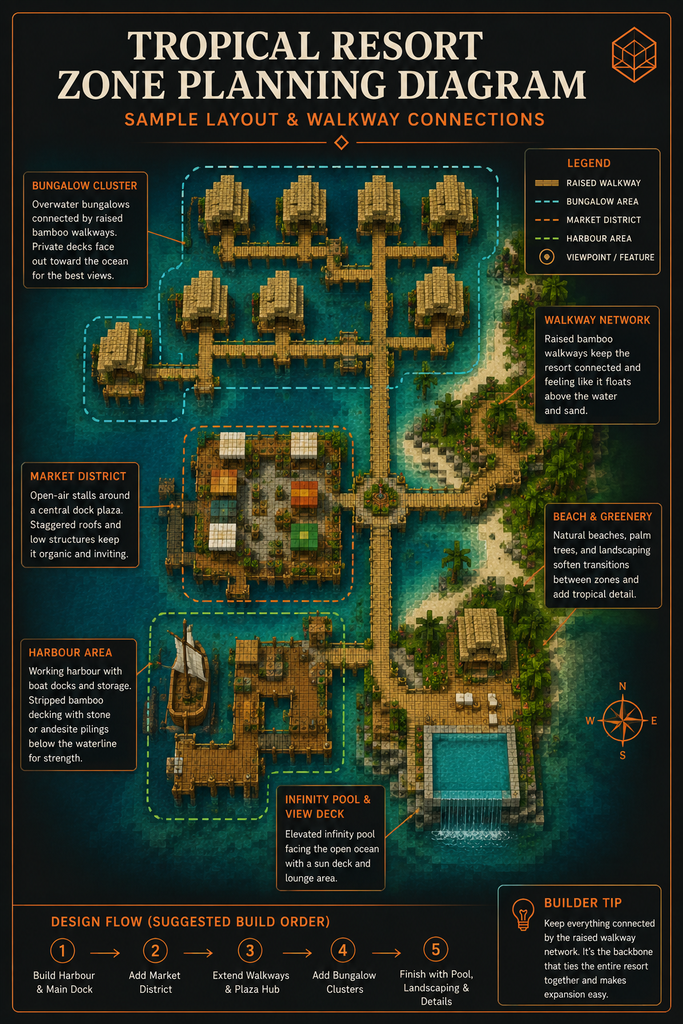
Overwater bungalows are the centrepiece of most tropical resort builds, and they work best raised on stripped bamboo or spruce piling over shallow water, connected by a raised bamboo walkway rather than placed directly on the seabed. Keep the roofline low and wide using stairs and slabs in bamboo or an off-white wool for a thatched effect, since a steep roof reads more alpine than tropical.
Infinity pools are easier than they look. Build a raised platform pool using water source blocks contained by a one-block-high lip, then drop the outer edge away sharply so the water appears to spill toward the horizon. Placing the pool at the edge of your build facing open ocean sells the effect far better than a pool tucked mid-complex.
For roofing texture beyond flat bamboo, mix in a small amount of dried kelp block or hay bale in muted tones for a genuinely woven-thatch look, rather than relying on bamboo alone for every roof on the build.
🌊 City Planning: Walkways, Markets, and Harbours
Once you’re past a single bungalow, tropical builds live or die on circulation. Raised bamboo walkways connecting bungalow clusters read better than ground-level paths, since they keep the whole complex feeling like it floats just above the water and sand rather than sitting on it.
A market district works well anchored around a central dock, with open-air stalls built from bamboo fences and trapdoors (angled as awnings) rather than fully enclosed shops. Keep stall roofs low and staggered in height so the district reads as organic rather than gridded.
Harbour structures benefit from a mix of stripped bamboo decking and stone or andesite pilings below the waterline, since a harbour that’s bamboo all the way down looks flimsy rather than functional. Save the raw structural stone for anything actually touching the seabed, and let bamboo take over above the waterline.
🎨 Colour Palette and Block Pairing
Bamboo’s natural pale gold-green tone pairs best with:
- Sand and sandstone, for beaches, paths, and foundation work that reads as sun-bleached rather than muddy
- Scaffolding, used sparingly as an accent rather than a full material, for that under-construction beach-hut texture on balconies and edges
- Off-white wool or white concrete, for sail-like awnings and thatched roof accents
- A single accent colour (light blue or teal terracotta works well) on doors, banners, or awning trim to keep the palette from reading flat
Avoid mixing in dark oak or spruce as a primary material. Both read as jungle-canopy or cabin, and pull the build back toward the aesthetic this approach is deliberately avoiding.
🌴 How This Differs From Jungle Biome Building
Our jungle biome guide covering canopy cities and temple complexes leans into density: tall canopy cover, stacked platforms, ruins reclaimed by vines. Tropical resort building is the opposite instinct. It wants open sightlines, low rooflines, and water as a visual anchor rather than something to build around or over.
If you’re building near an ocean biome already, our guide to underwater domes and sea fortresses is a useful companion for anything below the waterline, and our breakdown of water features across every biome covers infinity pool and fountain mechanics in more depth than we’ve gone into here.
Quick Reference: Crafting and Block IDs
For readers building from this guide directly in-game:
- Bamboo block: craft with 9 bamboo in a crafting grid
- Stripped bamboo block: use an axe on a placed or held bamboo block
- Bamboo mosaic: craft from bamboo slabs in a crafting grid
- Bamboo mosaic slab and stairs: standard slab/stair crafting recipes using bamboo mosaic or bamboo planks as the base material
None of this requires a specific game version beyond the update that introduced bamboo blocks and mosaic, so it’s safe to build this way on any current Java or Bedrock world.