There is something uniquely compelling about the Minecraft jungle biome in spring. After months of cold biome builds — stone fortresses, snow-capped keeps, the monochrome drama of frozen tundra — dropping into a dense, humid jungle feels like an exhale. Everything here is loud with colour: the deep jade of oak and jungle leaves, the pale jade of bamboo, the warm amber of jungle wood, the persistent creep of vines over absolutely everything you build. It is messy in the best possible way, and that messiness is your greatest creative advantage.
This guide is for builders who want to stop fighting the jungle and start working with it. Whether you are planning a suspended canopy city woven between ancient trees or a multi-structure temple complex slowly being reclaimed by the forest, the techniques and principles here will help you build something that feels genuinely alive. The jungle rewards patience, verticality, and a willingness to treat nature as a co-designer rather than an obstacle to be flattened.
Understanding the Jungle Palette
Before placing a single block, it is worth spending time really reading what the jungle gives you. This is not a biome for clean, uninterrupted surfaces — and that is actually a gift.
The core building palette breaks down naturally into three layers:
- Warm woods: Jungle log, jungle planks, and stripped jungle log for structural and flooring work; bamboo blocks and stripped bamboo for lighter, brighter accents
- Living greens: Jungle, oak, and azalea leaves for canopy fill and roofing; moss blocks and moss carpet for ground cover; vines as free texture, verticality, and narrative
- Aged stone: Stone bricks in all four variants (regular, mossy, cracked, chiselled), mossy cobblestone, and cobblestone for temple and ruin work
Jungle Biome Palette
Spring / growth framingThe spring angle comes from emphasising the growth end of this palette rather than the decay end. Most builders default to the moody, overgrown-ruin reading of the jungle, and while that is certainly valid, there is an equally interesting approach that leans into brighter greens, deliberate flower placement (azaleas, flowering azaleas, tulips in jungle clearings), warm amber lighting from lanterns and torches, and water features that suggest the jungle is being nourished rather than just getting waterlogged.
Working with the Colour Story
A jungle build reads as spring rather than decay when you treat your colours with intention. Use bamboo blocks and stripped bamboo logs in sections where you want warmth and lightness — the contrast between the pale bamboo and the deep jungle wood is striking. Introduce moss carpet on horizontal surfaces rather than letting vines cover everything vertically. Let azalea bushes cluster at the bases of trees and along pathway edges. Hang glow berry vines in canopy interiors where you want a warm, dappled light effect that reads as light filtering through a forest canopy.
The colour trap to avoid is defaulting to grey. Stone bricks, cobblestone, and mossy stone are essential for temple work, but if more than 60% of your palette is grey-brown stone, the build stops reading as jungle and starts reading as a dungeon with plants. Keep your stone anchored by constant intrusions of green — moss in cracks, leaf blocks overhead, fern clusters at the base of walls.
Canopy Cities: Building Vertically
The single most important principle in jungle building is build up, not out. The jungle floor is dense, navigable only with significant terraforming effort, and aesthetically it is your least interesting layer. The canopy — 15 to 25 blocks above the forest floor, where the crowns of the giant jungle trees break into open air — is where the magic lives.
Think of a canopy city as a vertical village. Each tree is a tower. Each bridge between them is a street. Every suspended platform is a neighbourhood. The jungle provides the infrastructure; you provide the inhabitants and the story.
For inspiration and broader context, the complete guide to Minecraft biomes is a useful reference for how jungle resources and geography fit into the wider world — particularly if you are planning to connect your jungle build to other biome settlements.
Vertical Navigation Layers
Canopy city cross-section · click any elementStarting Your First Canopy Platform
Find a large jungle tree — ideally one of the four-trunk giant variants — and establish your first platform at the canopy break point, roughly at the height where the tree’s crown begins to spread. Do not just place a flat grid of planks. Instead, trace the shape of the tree’s existing canopy, let the platform follow the irregular natural outline of the branches, and cut into the crown rather than sitting on top of it.
Use jungle logs as the structural beams, extending horizontally from the trunk. Layer jungle planks and slabs for the platform surface, and introduce trapdoor detailing on the underside to break up what would otherwise be a flat ceiling visible from below. Fence posts and leaf blocks serve as railings, keeping the platform feeling airy and integrated into the canopy rather than planted on top of it. A single large platform works best when divided into distinct zones:
- Covered living area — enclosed enough to feel like shelter, with interior furnishings
- Open observation deck — exposed to the canopy, with clear sightlines across to adjacent trees
- Small farm nook — cocoa pods, melon vines, or bamboo tucked into railing planters
- Rope ladder access point — the vertical connection down to ground level
The character of each zone motivates your subsequent bridge connections, because the next tree you link to should logically serve a different purpose.
Bridge Networks and Expansion
Once your anchor platform is established, the city grows organically through bridge connections. Rope-style bridges work beautifully: a central spine of spruce or jungle slabs, with fence posts as posts and string or trapdoors to suggest rope rails. Keep bridges slightly curved if you have the blocks to spare — a bridge that bows gently downward in the centre reads as suspended rather than rigid, which sells the canopy-city illusion.
Each tree your bridges connect to should serve a different function. Good options for dedicated node purposes include:
- Bamboo farm tower — a tall, narrow platform with bamboo growing to full height, providing both resources and visual drama
- Enchanting pavilion — open-sided, hung with glow berry vines, with an enchanting table at the centre
- Lookout post — wrapped with leaf blocks for camouflage, with a clear view over the canopy
- Guest platform — simple but distinct interior, implying the city is inhabited by more than one person
- Suspended garden — hanging planter boxes with flower pots, melon and cocoa farms, and bamboo clusters in the railings
The approach to canopy navigation in the jungle biome overlaps closely with the broader forest treehouse tradition — if you have already built in that direction, the forest biome treehouse and woodland architecture guide covers comparable techniques that translate well to jungle scale.
Living Within the Trees
The best canopy cities use the native shape of the trees rather than cutting them back. This is both aesthetically rewarding and a useful constraint: if you commit to working around existing branches rather than removing them, you end up with layouts that are genuinely organic rather than a grid suspended in mid-air. Let vines drape over walkways rather than trimming them. Let leaf blocks intrude into interiors at the edges — a room with leaves pressing against one wall feels embedded in the canopy, whereas a fully sealed room just feels like a treehouse that forgot where it was.
Ground level deserves attention too, even if you are primarily a canopy builder. A rope ladder or staircase down from your main platform, a small dock along a river if your jungle has one, a modest ground-level storage structure — these anchor the city in its terrain and give it a sense of having grown from the ground up rather than been dropped in from above.
Temple Complexes: Ruins Waking Up in Spring
The vanilla jungle temple is a deliberately humble structure — three floors of stone brick, a simple puzzle, some modest treasure. It is a seed, not a destination. The real creative opportunity is building a full temple complex around it, or from scratch, using the same formal vocabulary of stepped stone, mossy overgrowth, and hidden depths.
The most effective framing for a spring jungle temple isn’t abandonment — it’s reclamation that is still in progress. The jungle hasn’t finished swallowing these structures. It has moved in, taken up residence, and started adapting them for new purposes. That reading gives you permission to mix crumbling stone and living growth without the build tipping into pure ruin territory.
Before beginning any large temple project, it is worth considering how the terrain around it will work. The terraforming guide covers the principles of reshaping biome terrain that apply directly to creating the raised plateau, cleared sightlines, and approach paths a temple complex needs to feel properly monumental.
Temple Complex Layout
Top-down schematic · click any elementThe Temple Palette and Massing
Stone bricks are your foundation — regular, mossy, cracked, and chiselled, used in deliberate proportion. A surface with too much regular stone reads as new construction. A surface with too much mossy stone reads as uniform decay. The most convincing aged stonework mixes all four variants, with cracked and mossy variants concentrated at lower levels and around water exposure, and regular stone and chiselled details at upper levels and corners where the structure has been better preserved.
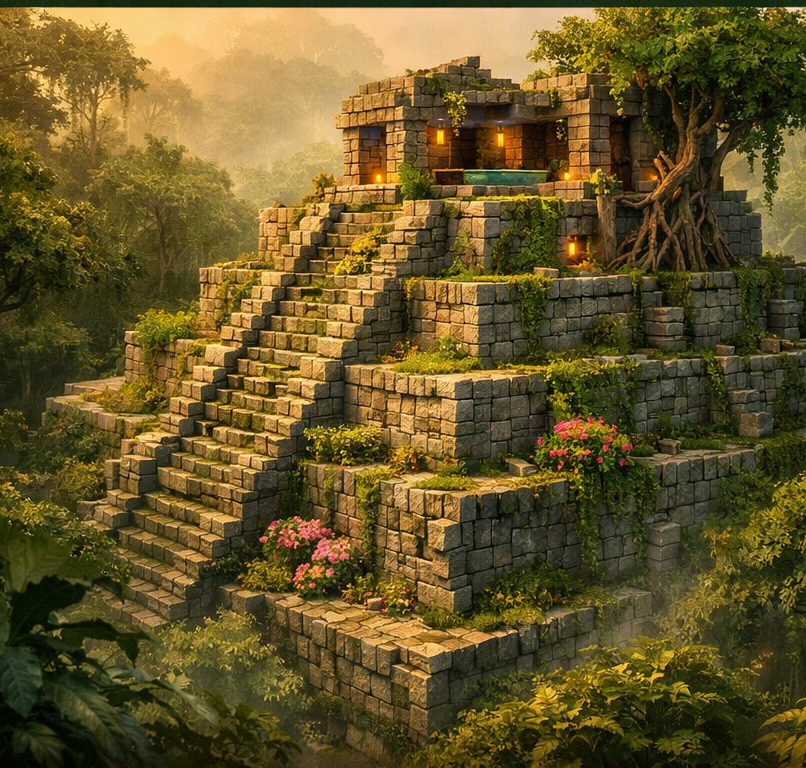
The formal vocabulary is Mayan-inspired stepped pyramid: wide base, receding terraces, a flat summit platform. Each terrace should be at least three blocks tall to give you enough height for meaningful architectural detail — arched doorways using stair blocks, window niches, bas-relief decoration using chiselled stone bricks. The stepped profile is what distinguishes a serious jungle temple from a stone hill with a door in it.
Breaking the monotony of the stone surface is where the build comes alive. The most effective techniques for integrating growth into stonework include:
- Moss blocks pressed into wall cracks rather than coating whole surfaces
- Hanging vines at window openings and along terrace edges
- Leaf clumps emerging from upper terrace corners as if small trees have taken root
- Mangrove roots or pointed-dripstone forms spilling down the sides to suggest deep root penetration
- A tree grown partially into an upper terrace, its trunk splitting the stonework — one of the most evocative single details in any jungle temple build
Interior Design for Temple Spaces
The vanilla jungle temple’s interior is famously spartan. A proper temple interior rewards exploration across multiple rooms with distinct purposes.
A well-designed temple floor plan rewards exploration across multiple rooms with distinct purposes:
- Ground level — processional hall: Long and narrow, with a taller ceiling achieved by recessing the floor; lit by torches in iron brackets and sea lanterns behind decorative stone grilles
- Middle levels — functional spaces: A library with lecterns and bookshelves, a preparation chamber with brewing stands and cauldrons, a throne room or audience chamber with a dais at one end
- Summit — open sanctum: Partly roofless where the jungle has pushed through, with water trickling down one wall and glow berry vines descending from the remaining roof sections
- Hidden underground garden: Accessible via a tunnel from the library; a lush cave aesthetic with dripleaf, azalea, and glow lichen fed by a single skylight shaft
The hidden spaces matter as much as the visible ones — a space that rewards exploration gives the whole complex a sense of secret purpose that no amount of surface decoration can replicate.
Building a Temple Complex
A single temple is a statement. A temple complex is a world. The most satisfying complexes have a central structure and a cluster of supporting buildings, each with its own character and purpose.
The most satisfying complexes have a central structure and a cluster of supporting buildings, each with its own character and purpose:
- Central pyramid — the anchor structure, largest and most detailed, with the best interior depth
- Smaller shrines — a pair, each with a distinct implied purpose (water, fire, forest, sky), clustered near the main pyramid at irregular angles
- Ruined perimeter wall — with collapsed sections where jungle has pushed through, implying the complex once had defined boundaries
- River dock or riverside ruin — if water runs nearby, a landing point that suggests the temple was once accessible by boat
- Reclaimed village at the edge — modest structures built in the shadow of the complex, mixing jungle wood with salvaged temple stone
The approaches to and between structures matter enormously. Stone-paved paths, cracked and overgrown, give the complex its sense of once having been a functioning settlement. Moss growing between the paving stones. Lanterns on short stone posts at path junctions. A dry channel that once carried water between structures, now planted with fern and dripleaf. The walkways and transitions are what transforms a collection of individual buildings into a place.
For the question of how to keep your temple complex defensible as a survival build — particularly given the jungle’s aggressive mob spawning at ground level — the security and defence by biome guide covers jungle-specific threats and solutions that integrate naturally with aesthetic builds.
Water as Architecture
Water in the jungle is not an obstacle — it is infrastructure. The jungle biome generates rivers, streams, and ponds with generous frequency, and every one of them is a compositional gift.
The water features guide covers the technical side of managing water in all biomes, but for the jungle specifically the design principles are: always let water go downward, never try to make it go up (even when it is possible, it rarely reads naturally), and treat rivers and ponds as the primary organizing lines of your layout rather than obstacles to route around.
A river running through your temple complex should influence where structures sit, which approaches are available, and where bridges cross. A waterfall descending from a canopy platform to the ground below is one of the most immediately legible “this place is alive” signals you can put in a build. Shallow pools in temple courtyards, fed by a trickle down a moss-covered wall, suggest that the space has been deliberately kept fertile. A flooded lower level — stone walls rising from ankle-deep water, lily pads floating, a boat moored to an iron ring — communicates abandonment and reclamation simultaneously.
Navigation and Practical Layout
Dense jungle builds present a navigation problem that must be solved at the design stage, not retrofitted after the fact. Leaves slow movement. Vines create vertical navigational noise. The canopy cuts sightlines. Without deliberate planning, even a beautiful jungle build becomes frustrating to move through.
The solution is layered vertical navigation across three distinct tiers:
- Canopy tier: Clear sightlines from platform to platform, so you can always see your destination before committing to a bridge crossing
- Ground tier: A paved path network, cleared of obstructions, lit by lanterns on fence-post poles at regular intervals
- Vertical connections: At least two independent routes between layers — a bamboo-pole ladder on one side of your main tree, a staircase on another — so navigation never becomes a single point of failure
Mark path junctions with distinctive waypoint structures — a single lit lantern post, a carved stone marker, a block type used nowhere else in the build — so that navigation becomes intuitive rather than exploratory.
The biome exploration checklist is useful here for thinking about how players will first encounter and move through your jungle — particularly if you are building in survival or want the build to function as an adventure map location.
Lighting the Jungle
Jungle builds present a particular lighting challenge: the natural environment is dark at ground level (leaf cover blocks sky light), which creates mob spawning issues, while the canopy level is exposed to full daylight. Your lighting design needs to address both layers independently.
Ground level — the goal is a dappled, warm-light aesthetic that reads as firefly lanterns rather than industrial lighting:
- Lanterns on fence-post poles at regular intervals along all paths
- Sea lanterns or shroomlights embedded in the ground at platform bases and building entrances
- Glow lichen spread across stone surfaces for soft ambient fill without the visual intrusion of a placed block
Canopy level — the atmosphere here should feel like filtered sunlight and warm firelight:
- Glow berry vines hanging from ceiling beams and branches as the primary light source; the ambient orange warmth they cast is ideal for the living-canopy aesthetic
- For interior temple spaces, torches in iron brackets combined with sea lanterns behind decorative grilles give warm, directional light that reads as period-appropriate
The full technical options and atmosphere-building principles for interior and exterior lighting are covered in depth in the Minecraft lighting design guide.
Spring Reset: Refreshing an Existing Jungle Build
If you already have a jungle build that has grown organically over time — the vines have taken over more than you intended, the paths are hard to follow, and the whole thing feels more like a cave than a canopy — a spring-clean refresh is a satisfying project in itself.
Work through the build in layers from ground up:
- Paths first: Clear them back to their original width, re-pave any obscured sections, and add or replace lanterns for consistent illumination
- Walls and surfaces: Trim vines back to the structural elements they were meant to accent; add moss blocks and moss carpet where bare stone has become dominant
- Ground level colour: Introduce flowers and azaleas at the bases of trees and along path edges to reinforce the spring palette
- Canopy detail: Add suspended bamboo planters and flower baskets to areas that feel sparse; replace generic torches with glow berry vines or lanterns
- Water: A new waterfall off an existing platform edge costs three or four blocks and dramatically improves visual interest; a small pond at the base of your main tree adds the sense that the build is being nourished
The spring refresh is also a useful audit of what the build actually needs versus what it has accumulated. Sometimes the most effective change is removal — cutting vines back to reveal stonework that has been buried, or clearing ground-level clutter to restore sightlines to your main structures.
Putting It Together
The jungle biome’s most underestimated quality is patience. Desert builds reward decisiveness — clean lines, bold geometry, a palette that telegraphs its intentions immediately. Jungle builds reward accumulated detail. The third vine you hang, the moss block you wedge into a stone wall crack, the bamboo planter you add to a platform railing that already looked fine without it — these are the gestures that make a jungle build feel inhabited rather than constructed.
Build up, not out. Use water as a design element rather than a problem to solve. Treat the temples as inhabited ruins rather than abandoned ones. And keep the palette bright enough to read as spring rather than decay. The jungle gives you everything you need; the work is editing what you take from it.
Continue Your Journey
Complete Guide to Minecraft Biomes: Resources, Building and Exploration — The full overview of every biome type, with building notes and resource highlights.
Swamp Biome Building: Stilted Houses and Witch’s Workshops — Another lush, organic biome that shares the jungle’s love of water and vertical architecture.
Terraforming Guide: Reshaping Biomes for Better Building — Essential techniques for preparing jungle terrain before placing your first structure.
Water Features in Every Biome: Fountains, Rivers, and Artificial Lakes — The complete guide to working with water as an architectural element across all biome types.
Recreating Real Architecture in Minecraft: A Step-by-Step Guide — For builders who want to root their jungle temples in real Mesoamerican architectural traditions.
Are you building a canopy city, a temple complex, or attempting both? Share your approach — and any jungle-specific challenges you’ve run into — in the comments below. We’d love to see what you’re working on.
Sign up for the Bricks & Blocks Creative newsletter for weekly building guides, Minecraft and LEGO news, and exclusive tips for adult builders.