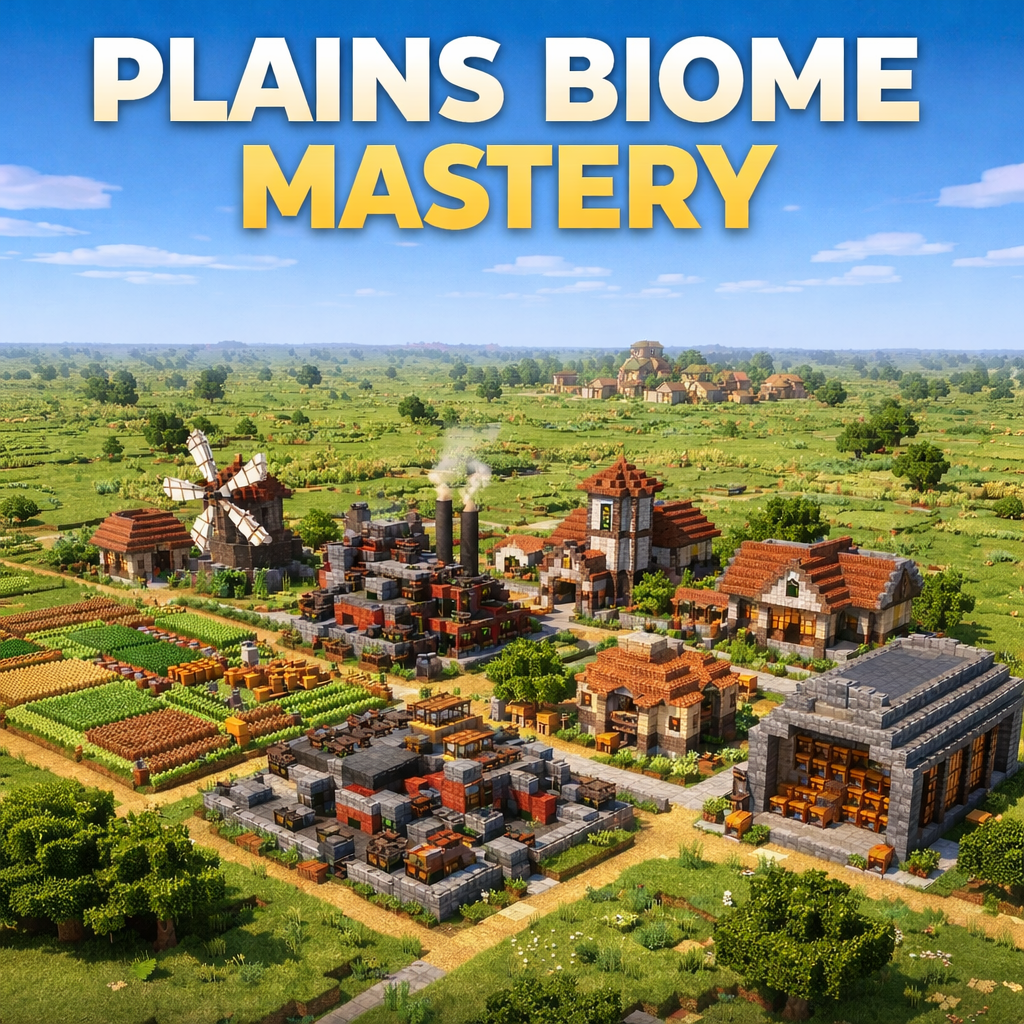
Plains biomes might look simple at first glance, but they’re secretly one of the most powerful locations for ambitious Minecraft builders. If you’ve ever dreamed of creating a sprawling megabase with industrial-scale farms, automated systems, and carefully planned districts, the plains offer everything you need: flat terrain, abundant resources, and the perfect canvas for your architectural vision.
Whether you’re planning your first large-scale base or looking to optimize your mega-farm empire, understanding how to leverage the unique advantages of plains biomes will transform your building experience. Let’s explore why experienced builders consistently choose plains for their most ambitious projects and how you can master this versatile biome.
Why Plains Biomes Are Ideal for Megabases
The plains biome stands out as the premier choice for large-scale building projects, and there are solid reasons why veteran builders return to this landscape time and again.
Terrain That Works With You, Not Against You
Flat, open land means you can focus your creative energy on building rather than endless terraforming. While mountain builds have their charm, nothing beats the efficiency of starting with a naturally level foundation when you’re planning multiple districts, extensive road networks, and dozens of farm modules.
Resource Accessibility From Day One
Plains provide an excellent balance of essential resources right where you need them:
- Oak trees for your initial wood supplies and ongoing building materials
- Tall grass that drops wheat seeds instantly, jumpstarting your food production
- Passive mobs spawning freely for early-game meat and leather
- Stone and common minerals easily accessible below the surface
- Water sources typically within reasonable distance for irrigation and fishing
Village Integration Opportunities
One of the biggest advantages? Plains biomes frequently generate with villages, and these aren’t just decorative—they’re functional goldmines for megabase builders. Early access to beds, crops, basic tools, and most importantly, villagers for trading halls and automated farms can accelerate your progression significantly.
If you’re still deciding where to spawn, check out our guide on the best Minecraft spawn biomes for more location insights.
✅ Megabase Planning Checklist
Track your progress from concept to completion
🎯 Pre-Build Preparation
0/8📐 District Planning
0/7🌾 Farm Construction
0/10🚛 Infrastructure Setup
0/9🎨 Aesthetic Finishing
0/8Strategic Planning for Plains Megabases
Building big requires thinking big from the start. The worst mistake you can make is starting construction without a clear vision, only to realize you’ve blocked your expansion routes or mixed incompatible districts.
Choosing Your Build Site
Even within a plains biome, some locations work better than others for megabase construction. Look for areas that offer:
- Sufficient flat space for your planned districts (think bigger than you initially estimate)
- Proximity to water for aesthetic variety, irrigation, and fishing farms
- Access to at least one village for villager-based automation
- Clear sightlines that let you appreciate your builds from multiple angles
- Nearby biome transitions for resource diversity without long travel times
Building near water in plains isn’t just practical—it dramatically improves the visual appeal of your base by breaking up the horizontal landscape with natural features.
Designing Your District Layout
Professional megabases separate functionality into distinct zones rather than clustering everything randomly. This modular approach makes expansion easier and keeps your base organized as it grows.
Consider organizing your megabase into these core districts:
- Storage and logistics hub: Your central sorting system, general storage, and item transportation network
- Agricultural district: All crop farms, animal pens, and food production systems
- Industrial zone: Technical farms like mob grinders, iron farms, and material production
- Residential area: Your actual living space, enchanting setup, and aesthetic buildings
- Transportation hub: Nether portal, ice boat systems, and inter-district connections
Connect these districts with clear roads, paths, or rail systems. The flat terrain makes it easy to create straight, efficient routes that look intentional rather than haphazard.
🏗️ Megabase District Planning Calculator
Calculate the total space you’ll need for your plains megabase
Agricultural District
Industrial District
Storage & Residential
Infrastructure
Your Megabase Requirements
💡 Planning Tips
- Add 20-30% extra space for future expansion
- Consider building districts in separate chunks for better performance
- Plan roads before placing structures
For inspiration on organizing different biome features, our biome exploration checklist can help you think systematically about spatial planning.
Building Style and Block Palette Selection
Plains biomes naturally provide oak wood and common stone—basic materials that form the foundation of countless building styles. The key is using these materials thoughtfully rather than letting your base become a monotonous brown-and-grey sprawl.
Developing a Cohesive Palette
Your block palette should create visual interest through contrast and texture while maintaining coherence across multiple structures:
- Primary materials: Oak wood, stone bricks, and cobblestone provide your structural base
- Accent materials: Terracotta, concrete, or glazed terracotta add color pops
- Texture variation: Incorporate stairs, slabs, walls, and fences to create depth
- Natural elements: Stone buttons, trapdoors, and anvils break up flat surfaces
The contrast principle is crucial—light sandstone against darker oak planks creates striking facades, while stone bricks against surrounding greenery provides architectural definition.
🎨 Block Palette Visualizer
Preview block combinations before building in Minecraft
Preview: Building Facade Pattern
Primary
Secondary
Accent
Color Contrast Rating
💡 Palette Design Tips
- Use your primary material for 60% of the build
- Secondary material should cover 30% (walls, supports, trim)
- Accent material adds pops of color (10% or less)
- Light and dark contrast creates depth and definition
Creating Architectural Consistency
To make your megabase feel like one integrated complex rather than a collection of random buildings, repeat certain design elements across structures:
- Consistent roof angles and materials (all gabled roofs with spruce, for example)
- Repeating support structures or pillar designs
- Unified lighting approach (lanterns vs. torches vs. glowstone)
- Similar window styles and placement patterns
- Matching trim details and decorative elements
This doesn’t mean every building looks identical—variation within your established rules creates interest while maintaining harmony.
Addressing Visual Emptiness
Plains can feel sparse without intentional landscaping. Break up large open areas with:
- Custom tree clusters using bone meal and saplings
- Hedgerows or low fences defining property boundaries
- Small decorative ponds or water features
- Field patterns using different grass types or path blocks
- Flower patches adding seasonal color
These touches transform industrial farm grids into lived-in landscapes that feel organic despite their technical functionality.
Core Mega-Farms for Plains Biomes
The real power of plains megabases comes from their capacity for industrial-scale automation. Flat, open terrain lets you build farms that would be impractical in other biomes.
Villager-Based Crop Production
Villager crop farms are the backbone of any serious agricultural district. The beauty of these systems is their modularity—each farm functions independently, so you can build one now and add more later.
A standard villager crop farm module includes:
- 16×16 crop field (potato, carrot, wheat, or beetroot)
- Single farmer villager with a composter
- Adequate lighting to prevent mob spawns (light level 8+)
- Hopper collection system underneath
- Storage for excess crops
Stack these modules side by side in your agricultural district, and you’ve got scalable food production that requires zero player input once established.
Iron Farm Integration
If you’ve built near a plains village, you’re perfectly positioned to add an iron farm—one of the most valuable technical farms in Minecraft. The flat terrain makes construction straightforward, and the visual integration with nearby village structures feels more natural than dropping a technical contraption in a forest or mountain.
Modern iron farms can be surprisingly compact while still producing hundreds of ingots per hour. Position yours near your crafting area for convenient access when building rails, hoppers, or beacon pyramids.
Passive Mob Farms
The plains’ high spawn rates for passive mobs make it ideal for animal farms:
- Sheep farms for wool production (essential for beds and decoration)
- Cow farms for leather and food (leather for books and item frames)
- Chicken farms for feathers and eggs (feathers for arrows and book editing)
Design these with grass blocks and adequate space—cramped animals produce slower and look worse aesthetically.
Industrial Farm Clusters
Beyond basic food and iron, consider dedicating space for:
- Bamboo farms for fuel and scaffolding
- Kelp farms for additional fuel and building blocks
- Lava farms for infinite fuel (1.17+)
- Moss farms for decorative blocks and bonemeal
- Tree farms for massive wood production
Group farms by similarity—all plant-based farms in one area, all mob farms in another—to create logical industrial districts.
For ideas on technical builds, explore our Minecraft mods for builders to see how some builders optimize their farms even further.
Performance Optimization and Chunk Alignment
When you’re running multiple high-output farms simultaneously, performance becomes critical. The last thing you want is your megabase turning into a lag-fest.
Chunk-Aligned Farm Design
Minecraft processes the world in 16×16 chunks, and farms that respect chunk boundaries perform more reliably:
- Build key farms centered on chunk borders for predictable loading
- Use F3+G to display chunk boundaries while planning
- Keep critical redstone components within single chunks when possible
- Design farms to minimize cross-chunk hopper chains
Reducing Entity Lag
Entities (items, mobs, minecarts) create most performance issues in megabases:
- Use hopper minecarts sparingly—they’re laggy compared to water streams
- Implement item despawn timers in farms to prevent buildup
- Cap mob farm populations with smart spawning limits
- Consider using droppers instead of dispensers where appropriate
Lighting and Spawn-Proofing
Plains’ open terrain means hostile mobs can spawn anywhere you haven’t explicitly prevented it. Around high-density farm and storage areas, thorough spawn-proofing is essential:
- Place torches, lanterns, or sea lanterns at regular intervals
- Use slabs, carpets, or buttons on surfaces where torches look bad
- Light up caves underneath your base to reduce subsurface spawning
- Consider building a perimeter wall with internal lighting
Proper lighting also prevents creepers from ruining your carefully planned builds—nothing worse than rebuilding a corner of your storage system because you missed one dark spot.
Transportation and Logistics
As your plains megabase grows, efficient movement between districts becomes increasingly important. You’ll waste hours just walking between your farms and storage if you don’t plan ahead.
Ground Transportation
The flat terrain makes plains perfect for:
- Road networks: Paths connecting all major districts with clear signage
- Minecart systems: Rails for item transport and player movement
- Ice boat highways: Blue ice paths for incredibly fast travel
Build your main roads first, then fill in structures around them. It’s much harder to retrofit roads through existing buildings.
Nether Hub Connections
For a megabase spanning thousands of blocks, Nether hub connections are essential:
- Each 8 blocks in the Nether equals 64 blocks in the Overworld
- Build tunnels connecting to your major districts via precisely aligned portals
- Use ice boat highways in the Nether for extremely fast transit
- Mark coordinates clearly to avoid portal linking errors
Item Transportation
Moving items between farms and storage requires planning:
- Water streams: Simple, lag-free, but slower for long distances
- Hopper chains: Fast but expensive and laggy over distance
- Minecart systems: Good for branching networks with multiple endpoints
- Ender chests: Expensive but perfect for remote access to key items
Design your central storage hub as the destination for all farm outputs, with sorting systems directing items to appropriate chests.
Vertical Building in Plains
While plains are famous for horizontal expansion, don’t overlook vertical possibilities. Building upward adds visual interest and can be surprisingly practical.
Multi-Level Farms
Stacked farm layers multiply your production without increasing your footprint:
- Crop farms can stack vertically with independent villagers on each level
- Mob farms benefit from increased spawning space in tower designs
- Storage silos create impressive landmarks while organizing items by category
Observation Towers and Build Markers
Tall structures serve both practical and aesthetic purposes:
- Central towers provide vantage points to appreciate your entire base
- Corner markers define your build area and look impressive from a distance
- Lighthouses guide you home when exploring nearby biomes
Floating Islands and Elevated Platforms
If you want drama, consider suspended elements:
- Elevated farms maximize space while looking distinctive
- Floating gardens add organic elements above the flat terrain
- Suspended walkways between buildings create layered visual complexity
Just ensure elevated builds don’t interfere with farm efficiency—shadows can disable crop growth if positioned poorly.
Expanding Beyond Plains
Even the best plains megabase benefits from nearby biome diversity. Use the flat terrain as your central hub while reaching out to neighboring biomes for specialized resources.
Identifying Nearby Biomes
Within render distance of your plains base, you might find:
- Forests for diverse wood types and mushrooms
- Rivers for fishing and clay harvesting
- Mountains for stunning views and unique stone types
- Oceans for prismarine, kelp, and ocean monuments
Check our guide on all Minecraft biomes to understand what each nearby biome offers your megabase.
Building Outposts
Rather than long commutes for specialty resources, establish mini-bases:
- Small shelters in mountain biomes for mining trips
- Fishing huts at rivers or ocean edges
- Forestry outposts in different wood biomes
- Mining camps at interesting cave systems
Connect these to your main base via Nether portals for quick access.
Contrasting the Taiga Alternative
Some builders prefer taiga biomes for megabases, and while they offer spruce wood and foxes, they lack the sheer buildable space and village integration of plains. If you’re curious about taiga building, see our Minecraft taiga building guide for comparison.
For mountain building strategies that contrast with plains approaches, check our mountain biome construction guide.
Seasonal and Weather Considerations
Plains experience standard Minecraft weather, which affects both aesthetics and functionality.
Rain and Snow
Plains don’t snow naturally, but rain occurs regularly:
- Ensure farms have proper roofing or draining to prevent water flow issues
- Use rain as an opportunity for atmospheric screenshots
- Consider adding covered walkways between buildings for immersion
Aesthetic Lighting
Weather changes how your base looks:
- Test your lighting at night and during storms to ensure visibility
- Strategic glowstone or sea lantern placement creates ambiance
- Consider different lighting for different districts (warm lanterns for residential, bright white for industrial)
Seasons Mod Compatibility
If you use the Serene Seasons mod, plains cycle through spring growth, summer greenery, autumn browns, and winter snow. Design with seasonal variation in mind—structures that look good year-round use materials with consistent appearance rather than relying on green grass blocks.
Common Mistakes to Avoid
Learning from others’ errors saves you rebuilding time later.
Building Too Small Initially
The biggest regret megabase builders report? Not planning big enough from the start. Your needs will grow—design districts with expansion space from day one.
Neglecting Infrastructure Early
Don’t delay building your storage system, transportation network, and farm foundations. These are harder to retrofit after you’ve built around their eventual locations.
Mixing Incompatible Farms
Some farms interfere with each other—hostile mob farms near villagers, light-sensitive farms under tree growers. Plan district purposes before placing farms randomly.
Forgetting Backup and Lighting
Always back up worlds before major construction, and light as you build rather than leaving dark patches for later. One creeper can undo hours of work.
Ignoring Aesthetics for Function
Purely functional farms work, but they’re boring to look at. Integrate decoration, use attractive materials, and design farms that look good and work efficiently.
Advanced Plains Building Techniques
Once you’ve mastered basics, these advanced techniques elevate your megabase to the next level.
Terraforming for Purpose
Even in flat plains, strategic terraforming adds character:
- Gentle hill contours break up monotonous flatness
- Sunken gardens create private, enclosed spaces
- Raised platforms elevate important structures
- Artificial rivers add movement and sound to your base
Custom Biome Integration
With the right seed selection (check our top Minecraft seeds for creative mode), you can find plains adjacent to multiple biomes, creating natural transitions in your building palette and resources.
Redstone Networks
Plains provide ideal flat surfaces for complex redstone:
- Underground redstone highways connecting distant farms
- Automated door systems across your entire base
- Central control rooms managing multiple farm types
- Item sorting systems processing thousands of items per hour
Modular Expansion Planning
Design each district as a self-contained module that can be expanded independently:
- Agricultural zones add fields one module at a time
- Storage systems expand by adding new sorting categories
- Industrial areas grow by duplicating successful farm designs
This modular approach means you’re never “done”—there’s always another module to build when inspiration strikes.
🗺️ Interactive District Layout Planner
Drag and drop districts to plan your megabase layout
Agricultural
Industrial
Storage
Residential
Transport Hubs
💡 Planning Tips
• Keep agricultural districts together for efficient collection systems
• Place industrial zones at least 128 blocks from villages (for mob farms)
• Position storage centrally for easy access from all districts
• Add transport hubs at major intersections
• Leave space between districts for roads and expansion
Bringing It All Together
Plains biomes offer adult builders the perfect combination of accessibility and potential. The flat terrain removes building barriers, letting you focus creative energy on design rather than terrain management. Natural resources support self-sufficient bases from day one, while village integration accelerates progression into complex automation.
Your plains megabase should feel like a planned city rather than a random collection of structures. Distinct districts connected by clear transportation networks, consistent architectural language tying buildings together, and strategic landscaping transforming industrial grids into lived-in communities—these elements separate amateur builds from masterful megabases.
Start with a clear vision, plan your districts before building, and expand systematically rather than randomly. The beauty of plains building is that you can always add more—another farm module, another storage wing, another architectural experiment.
The flat horizon isn’t limiting; it’s liberating. Every block of open plains terrain represents potential waiting to be realized by a skilled builder with ambitious plans.
What’s your plains megabase vision? Are you planning an industrial powerhouse focused on maximum automation, or a beautiful planned city that happens to be highly functional? The plains provide the canvas—your creativity provides the masterpiece.