Tiny homes are having a moment — and not just in the real world. In Minecraft, the compact build has become something of a design obsession for builders who want to push their skills beyond sprawling megabases and endless corridors. There’s a particular satisfaction to making a 7×9 footprint feel genuinely liveable: every block earns its place, every piece of furniture serves a purpose, and the result, when it all comes together, feels considered in a way that larger builds rarely do.
The challenge, of course, is that Minecraft’s block scale is inherently generous. A standard bed is a full block wide and two blocks long. A furnace stack takes up at least a column. Before long, your cosy one-room retreat starts to feel like a furniture warehouse. The principles that make real-world tiny homes work — layered function, vertical thinking, subtle zone separation, and integrated storage — translate remarkably well to Minecraft’s grid, provided you know how to apply them.
This guide walks through each of those principles in practical detail, with specific block choices and layout strategies to help you build small without building cramped.
Make Every Piece of Furniture Do Two Jobs
The foundation of any successful tiny interior — in Minecraft or in life — is multi-functional furniture. The goal is to eliminate any block that does only one thing when something nearby could do two.
The most obvious example is the loft bed with storage underneath. Rather than placing a bed at ground level and leaving the space beneath it wasted, raise it on a platform of slabs or stairs and fill the gap with chests, barrels, or even a compact crafting area. The bed still reads visually as a bed; the space beneath it becomes a functional utility zone without eating into your floor plan. For very compact builds, a single layer of slabs elevating the bed by half a block is enough to tuck a row of barrels out of sight. This approach is covered in detail in our guide to creating the perfect Minecraft bedroom sanctuary, which explores loft configurations and under-bed storage across different room sizes.
Minecraft Tiny Home
Block Pairing Guide
Every functional block concealed inside a furniture form that belongs there.
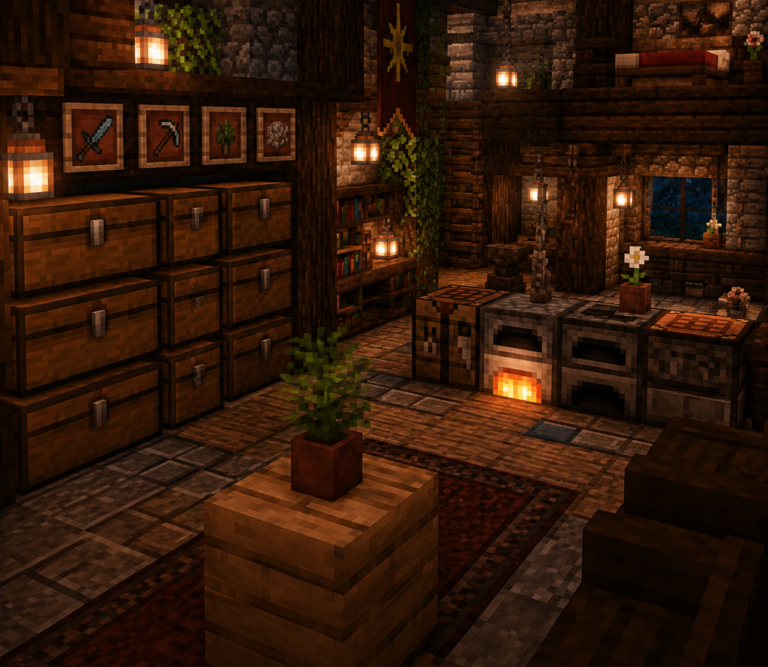
Kitchen counters offer similar opportunities. A surface built from slabs running along one wall can conceal a furnace, a smoker, and a crafting table beneath or behind it — all the functional blocks hidden behind a clean, consistent counter front. Add trapdoors flush against the face of the counter and they read as cabinet fronts while concealing whatever is behind them. A single well-designed kitchen run can contain everything a Minecraft cook needs in three or four blocks of wall space.
Seating That Does More
Seating is often the most wasteful use of space in a small Minecraft interior. A staircase block used as a chair consumes a full square of floor space for purely decorative purposes. The solution is to build seating into structures that already need to exist: a window seat over a row of chests, a bench along one wall that doubles as a lid for a barrel storage run, or a sofa arrangement where the “back” of the seating is actually a bookshelf row carrying both aesthetic weight and storage function.
This kind of layered thinking — asking “what else could this block be doing?” — is the habit that separates a cramped tiny interior from one that feels intentional. As you’re designing each area of your build, our guide to advanced Minecraft furniture explores specific techniques for creating furniture that earns its footprint.
Think Vertically: Build Up, Not Out
Vertical space is the most consistently underused resource in Minecraft’s small builds. The instinct is to spread horizontally — to add another room, extend a wall — when the most efficient expansion is always upward. A tiny home with a standard two-block ceiling has almost no overhead storage; push to three blocks and you gain an entire level of usable space without touching your footprint.
The loft is the most powerful tool in the tiny-home builder’s kit. A sleeping loft accessed by ladder or a tight spiral staircase can free up the entire ground floor for living and working space. With a three-block-high interior, you have just enough room for a loft with roughly 1.5 blocks of clearance — enough to sleep in comfortably (by Minecraft standards) with head room to crouch-move around. That ground floor then becomes entirely yours to furnish as a kitchen, workshop, or living area.
Wall Storage as Architecture
Once you’re thinking vertically, wall-mounted storage stops being an afterthought and becomes part of the architecture. A full wall of bookshelves doesn’t just look good — it signals a reading nook, a library corner, an intellectually inhabited space. A vertical column of item frames and barrels along a narrow wall creates what builders sometimes call an “item wall”: a visual display of materials or tools that also provides genuine access.
Staircase storage is another underexplored option. Each step in a Minecraft staircase is cosmetically distinct enough to suggest a structural element, and barrels or chests tucked beneath each rise create a storage-under-stairs effect that reads as architectural rather than cluttered. Even a three-step interior staircase leading up to a loft can incorporate two or three barrels without the build feeling overstuffed.
Lighting also belongs to this vertical thinking. Rather than placing torches at eye level (which eat into wall space and look flat), push lighting into ceiling recesses using lanterns hung from trapdoors, or tuck sea lanterns beneath slab overhangs. This keeps the light source above eyeline and opens up the walls for storage and decoration. The full possibilities here are covered in [Minecraft Lighting Design: Creating Mood and Atmosphere] — add this URL once published — which is worth reading before you finalise your ceiling plan.
Zone Your Space Without Walling It Off
One of the biggest mistakes builders make in tiny interiors is using full-height walls to create separate rooms. In a 7×9 build, adding even a one-block-wide partition wall immediately makes both resulting spaces feel claustrophobic. The solution used by experienced interior builders is to define zones through suggestion rather than enclosure.
Zone Your Space
Without Walling It Off
Four techniques for defining separate areas in a Minecraft tiny home — without adding walls that make every space feel smaller.
Half-Height Walls
Stack your divider 2 blocks high instead of the full 3. The eye reads the boundary clearly, but sightlines and light pass freely over the top. No space feels cut off or darkened.
Floor Material Change
Switch flooring materials at the zone boundary. Smooth stone kitchen, oak plank bedroom — the brain immediately registers these as different rooms, even with no wall between them.
Level Change
A single slab of elevation separates a sleeping area from living space more convincingly than most walls. The brain reads “step up” as “different room” — hardwired from real-world architecture.
Glass Screen
A run of glass panes creates a visual division while preserving sightlines and light. The separation is obvious — you’re clearly in a different zone — but the space doesn’t shrink or darken.
When to use walls vs. these techniques
Every full-height wall costs sightline, light, and psychological space. A 7×9 build divided by a wall becomes two cupboards. Avoid unless you genuinely need a door or privacy boundary.
These four techniques communicate “different space” without removing light, sightlines, or openness. Layer two — a half-wall plus a floor change — for maximum effect without any walls.
Sightlines
Preserve views across zones — keeps small spaces feeling open.
Light
Every wall blocks light. Every technique here lets it pass.
Layer two
A floor change plus a half-wall is stronger than either alone.
Materials
Contrasting materials signal zones without any structure.
A half-wall of slabs — two blocks high rather than three — creates a visual boundary between a sleeping area and a living area without blocking sightlines or light. The eye reads the separation; the space doesn’t feel cut in two. Trapdoors used as partial screens work similarly: arranged vertically or angled outward, they create a sense of a doorway or divider without fully closing off any part of the room.
Rugs, Levels, and Material Changes
A change of floor material is one of the most elegant ways to define a zone in a small space. If your living area uses smooth stone slabs and your kitchen transitions to stripped log planks, the shift reads as a distinct space even with no wall between them. Adding a carpet layer to a specific area reinforces the reading further — carpet over wood planks in a sleeping area immediately signals “bedroom,” regardless of whether anything else separates it from the rest of the room.
Level changes serve the same purpose. A sleeping platform raised by a single slab creates a “step up” that psychologically separates the bedroom from the rest of the living space. It’s a technique borrowed directly from real-world interior design, where platform beds and sunken seating areas create zones within open-plan spaces. In Minecraft, even a half-slab elevation is enough to create the distinction.
Glass — whether panes or full blocks — can define space while preserving openness. A glass screen between a kitchen and a living area creates a division without darkness; light passes through, sightlines remain, but the separate functions of each zone are clearly communicated.
Integrated Storage: Keep It In the Walls
The final principle of successful tiny-home design is storage that disappears into the architecture. Freestanding chests clustered on the floor break the visual logic of a small space and make it feel disorganised regardless of how neatly they’re actually sorted. The goal is to push storage into the walls, the floor, the furniture — anywhere that doesn’t read, at a glance, as a pile of boxes.
Built-in shelf alcoves are the most straightforward solution. A one-block-deep recess in a wall, two or three blocks wide, housing a row of barrels with slab shelves above them, reads as a cupboard rather than a storage dump. If you line the alcove with stripped logs or contrasting planks, it becomes a feature rather than a functional necessity. The barrels can be labelled using name tags to help with organisation without adding any clutter.
Under-bed storage has already been mentioned in the context of loft design, but it bears repeating for ground-level beds too. A bed placed over a recessed platform of slabs, with a barrel or two tucked into the face of that platform, creates the impression of a bed frame with integrated drawers — a detail that reads as designed rather than improvised. Our full guide to [Minecraft Storage Solutions: How to Build Organised, Beautiful Living Spaces] — add URL once published — covers the broader taxonomy of storage approaches in detail if you want to go deeper on system and labelling logic.
Hidden Utility Blocks
Crafting tables and furnaces are functionally essential but aesthetically disruptive in a tiny interior. The trick is to conceal them within furniture forms. A furnace behind a trapdoor “door” becomes an oven. A crafting table sunk into a counter beneath a slab top reads as a preparation surface. A smoker tucked into the base of a kitchen island becomes a hob.
These concealment techniques don’t require any special mods or tricks — just an awareness that the functional block beneath matters less than the visual block on top. By treating utility blocks as infrastructure to be hidden rather than furniture to be displayed, you keep your interior reading as a home rather than a base.
The texture packs you choose will also make a significant difference to how convincingly small spaces read as finished interiors. The best realistic Minecraft texture packs for modern interiors offers a curated selection specifically chosen for how well they handle interior block combinations — worth checking before you commit to a material palette for a compact build.
Putting It All Together: A Tiny Home That Breathes
The principles above — multi-functional furniture, vertical thinking, implied zone separation, and integrated storage — each solve a different aspect of the small-space problem. Used together, they produce builds that feel genuinely inhabited rather than merely assembled.
Tiny Home Floor Plan Builder
Click to place blocks · Right-click to remove · Plan before you build
Blocks
A practical sequence for approaching a tiny home build is to plan storage first. Decide where every barrel, chest, and utility block will live before you place a single decorative element. If the storage doesn’t have a home in the walls or furniture, you haven’t solved the problem yet. Once storage is resolved, design the zones through material changes and level differences. Then layer in furniture that does double duty. Lighting and decoration come last — and by the time you reach that stage, you’ll find you have more room for it than you expected.
The best tiny Minecraft interiors reward close attention. They’re the builds where a second look at a corner reveals a detail you missed — a barrel tucked beneath a stair, a shelf alcove in an alcove, a counter concealing a full kitchen’s worth of utility. That density of considered detail is what separates a small build from a cramped one, and it’s entirely achievable within even the tightest footprint.
If you’re working on a specific room type within your tiny home, the Minecraft kitchen design guide and Minecraft bedroom sanctuary guide both offer room-specific approaches that apply these same principles in more focused depth.
Continue Your Journey
[Interior Design in Minecraft: Making Spaces Feel Lived-In] — Add URL once published. The foundational guide to Minecraft interior design principles, covering everything from colour palette to storytelling through objects.
Advanced Minecraft Furniture: Beyond Basic Chairs and Tables — A deep dive into furniture construction techniques, including multi-block pieces and unconventional block combinations.
[Minecraft Storage Solutions: How to Build Organised, Beautiful Living Spaces] — Add URL once published. Comprehensive coverage of storage design, from basic barrel systems to fully integrated built-in cupboards.
Minecraft Kitchen Design: From Functional to Fabulous — Room-specific kitchen design from basic counters to fully realised culinary spaces.
Creating the Perfect Minecraft Bedroom Sanctuary — From romantic master suites to compact guest rooms, everything you need for a bedroom that feels genuinely designed.
What’s your biggest challenge when building tiny in Minecraft? Whether it’s storage overflow, rooms that feel too dark, or furniture that just won’t cooperate, drop it in the comments — we’d love to help you work through it.
Want more Minecraft building guides delivered straight to your inbox? Subscribe to the Bricks & Blocks Creative newsletter for weekly tips, tutorials, and roundups.