Pick up a handful of old bricks from a box at a toy fair, tip them onto a table beside a modern set, and you will probably spot it within seconds: two browns that look like they should match and absolutely do not. One is warm and slightly red. The other is flatter, more orange, a little tired. Same name in casual conversation, very different results on a roof.
That mismatch is the whole story of Reddish Brown, the earth tone that quietly holds up more of your builds than almost any other. It is the colour of timber frames, tree trunks, soil, furniture and castle gates. It is also one of the easiest colours to get wrong when you start mixing old stock with new.
This guide is the Reddish Brown deep dive in our Lego Color series. It follows the Dark Bluish Grey LEGO Guide, and it assumes you already have a general method for matching colours. If you do not, start with the Complete Guide to LEGO Color Matching and Substitution and come back.
Here, we stay with one colour. What it is, where the old Brown went, where Reddish Brown earns its place, what to pair it with, and what to reach for when the part you need is scarce.
This post may contain affiliate links. As an Amazon Associate I earn from qualifying purchases.
🟤 What Reddish Brown Actually Is
Reddish Brown is the deep, warm brown in the current LEGO palette. It leans toward red-orange rather than yellow or grey, which is exactly why it reads as “wood” so convincingly.
On BrickLink, the largest marketplace for loose parts, it is listed simply as Reddish Brown. LEGO uses the same name. That consistency is rare for LEGO colours, and it is a relief when you are building a parts list.
The colour is also quite sensitive to light. Under warm indoor bulbs it glows and looks richer. Under cool daylight or LED panels it can look flatter and a touch duller.
Next to other colours it shifts again. Beside Dark Tan it looks redder. Beside Dark Orange it looks darker and calmer. Beside Dark Bluish Grey it looks warmer than it does on its own.
So if a build looks “off” in a photo, check the lighting before you blame the bricks. Our guide to LEGO lighting and photography covers how to keep colours honest on camera.
🕰️ The Brown-to-Reddish-Brown Change
Here is where the confusion starts. Reddish Brown is not the original LEGO brown.
For years, LEGO’s standard brown was a different, more orange-leaning shade. Fans usually call it old Brown, or simply Brown. LEGO’s own name for it was Earth Orange, which is a confusing name that does not help anyone shopping for parts.
Around 2004, LEGO tightened up its palette and the old Brown gave way to Reddish Brown. The Brothers Brick traced this shift in their look at the changing LEGO palette, and builder discussions on Eurobricks place the changeover in the same period. Some sets from the transition years are reported to contain both.
I have kept the timeline loose on purpose. Sources disagree on exact end dates for the old colour, and I would rather be honest about that than hand you a precise year I cannot back up.
What matters for you as a builder is the practical consequence. Older sets, and secondhand parts from that era, may be old Brown. Newer parts are Reddish Brown. They are close cousins, but they are not twins.
Put them in the same roof and the difference shows. The old Brown looks more orange and a little faded beside the richer Reddish Brown.
How to tell which one you have
- Compare the part against a known modern Reddish Brown brick in daylight, not under a desk lamp.
- Look at the date or theme of the set it came from if you know it. Older castle, pirate and town sets are the usual suspects.
- Check for yellowing or fading. Age can shift any colour, so do not assume a faded part is a different colour entirely.
- When in doubt, sort the two into separate piles before you build, not after.
There is one more wrinkle. Builders also report that Reddish Brown itself varied slightly from batch to batch over the years. Treat that as anecdotal, but it is a good reason to buy everything for one visible area in a single order where you can.
🏰 Where Reddish Brown Does the Heavy Lifting
If Dark Bluish Grey is the structural colour of the palette, Reddish Brown is the organic one. It is what you reach for when you want something to look like it grew, aged or was built by hand.
Roofs and timber framing
Reddish Brown roof slopes read as clay or timber shingles without any extra effort. It is a natural choice for cottages, taverns and farmhouses.
For timber framing, it works as the dark beams against a Tan or white wall. Keep the beam pattern slightly irregular. Perfectly even spacing looks like a fence, not a frame.
Trunks, branches and soil
Almost every tree trunk in LEGO is Reddish Brown for a reason. It sits comfortably between the greens of foliage and the tans of ground cover.
For soil and earth banks, it gives you depth. Mix it with Dark Tan and a little Dark Bluish Grey for a convincing, uneven ground. Our post on landscape and terrain colours goes deeper on layering natural environments.
Furniture and interiors
Desks, bookcases, beds, barrels and chests are all natural territory. A small amount of Reddish Brown inside a build makes it feel lived in.
If you are building at minifigure scale, it also gives you a strong contrast against pale floors.
Castles and period builds
Gates, drawbridges, beams and doors in a castle are almost always Reddish Brown. Pair it with Dark Bluish Grey stone and you have the classic medieval look.
If you want to take that further, medieval and castle building with historical colour accuracy explores what real period palettes looked like and how to approximate them.
Brownstones and row houses
Reddish Brown is also a staple for brownstone facades and city streets. We keep that topic in its own guide so we do not repeat ourselves here. If a terrace of brick-fronted houses is what you are planning, read Row Houses and Brownstones.
🎨 Palettes That Work With Reddish Brown
Reddish Brown is easy to like and a bit tricky to balance. It is dark and warm, so it needs partners that lighten it or cool it down.

Reddish Brown and Dark Tan
This is the most reliable pairing in the whole palette. Dark Tan softens the red in Reddish Brown and gives you an earthy, weathered look.
It works for cottages, farm buildings, deserts with scattered timber, and any scene where you want a natural, sun-baked feel.
Reddish Brown and Tan
Tan is lighter and cleaner than Dark Tan. Together with Reddish Brown it feels crisper and more domestic.
This is the combination for plaster-and-beam walls, bakery fronts and tidy village streets.
Reddish Brown and Dark Green
Brown and green is the classic forest pairing. Dark Green foliage against Reddish Brown trunks looks natural without trying.
Be careful with proportion. A lot of Reddish Brown next to a lot of Dark Green can go heavy and gloomy. Break it up with a lighter accent such as Tan, or a small flash of a brighter colour.
Reddish Brown and Dark Bluish Grey
This is the stone-and-timber combination. The cool grey makes the brown look warmer, and the brown stops the grey from feeling cold.
It is a dependable palette for castles, mills and workshops. It is also the natural follow-on from our Dark Bluish Grey guide.
A quick rule of thumb
Treat Reddish Brown as your anchor. Use one lighter neutral beside it, one cooler colour for contrast, and keep any bright accent small.
🔄 Substitutes When Reddish Brown Is Scarce
Sooner or later you will want a part in Reddish Brown that is expensive, rare or simply missing. Here are the usual candidates, and an honest note on when each one works.
Remember that substitution is about context. The same swap that is invisible on the back of a model can be glaring on a front facade.
Dark Brown
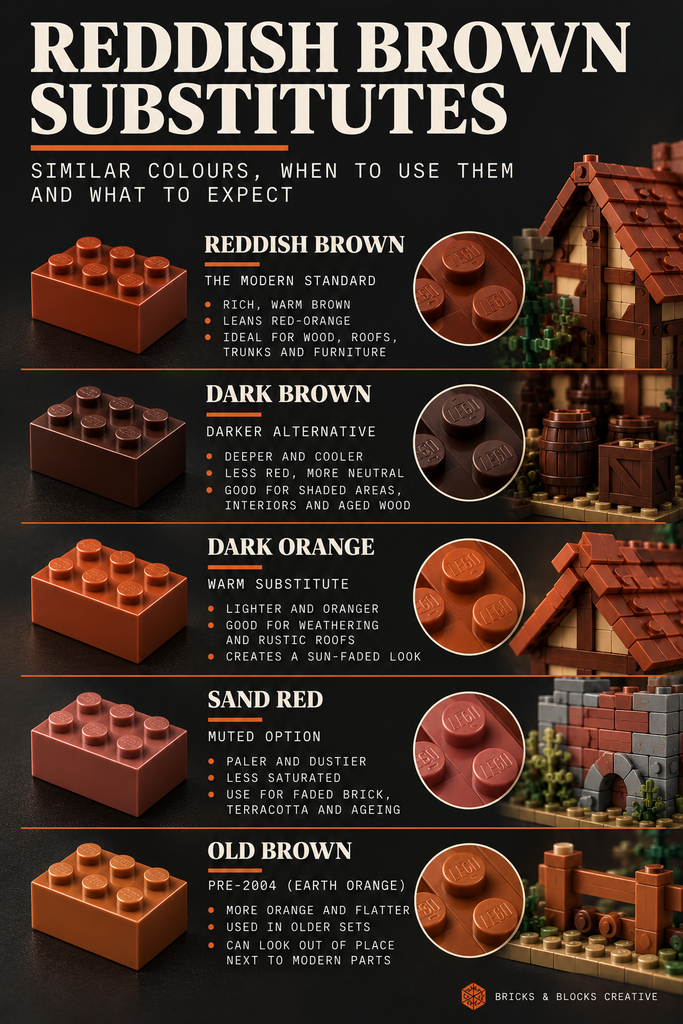
Dark Brown is a separate, darker colour. It is not a version of Reddish Brown, and it is still a current colour.
It works well for shadowed areas, interior beams, or any spot where you want the brown to recede. It is cooler and less red, so placed right next to Reddish Brown it looks clearly different.
Best use: hidden or shaded areas, or as a deliberate second tone. Worst use: swapping a single piece into a visible run of Reddish Brown.
Dark Orange
Dark Orange is brighter and more saturated. It gives a richer, rustier look.
It can work as a substitute for roofs and rough wood in a warm scene, especially if you use it for a whole section rather than a stray part. Mixed in randomly, it looks like a mistake.
Sand Red
Sand Red deserves a plain warning. It reads pinkish, and that is the first thing most builders notice.
In a cluster of Reddish Brown, a Sand Red part can look washed out or oddly rosy. It can suit a deliberate terracotta or faded-brick effect, but it is a poor stealth substitute.
Old Brown
If you are sitting on a pile of old Brown, it can actually be a useful stand-in. It is the closest in hue family to Reddish Brown, just more orange and less rich.
The trick is to use it where age is part of the story. An old barn, a weathered fence or a ruined hut can carry the difference as deliberate character. A pristine new door cannot.
Choosing a substitute: a quick checklist
- Will the part sit directly next to Reddish Brown, or on its own?
- Is the surface seen from the front, or hidden inside?
- Can you replace a whole run of parts instead of one?
- Could the difference be turned into weathering or detail?
For the method behind all of this, our colour matching and substitution hub is the place to go. And if a swap goes wrong, LEGO Color Disasters shows common mistakes and how to fix them.
🛒 Sourcing Reddish Brown Without Overspending
Reddish Brown is common, which makes sourcing easier than for rarer colours. Common does not mean every part exists in it, though.
BrickLink
BrickLink is the first place to look for specific parts. Filter by colour and part number, and compare several sellers before you buy.
Order everything for one visible section from a single seller where possible. That helps keep the shade consistent, which matters given what we said about batch variation.
Pick a Brick
LEGO’s own Pick a Brick service is useful for current parts in current colours. Availability changes, so check what is listed rather than assuming a part exists in Reddish Brown.
Parts to watch
Basic bricks, plates and common slopes in Reddish Brown are usually easy to find. The tight spots tend to be less common shapes, larger or specialist pieces, and parts tied to a single older set.
I have not verified a list of scarce parts for this post, so do your own check on any specific piece before building around it.
Budget tips
- Buy the colour in bulk where the part is common. Shipping is often the real cost.
- Use Reddish Brown on the visible faces and a cheaper colour on hidden structure.
- Plan the build before you buy. Our MOC planning guide helps you turn a concept into a parts and colour list.
- Mix sets and lots rather than buying one rare piece alone.
Prices and stock move constantly, so check current listings rather than relying on any figure you remember.
✅ Bringing It All Together
Reddish Brown is the quiet workhorse of the LEGO palette. It handles roofs, trunks, timber and furniture, and it asks very little of you as long as you respect one thing: it is not the old Brown.
Keep your old and new browns in separate piles, test your substitutes in daylight, and be honest with yourself about when a swap is acceptable. Sand Red will look pink. Dark Brown will look cool. Old Brown will look tired. Use each where that is a feature, not a flaw.
Next in the series, we will keep working through the palette one colour at a time. In the meantime, I would love to know how you handle the old-versus-new brown problem. Do you sort ruthlessly, or do you let the mismatch become part of the build? Tell us in the comments.