The Nether has always rewarded players who commit to an aesthetic. Its raw, hostile terrain — all lava lakes and crimson fog — doesn’t call for cosy cottages or pastoral farmhouses. It calls for something heavier, harder, and more deliberate. Brutalist architecture, with its emphasis on exposed materials, monumental scale, and structural honesty, slots into the Nether so naturally it’s almost suspicious. Strip away the ornament, lean into the darkness, and you end up with bases that feel less like player-built shelters and more like something the dimension itself extruded from the bedrock.
This guide is a practical style manual for building a Brutalist industrial Nether cluster. It covers the design philosophy translated into Minecraft terms, the specific block palette that makes it work, how to shape and scale your forms convincingly, and how to tie multiple structures into a cohesive base that reads as a planned industrial complex rather than a collection of separate builds. If you’ve already covered the fundamentals of surviving and thriving in the Nether’s architecture, or you’ve worked through Nether materials in depth, this is where that knowledge gets applied at its most disciplined.
What Makes a Base “Brutalist” in Minecraft?
Brutalism in the real world is defined by a handful of interrelated principles: raw, unfinished materials left exposed rather than dressed; massive geometric forms that prioritise silhouette over surface; a monochrome or severely restricted palette; and a philosophical commitment to showing how a building actually works rather than disguising it. You can see it in post-war civic architecture from London to São Paulo — concrete towers that make no apology for what they are.
In Minecraft terms, Brutalism translates to bases that look as though they were carved from a single enormous block of stone. Minimal decoration. Bold, stacking silhouettes. Repetition of simple shapes at a scale that makes individual blocks feel small. And crucially, a kind of structural honesty where your smelteries, storage banks, and transit corridors define the shapes of your wings and towers rather than being hidden behind a decorative façade.
The Nether suits this approach for practical as well as aesthetic reasons. The dimension already has a restricted, high-contrast palette. Its terrain is violent and geological. Fog and lava light create natural shadow gradients that make heavy, angular forms read beautifully at distance. A Brutalist complex planted in the basalt deltas doesn’t fight the environment — it amplifies it.
The Core Principles to Keep in Mind
Four principles will guide every decision as you build. Mass and weight means thick walls — three to five blocks minimum — low squat volumes, and wide columns rather than slender supports. Function first means letting your actual infrastructure define your architecture: the smeltery wing looks like a smeltery wing because the blast furnaces and lava channels are embedded in its walls, not hidden. Minimal ornament means replacing decorative trim with structural rhythm: repeated vertical pillars, grid-like window openings, and inset slabs that create shadow lines without adding visual noise. And monochrome control means choosing a primary palette of three blocks and treating any accent colour as a deliberate, occasional event — not a decorative habit.
The Palette: Basalt, Blackstone, and Concrete
Getting the material palette right is the single most important step. Brutalism lives or dies on material discipline. Introduce too many block types and the monolithic effect dissolves.
The Basalt Family
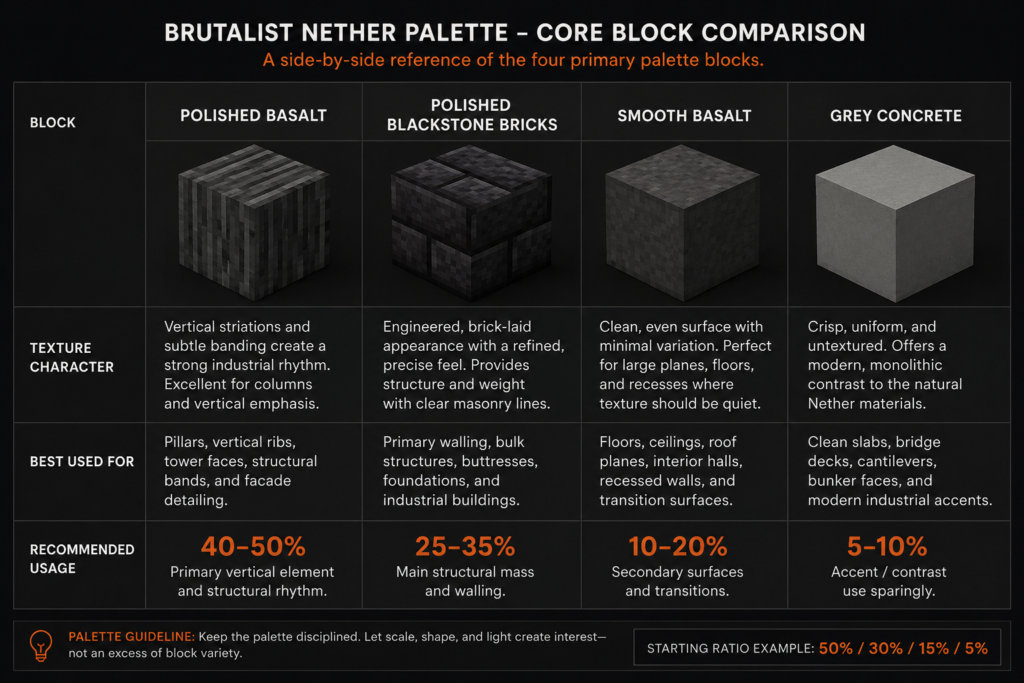
Polished Basalt is your primary vertical element. Its subtle striping, when placed upright along walls and towers, creates exactly the ribbed, industrial texture that Brutalism demands. Use it to define columns, vertical structural bands, and the cores of towers. Smooth Basalt is softer and flatter — ideal for floors, roof planes, and interior halls where you want readability at large scale without the texture doing all the work. Raw Basalt works best as a transitional material where your structure meets the terrain, blurring the boundary between built and geological.
The Blackstone Family
Blackstone itself — rough and broken in texture — is excellent for foundations, service tunnels, and any surface that should read as dug-out or excavated. Polished Blackstone Bricks are the workhorse structural block for main walls and massing: they read as engineered stone, precise and industrial. Chiseled and Gilded Blackstone should be used sparingly — five to eight percent of a wall at most — reserved for thresholds, control rooms, and key corridor intersections where a flash of texture or gold signals importance without decorating.
Brutalist Block Palette
Ratio visualiser — adjust sliders to mix your wall composition
Current mix
The Case for Importing Concrete
Grey and light grey concrete deserve a place in any serious Brutalist Nether build, even though neither occurs naturally in the dimension. The block’s crisp, unnaturally clean planes contrast beautifully against the noisy organic textures of basalt and Nether terrain, making monolithic façades and clean-cut slabs feel intentional rather than chaotic. Reserve concrete for your most deliberately “modern fortress” moments: cantilevered platforms, smooth bunker faces, and bridge decks where you want the geometry to dominate.
A working ratio for a primary tower — 50% polished basalt, 30% polished blackstone bricks, 15% smooth basalt, 5% gilded blackstone — gives you a useful starting point to adjust from rather than stare at an empty palette.
Supporting Industrial Elements
Iron bars, chains, and exposed mechanical blocks tie the aesthetic together. Iron bars serve as industrial railings, cable-like detailing in vertical shafts, and infill for recessed openings that should feel barred rather than open. Magma blocks, blast furnaces, smokers, and cauldrons filled with lava build in glowing “heat lines” and machinery clusters that double as functional infrastructure. They do two jobs at once, which is exactly what Brutalism asks of every element.
Form, Scale, and Geometry
The temptation in Minecraft is always to add detail at the surface level. Brutalism requires you to resist that and invest instead in the geometry of your forms. Work with simple primitives at large scale: cubes, rectangular slabs, and cylindrical rings. A 25×25×25 cube of concrete, or a stack of basalt fins each three blocks wide and fifteen high, achieves more with one shape than a smaller, intricately decorated structure achieves with dozens.
Stacking, Cantilevering, and the Shadow Band
One of the most distinctive moves in Brutalist architecture is the cantilevered volume — a heavier mass projecting outward from a lower, narrower base. In Minecraft, you can achieve this by stacking offset boxes: a heavy lower volume in polished blackstone bricks, with a slightly smaller smooth basalt volume shifted forward to create a cantilevered gallery over a lava lake. Underline each shift with a dark “shadow band” — a row of inverted stairs or slabs along the joint — to emphasise the overhang and add depth.
Repetition as Structure
In the absence of ornament, repetition becomes decoration. A row of identical polished basalt columns spaced every three or four blocks along a bridge does more for the Brutalist aesthetic than any carved detail could. The same principle applies to recessed windows, evenly spaced magma grilles, and vertical pilaster strips along walls. Fix your intervals and stick to them. The regularity itself becomes a design statement.
A simple starting geometry: take a 21×21 square footprint, extrude it fifteen blocks high in polished blackstone bricks, then carve a 7×7 void through the centre for a lava atrium. Wrap the exterior with evenly spaced polished basalt columns on every third block. You now have a tower with architectural presence before you’ve added a single detail.
The Industrial Nether Cluster: Four Structures
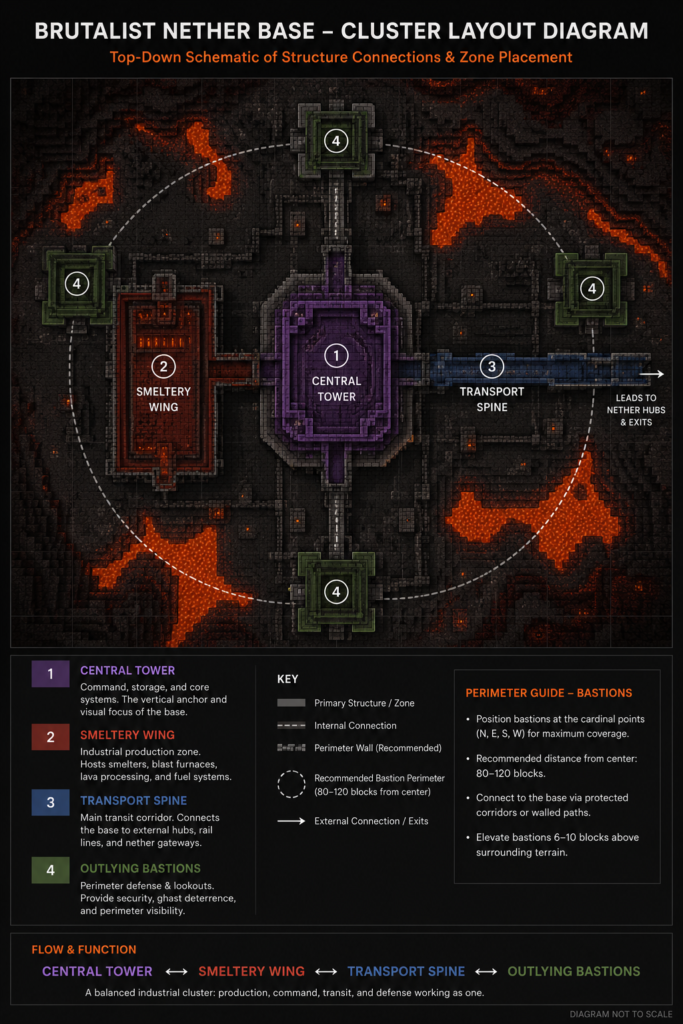
A single building is a statement. A cluster of related buildings becomes a world. The goal here is a collection of distinct Brutalist structures linked by industrial infrastructure, so that the whole complex reads as a planned facility rather than an assortment of boxes.
The Central Monolith Tower
The tower is your anchor point and visual centrepiece. It should be squat rather than spindly — heavy — and almost entirely closed to the outside. A nearly windowless core in polished blackstone bricks, twelve to twenty blocks tall, with a single vertical slit of coloured glass (red, cyan, or amber) cutting from near the base to the roofline. Inside: main storage, the Nether portal shaft, and a command floor at the top. The tower’s mass communicates importance more convincingly than any decorative treatment.
The Smeltery and Forge Wing
Run a long, low basalt bar parallel to the nearest lava lake. Keep it low — six to eight blocks is enough — and wide. Line the interior with blast furnaces, cauldrons of lava, and magma strips recessed into the floor as hazard channels. Campfires hidden beneath trapdoors at regular intervals produce a smoke effect that sells the “active facility” reading from the outside. This wing should look exactly like what it is: a heavy industrial structure built for production.
The Transport Spine
Brutalist complexes are defined by their circulation infrastructure — not as afterthoughts, but as architectural objects in their own right. Build a transit corridor connecting your major structures: a concrete and smooth basalt tube, three blocks wide, with minecart rails or an ice-boat strip running through it. Add support frames of iron bars and chains every five blocks, with occasional open slits cut in the sides that give sightlines over the Nether void. The corridor should feel like engineering made visible.
Outlying Bastions and Watchtowers
Repeat a simple, standardised outpost around the perimeter of your cluster: an 11×11 blackstone bastion with a ground-level kill box, a mid-level walkway, and a roof observation platform. The repetition of identical units reinforces the sense of planned industrial infrastructure. You can vary the height or add a parapet detail without abandoning the module — the consistency of footprint and layout does the work.
Interior Design: Functional, Tough, Slightly Oppressive
Brutalist interiors should feel like working spaces, not living ones. The atmosphere you’re aiming for is operational: controlled, compressed, and intentional.
Floors, Ceilings, and Spatial Proportion
Keep ceiling heights at three to four blocks to maintain the compressed, heavy feeling of a real Brutalist interior. Break that rule deliberately in your machinery hall — a double-height space among lower ones creates the same contrast effect as a nave in a cathedral, and it draws attention to your most impressive functional set-piece. For floors, smooth basalt or polished blackstone with occasional hazard striping in magma or yellow-black concrete patterns reads as industrial in exactly the right way. Ceiling beams in polished basalt or deepslate tiles at regular intervals reinforce the rhythm.
Walls, Stations, and the Absence of Decoration
The hardest thing to resist in a Brutalist interior is the urge to add warmth — banners, potted plants, wood accents. Avoid all of it. Instead, break large wall surfaces with a consistent grid of recessed 2×3 or 3×3 niches that hold storage, machinery, or lighting. Use iron bars as pipe-like detailing in vertical shafts, trapdoors over smokers as ventilation grilles, and composters, stonecutters, and lever banks as industrial consoles. Design stations rather than rooms: a map wall with item frames inlaid flush into concrete, a control desk from stone slabs and levers, maintenance corridors with barely enough width to pass single-file. The compression and regularity are the aesthetic.
Lighting for Drama: Industrial Glow, Not Ambience
Lighting is where most Brutalist Nether builds either succeed completely or collapse into generic darkness. The goal is not even, well-lit spaces. It is selective, directional light that emphasises the mass and geometry of your forms.
Hidden Sources, Sharp Contrasts
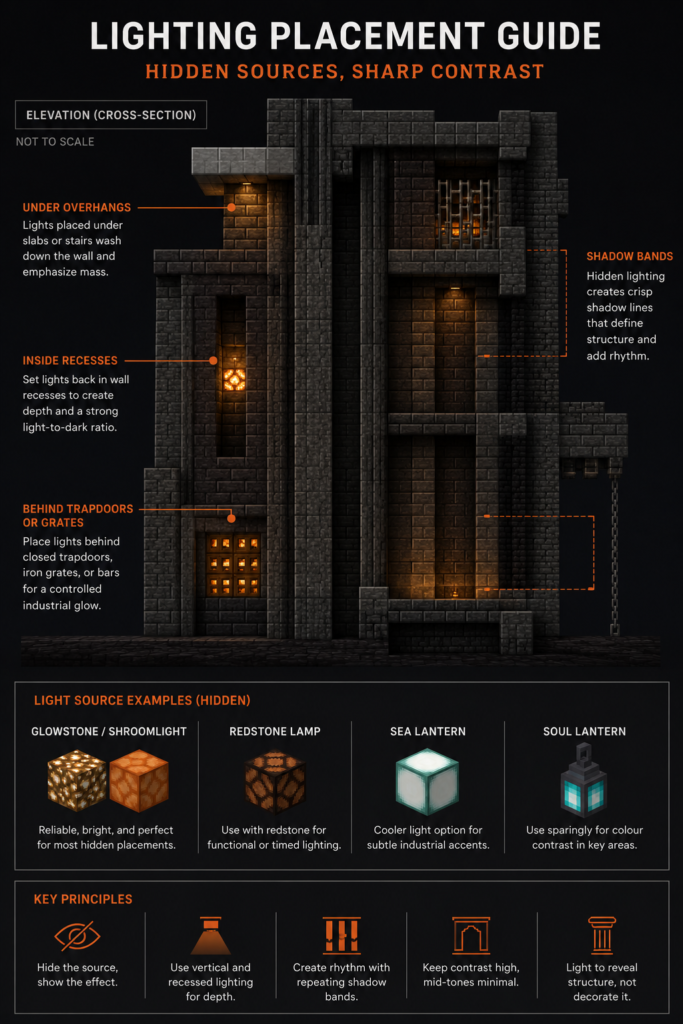
Keep the majority of your light sources out of direct sight: behind trapdoors, inside recessed block niches, under stair overhangs. This approach produces the sharp contrasts and deep shadow bands that emphasise structural weight rather than flattering surfaces. Magma blocks work best as hazard strips — glowing floor channels along walkways and backlit wall grilles. Shroomlights and sea lanterns, used sparingly, serve as cold, even lighting in high-tech functional areas. Soul lanterns and soul fire in blue-tinged maintenance areas and exterior perimeters add dimension without breaking the industrial read.
Silhouette Over Brightness
The most powerful lighting decision you can make for an exterior is to light edges, walkways, and entry points only, letting the mass of your towers and walls read as looming voids punctured by controlled glow. A building silhouetted against a lava lake, lit only at its base and along its roofline, will read more powerfully at distance than one that’s evenly illuminated. Space lights at the edge of mob-spawn thresholds for safety, then rely on glass barriers and half-slabs to close spawn surfaces rather than flooding the space with light.
Putting the Cluster Together
The process of building a Brutalist industrial Nether cluster doesn’t have to be overwhelming if you work in the right sequence. Start by choosing a basalt deltas or adjacent terrain with strong geological character, and rough in your central monolith footprint plus two or three outbuilding masses in simple rectangles or hexagons. Lock in your palette before you lay a single decorative block — primary three blocks, one or two accents, and no exceptions. Block out all your masses in solid forms first, then carve voids into them: courtyards, atriums, lava pits. Adding protrusions is harder to control than subtracting from a mass.
Once your geometry reads correctly, establish your repetition systems — columns, window slits, and frame segments at fixed intervals along every major wall. Then build out your interiors as industrial programmes: smelteries, storage silos, transit corridors, and control rooms. Finish with strategic lighting that emphasises edges and machinery over surfaces, and resist the urge to add colour or decoration in the final stages.
The Nether hub design guide covers how to connect your cluster to the wider network, and if you want to push the industrial feel further, Nether redstone engineering gives you the automation layer that makes a smeltery wing genuinely functional. For the Nether’s most architecturally demanding biome, the basalt deltas building guide covers terrain navigation and material sourcing for exactly this kind of project.
Brutalism in Minecraft is less a style to apply and more a discipline to commit to. But when you do commit — when the palette is locked, the geometry is bold, and the lighting is working — the result is unlike almost anything else in the game. Heavy, deliberate, and entirely at home in the most hostile dimension Minecraft has.
Which element of the Brutalist style are you most drawn to — the material palette, the scale, or the lighting approach? Let us know in the comments below.
Continue Your Journey
- Nether Building Mastery: Surviving and Thriving in Hell’s Architecture
- The Complete Nether Materials Guide: Building Blocks Breakdown
- Building in the Basalt Deltas: Complete Biome Guide
- Nether Hub Design: Complete Transportation Network Guide
- Gothic Architecture in Minecraft: Nether Fortress Design
Want more advanced Nether and architecture content delivered straight to your inbox? Subscribe to the Bricks and Blocks Creative newsletter for weekly guides, technique breakdowns, and the latest from both the Minecraft and LEGO building communities.