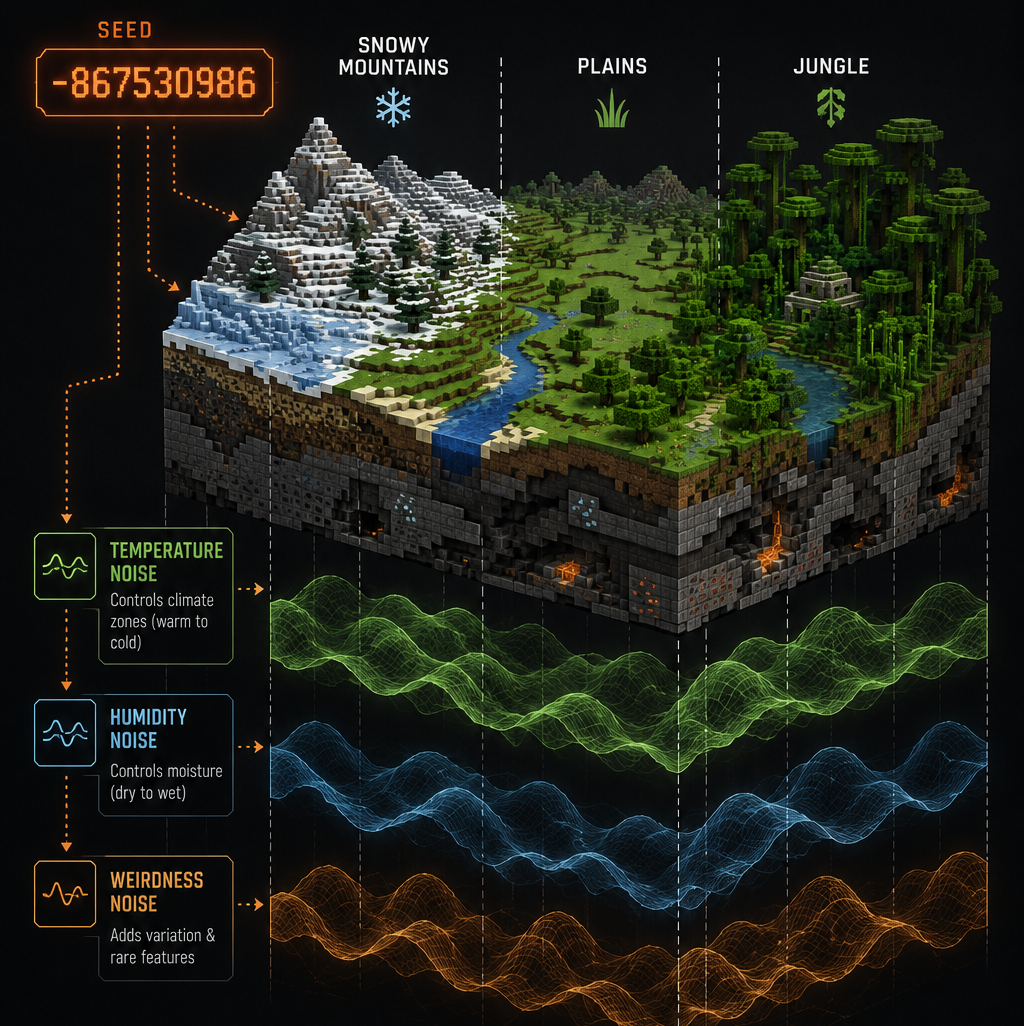
Every Minecraft world is simultaneously unique and entirely predictable. That apparent contradiction is the beating heart of the game’s world generation system, and once you understand it, the way you approach seeds, biome hunting, and megaproject planning changes completely. This is not a beginner’s guide to biomes. This is an examination of the machinery underneath, the mathematics that decides whether you spawn on a sun-baked savanna plateau or at the foot of a snow-capped mountain range.
If you have ever used a tool like ChunkBase to scout a seed before committing to a world, or wondered why the same number produces entirely different terrain in 1.17 versus 1.18, this article will give you a thorough understanding of what is actually happening under the surface.
The Seed: Deterministic Randomness
The first concept to grasp is that Minecraft worlds are not stored. The full terrain of a world does not exist on your drive as a complete, rendered map waiting to be explored. Instead, the game stores two things: a set of generation algorithms, and a seed.
A seed is a 64-bit integer. If you type a word or phrase into the seed field, Minecraft converts that string to a number behind the scenes. Given the same seed and the same game version, the algorithms will produce identical output every single time, on any machine, in any country. This is what makes speedrunning categories like “set seed” possible, and it is why the Minecraft community has been able to map and catalogue millions of worlds without ever loading them.
The mechanism driving this is a pseudorandom number generator, or PRNG. Java Edition uses a linear congruential generator (LCG), a simple but effective algorithm that takes the current state and transforms it into a new state through multiplication and addition. Each time the generator is sampled, it advances. The sequence it produces looks random but is entirely reproducible from the same starting point, which is the seed. Every hill, every ore vein, every village placement is a downstream consequence of that first number.
Why “Pseudorandom” Matters
The word pseudorandom is important. True randomness cannot be reproduced. Pseudorandom sequences can be, which is exactly what you need if you want a world that persists across sessions and systems. The LCG advances the state deterministically, producing a long sequence of numbers that appear statistically random but will always be identical given the same seed.
This is also why seed exploitation works. Because the output is deterministic, you can run the same algorithms offline, outside the game, using seed-analysis tools. The result is a complete map of structure placements, biome distributions, and terrain features without ever pressing “Create New World.”
The World Generation Pipeline
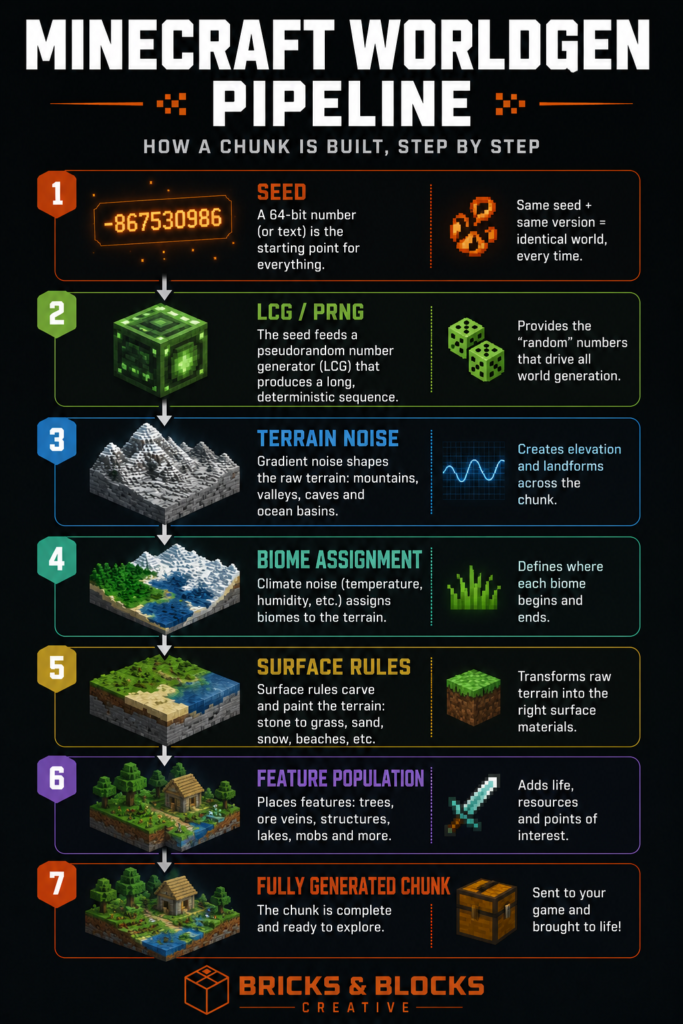
World generation does not happen all at once. It follows a structured pipeline that processes chunks in distinct phases, each phase building on the output of the last.
Terrain First, Biomes Second
The base terrain pass comes before biome assignment. The engine uses gradient noise to build the raw shape of the world: elevations, ocean basins, mountain chains, valleys. Gradient noise, often referred to in the industry as Perlin or Simplex noise, produces smooth, organic-looking output rather than the jagged results you would get from pure randomness. It achieves this by evaluating gradients at integer grid points and interpolating between them, which creates the flowing hills and natural coastlines that make Minecraft terrain feel geologically plausible.
Once the base terrain shape exists, the game runs the biome assignment pass, which paints climate data and biome identities onto that existing landscape. Then subsequent passes handle feature population: trees, ore veins, structures, mob spawning tables, and everything else that distinguishes a living world from raw terrain geometry.
Understanding this pipeline matters for builders because it means the terrain shape and the biome assignment are related but not identical. You can find biome boundaries that do not align with the terrain in ways that create unusual and useful build sites.
Chunk Lifecycle
A chunk in Minecraft progresses through a series of generation states on its way to being fully inhabited. A chunk request triggers terrain noise evaluation, then the biome source evaluation, then surface rule application and cave carving, and finally feature placement. This on-demand approach is what makes infinite worlds practical: the game streams terrain as you explore rather than precomputing everything.
The Multi-Noise Biome System (Java 1.18 and Later)
The 1.18 update represented the most significant change to Minecraft’s biome system since the game launched. Before it, biomes were assigned through a layered system that used cellular automata-style rules applied to a coarser noise map. After 1.18, the system moved to a multi-noise biome source, and understanding the difference explains a great deal about modern seed behaviour.
Climate Parameters and Biome Space
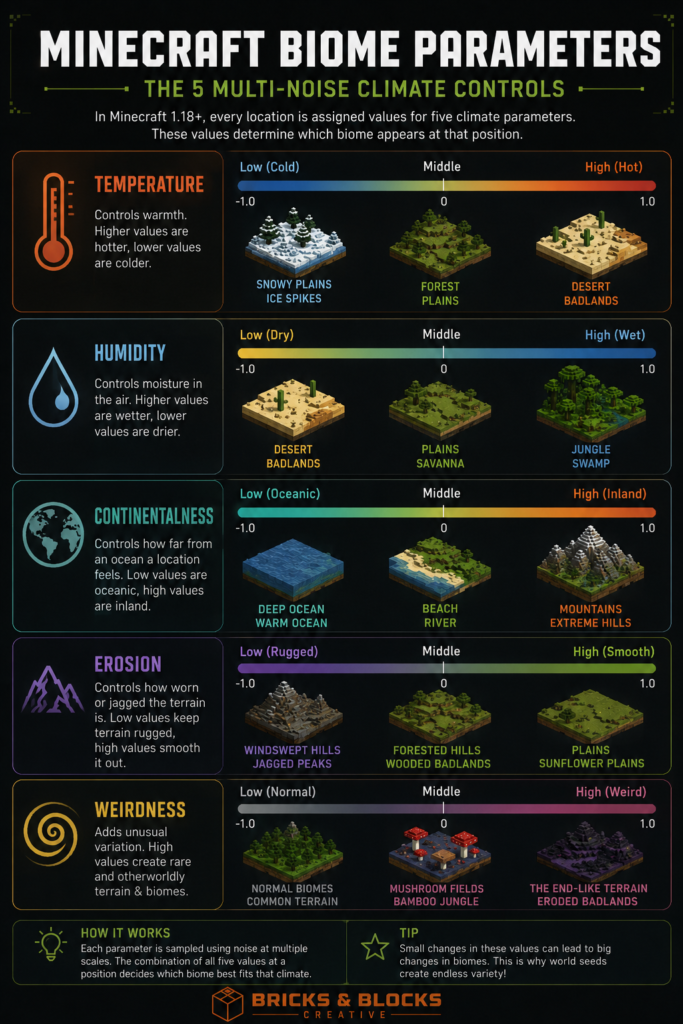
In the modern system, every position in the overworld is described by a set of climate parameters evaluated through noise fields. These parameters are temperature, humidity, continentalness, erosion, and weirdness, plus altitude information derived from the terrain pass.
Each biome has a set of target ranges in this multi-dimensional climate space. The engine samples the noise fields at a given position, obtains values for each parameter, and then selects the biome whose target ranges are the closest match to those sampled values. Think of it as placing a point in a five-dimensional space and finding which biome’s “territory” that point falls inside.
The practical consequence is that biome boundaries are no longer simple lines or smooth gradients from a top-down perspective. They are intersections of multiple overlapping noise fields, which produces far more natural-looking transitions and, occasionally, surprising pockets where unusual combinations of parameters create rare biome variants in unexpected locations.
The Role of Weirdness
The weirdness parameter deserves particular attention because it is the one most relevant to finding rare biomes. Weirdness pushes positions into different biome targets without necessarily changing the broader climate signature. Two positions with very similar temperature and humidity readings can end up assigned to entirely different biomes if their weirdness values differ significantly.
This is why old-growth forests, rare mountain subtypes, and unusual biome variants feel genuinely scarce. They occupy specific ranges of the weirdness noise that do not coincide with most positions in the world. Seed hunters who specifically target rare biomes near spawn are often, in effect, looking for seeds where the weirdness noise happens to align favourably with the positions they care about. This knowledge is directly useful when you are scouting biomes for a megaproject.
The Old System: Layers and Cellular Automata
To appreciate the 1.18 changes, it helps to understand what came before. Up to around 1.17, Minecraft used a layered biome generation system that combined multiple passes of cellular automata-style rules applied to noise-based climate maps.
These layers would expand, contract, and blend biome IDs through iterative rules. A layer might take a coarse map of “hot” and “cold” zones and expand them, then a subsequent layer would add shoreline transitions, and another would introduce biome variants and hilly subtypes. Each layer operation smoothed and refined the previous output.
The result had its own character: ragged climate bands, abrupt biome edges in some places, extremely long biome transitions in others, and some distinctive quirks near ocean and land boundaries that became beloved by the community. If you have played on a world from before 1.18, the biome layout feels noticeably different from modern generation, with larger, more contiguous biome regions and less vertical variation.
The shift to multi-noise introduced height-dependent biome assignment for the first time, which is why 1.18 worlds have biomes underground that do not simply mirror the surface above them. The dripstone caves and lush caves biomes that arrived with 1.18 were made possible by this architectural change.
Seed Version Dependency
One of the most important practical facts about seeds is that they are version-dependent. A seed that generates a beautiful mountain coastline in 1.20 will produce a completely different world in 1.17 or in a future update that changes the worldgen. The numeric seed is consistent, but the algorithms it is fed into change between major updates, and the output changes with them.
This is why technical players who record seeds always note the game version alongside the number. A seed shared in a forum post from 2019 is largely useless without knowing which version it was discovered in. For long-term build projects, this also means you should record your world’s version carefully, particularly before applying updates that include terrain generation changes.
Within a single version, the seed is a complete specification. Biome distribution, mountain ranges, cave patterns, village placements, stronghold locations, and all other structure positions are fully determined by the seed. Nothing in a world is actually random at the moment of play; the randomness was resolved at the moment the seed was chosen.
Analysing Seeds Without Loading the Game
The deterministic nature of worldgen has made it possible to build powerful offline analysis tools that process seeds using the same algorithms the game uses, just without the rendering layer. These tools are genuinely useful for advanced builders.
Seed Mapping Tools
ChunkBase’s Seed Map is the most widely used. It visualises biomes, rivers, coastlines, and structures across enormous map scales, and it is version-aware. You select the game version, enter your seed, and obtain a top-down view of the entire world at whatever zoom level you need. For planning builds on natural terrain, this is invaluable. You can identify favourable coastline geography, locate rare biomes near spawn, and check structure density before committing to a world.
Amidst is another option, slower to update but respected in the technical community for biome accuracy. MineMap offers similar functionality with some additional display options.
Seed Searching Tools
Beyond visualising a specific seed, tools like SASSA and similar seed searchers can scan the seed space automatically. You define constraints, such as “spawn within 500 blocks of a mushroom fields biome” or “a flower forest adjacent to a plains biome within 200 blocks of a village,” and the tool searches through large numbers of seeds to find candidates that satisfy your requirements. The search runs fast because the algorithms are the same ones the game uses, just implemented more efficiently for batch processing.
For builders with specific site requirements, a seed search workflow can dramatically reduce the time spent hunting for the right world to start a megaproject. You define what you need in terms of terrain shape, biome adjacency, or structure placement, run the search, and then validate the top candidates in-game.
Biome Mechanics: What Each Biome Controls
Understanding how biomes are assigned is only half the picture. Each biome is also a ruleset that governs what the game places inside it.
Block Palettes and Surface Rules
The surface of each biome is defined by surface rules that determine which blocks appear at and near the surface. Deserts replace grass and dirt with sand and sandstone. Badlands use terracotta in its colour variants. Snowy biomes add powder snow layers. These surface rules run after base terrain generation and paint the characteristic look of each biome onto the underlying terrain geometry.
Feature and Structure Spawning
Every feature that can appear in a world, from individual flowers and individual ore deposits to entire villages and woodland mansions, has a spawning ruleset that specifies which biomes it can appear in and at what frequency. Woodland mansions require dark forest biomes. Desert temples require desert. Ocean monuments require ocean variants above a certain depth. The biome assignment pass is essentially a gate that determines which features are eligible to appear at any given position during the population phase.
This is why biome choice matters enormously for resource gathering. The resources available to you in a given world region are a direct consequence of the biome system, and understanding that system lets you choose or hunt for worlds where the resources you need are well-distributed relative to your intended build site.
Weather, Mob Spawning, and Atmosphere
Beyond blocks and structures, biomes control precipitation type (rain, snow, or nothing), ambient sounds, water and foliage colour tints, and the mob spawning tables that determine which creatures appear naturally. The pale garden biome introduced in the Creaking update uses its biome identity to gate the appearance of creaking heart blocks and their associated mobs, demonstrating how the biome system continues to serve as the primary gating mechanism for new gameplay features.
For builders focused on atmosphere and environmental storytelling, understanding which biome controls which ambient elements is practical knowledge. The cold biomes produce snow and blue ice naturally; the swamp biomes provide the murky water and lily pads that make them so visually distinct. These are not cosmetic accidents; they are outputs of the biome rule system applied to the underlying terrain.
Noise Functions: A Brief Technical Primer
For readers interested in the mathematics, it is worth briefly examining the noise functions that power Minecraft’s generation.
Gradient noise works by assigning random gradient vectors to grid points in space, then interpolating the dot products of those gradients with the distance from each point. The result is a continuous function that varies smoothly, producing values that feel organic. Multiple octaves of gradient noise, stacked at different frequencies and amplitudes, produce the fractal-like detail that makes natural terrain convincing at both large and small scales.
The continentalness noise in 1.18+ determines broadly whether a position should be land or ocean, with intermediate values producing coastal zones. The erosion noise introduces variation in how flat or mountainous terrain becomes, with high erosion values flattening terrain regardless of the underlying heightmap. These two fields working in combination produce the geological logic of modern Minecraft terrain: continental interiors can be mountainous or flat, and erosion creates the flat plains that cut through mountain ranges like river valleys.
Diamond-square and midpoint displacement are older terrain algorithms you may encounter in discussions of general game development. Minecraft does not use these for its primary terrain, but understanding them contextually helps when reading about worldgen theory, since they represent an earlier generation of terrain generation approaches that gradient noise has largely superseded.
Seed Exploitation: Singleplayer Advantage and Multiplayer Ethics
Because worldgen is fully deterministic, knowing a world’s seed gives you complete information about that world. In singleplayer, this is simply a powerful planning tool. You can pre-map ore distribution, identify optimal base locations, find every stronghold position, and choose build sites with full knowledge of the surrounding terrain.
In multiplayer, the ethical picture is more complicated. Most competitive and survival servers suppress the /seed command for exactly this reason: a player who knows the seed can use external tools to locate any structure, any resource deposit, and any terrain feature with no in-game exploration required. Mods that recover seeds from live server data through observation of worldgen output are considered cheating in most community contexts.
This dual nature makes seed knowledge one of the more interesting technical topics in Minecraft: the same capability that enables careful creative planning becomes an unfair advantage in a shared world. It is worth being clear about which context you are operating in and what the community norms are before leveraging seed analysis tools in any multiplayer environment.
Choosing Seeds for Build Projects
The practical synthesis of everything above is a workflow for selecting seeds intentionally rather than accepting whatever a random roll produces.
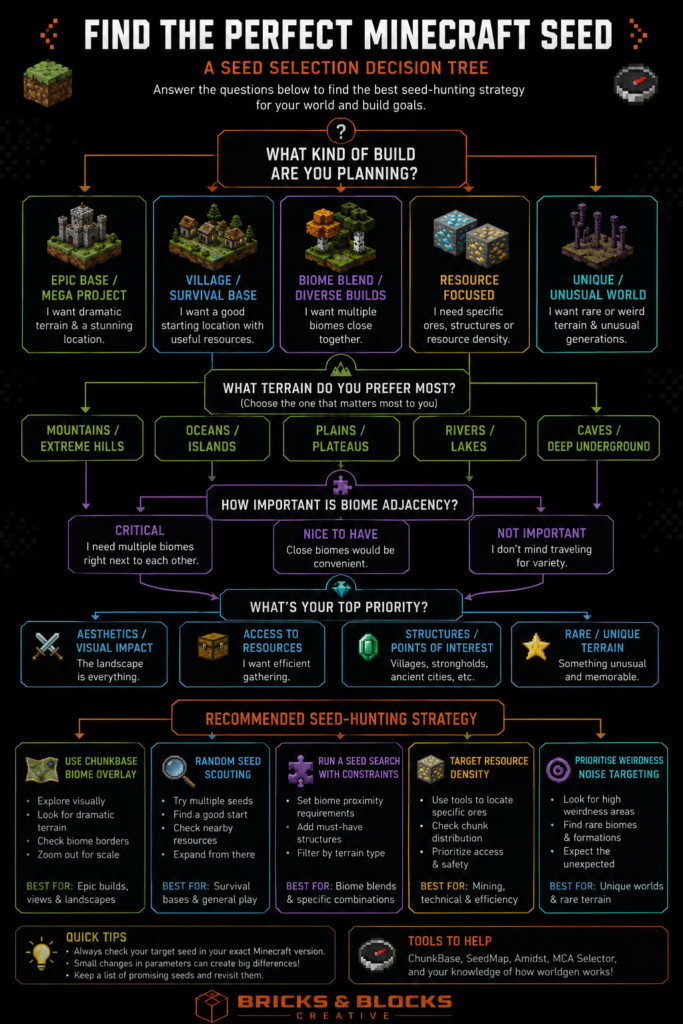
Start by defining what you actually need. If you are planning a mountain city build, you want a seed with a dramatic mountain range relatively close to spawn, ideally adjacent to a flat biome for infrastructure and resource gathering. If you are building an ocean city, you want an ocean monument as an aesthetic anchor and enough open water for the scale you have in mind. Being specific about terrain shape, biome adjacency, and nearby structures will make your seed search far more efficient.
Use ChunkBase or a similar tool to scan seeds visually. Filter for version-appropriate results and spend time at different zoom levels: the large-scale view tells you about biome distribution, while the detailed view reveals specific terrain features. Once you have a shortlist, validate in-game to confirm the terrain reads as well in three dimensions as it does on the flat map.
Record your seed and version permanently. If you are committing to a long-term build project, treat the seed as project documentation. Future you, or any collaborators, will need it.
Conclusion
World generation in Minecraft is a sophisticated engineering achievement built on a surprisingly small foundation: a single 64-bit number feeding a chain of deterministic algorithms. The LCG produces the pseudorandom values that noise functions transform into smooth terrain, which climate parameters then divide into biomes, which rules then populate with features and structures. Every element connects to every other element through this chain, and all of it traces back to the seed.
For builders, this understanding is not abstract knowledge. It changes how you approach world selection, how you use external tools, and how you think about the relationship between terrain and design. The world is not random. It is a mathematical output, and like any mathematical output, it can be analysed, predicted, and chosen deliberately.
The best build sites are rarely found by accident. They are found by players who understand what they are looking for and know how to look for it.
Continue Your Journey
Best Minecraft Biomes for Different Building Styles — a practical architectural analysis of which biomes suit which design ambitions, useful reading before committing to a seed.
Terraforming Guide: Reshaping Biomes for Better Building — once you have chosen your seed, this guide covers how to reshape the terrain to suit your vision.
Mountain Biome Construction: Cliff Cities and Alpine Fortresses — building on the dramatic terrain that seed analysis helps you locate.
Biome Exploration Checklist: What to Bring and What to Look For — essential preparation for validating a seed candidate in-game.
Essential Tools for Advanced Minecraft Building — a complete guide to the software toolkit that complements world seed analysis.
What seed are you currently building on, and did you choose it deliberately or stumble across it? Share your world in the comments.
Want more deep-dive content on Minecraft’s technical systems? Subscribe to the Bricks and Blocks Creative newsletter for monthly roundups and advanced building guides.